CHICAGO, Oct. 14 - With the United States likely to fall into recession during the next couple of years, now is a good time to evaluate purchasing polices from emerging markets as the household pinch on buying products extends up the supply chain to the source of product—in this case, China (although this perspective can also be applied to other currencies such as those in Mexico, Brazil, India, Russia).
Purchasing power parity is the art of recognizing the true value of the local currency, and applying that to buying techniques. Let’s take for example, the U.S. dollar and the RMB. According to conventional wisdom and current exchange rates, the U.S. dollar is valued at US$1 = RMB6.8. In fact, the two currencies are rather more similar than is commonly acknowledged.
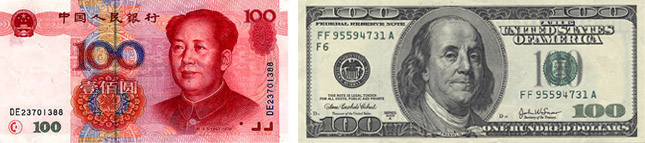
Both currencies have the unit of 100 as their largest denomination. Both feature pictures of deceased leaders. Both are the most sought after valued note in their respective nations. Yet, according to the current exchange rates, the RMB100 is only worth about US$15 (give or take a few cents). Yet purchasing power parity holds that in China, the RMB100 note will buy the same quantity of goods or services as the US$100 will in America; in which case, the two notes are essentially identical in their respective domains concerning their ability to purchase.
Let’s look at a couple of scenarios. A few weeks ago, I was lecturing to a group of prominent Chinese businessmen, all highly successful, and all Peking University alumni (the Ivy League of China). They were all multi-U.S. dollar millionaires in their own right, with very successful businesses in China and overseas. I asked one of them, a Mr. Wang, how much he had paid for his last haircut in China. He looked a bit shamefaced, and blurted out “RMB30” (about US$4.5). His colleagues all laughed. Yet the point is that he looked mildly ashamed, not because his haircut was cheap, but because he had paid too much. He knew his colleagues knew it, and had laughed at him for being so wasteful. When asking others in the same group how much their haircuts had cost, the average cost turned out to be RMB5—less than one dollar. The unfortunate Mr. Wang had been paying way over the odds for a simple service in his own country.
In another scenario, I recall visiting with a client with a factory in a small city about 200 kilometers west of Shanghai. To attract foreign investment, the local government had built the best hotel in town; a Chinese-run 4-star facility. We stayed there one night, and as we checked out, my client remarked on the size of the bill, which had run to RMB200 (about US$30) for the night. “I can see why China can manufacture cheaply,” he said. “With overheads like these there is no way the U.S. can compete. The hotel is actually very nice and for sure I cannot get a hotel for US$30 a night back in the States”.
I noticed that some of his Chinese managers, also visiting with him, had not stayed at the same hotel. Speaking to them later in the day, they confessed they’d preferred to stay in a similar hotel, but a bit further down the road. “The hotel we stay in costs RMB90 (US$13) a night,” they said. “We don’t want our bosses to feel we are being wasteful with the company money.”
Herein lies the crux of the matter, when purchasing in China, perceptions of currency need to change from being US$ dominated to being RMB dominated. RMB100 can buy, in China, roughly the same value of goods and services as US$100 can in the States. Wise purchasing managers will recognize this and look to instruct staff to fully understand the real value of China’s currency. Because if looking to compete with Chinese manufacturers while remaining US$ purchasing focused will never be enough, in terms of currency perception, to be able to compete on the same playing field.
Chris Devonshire-Ellis is the senior partner of Dezan Shira & Associates and the publisher of China Briefing. This article is excerpted from his speech to the Loyola University Chicago School of Law, at their U.S.-China Business Forum this coming Wednesday, October 15. Readers wishing to attend the full day event may download details here.


for Dezan Shira & Associates, the foreign direct investment legal and tax practice responsible for China Briefing 

Very interesting commentary on the subject, thank you. I also just signed up for your magazine. You have very good work here.
Great post. I guess this has a lot to do with the China & Emerging Market wages being far less than US, and also land costs, taxes and so on. But a good point well made. If China had US salary levels at USD50,000 per annum, land prices at USD125 a square foot and a profits tax rate of 35% then it wouldn’t have that purchasing power parity where RMB100 buys the same locally as USD100 either.
Ha ha Yes, with Chinese labor wages at US5,000 per annum, land at USD25 a meter, and profits tax of 25% it does make the local value of the RMB increase significantly. Excellent thread I’d never thought of the RMB/US$ in these terms before, thanks. I’m wondering if my Rochester Head Office will get it though. I can imagine trying to explain it to them (our global purchasing is US centralized) maybe we get Chris Devonshire-Ellis to try? Is he available?
A basket of goods and services that cost 100 USD in the US would cost about 1/3 rd in China, not one tenth. This is from about two years back. This follows from the concept that the RMB real value/exchange rate with the USD should be around 3.5 .
Of course there are exceptions but the PPP rate is being composed of a mixed bag of goods and services and in my experience this rate is pretty accurate in China. Now petrol has gone up a bit the rate might be even a bit less favorable.
It won’t be 1/3rd or maybe not even 1/10. I will vary greatly upon the specific type of product or service and upon prices of commodities, especially if they are State controlled, as they often are in China. But the point that you need to focus on the local currency and not the US$ when purchasing is well put and I think the actual intention of the article. Prices fluctuate, even in China, Lauentius Metaal.
Hold on. I’ve just back from Beijing this Monday. The price level there is quite high. 1:1 PPP cannot be simply drawn. Cost level in China varies a lot from more advanced east-coastal cities and metropolies like Beijing, Shanghai and Guangzhou to third-tier cities and rural countries. In Beijing, i don’t think you can easily find a salon with hair cut for man for only RMB5. Take a more commonly referred Big Mac Index (July 2008) by the Economist, RMB to USD with McCurrency PPP is 3.5, i.e., USD100 equivalent RMB350 in Big Mac price. Hence the current RMB rate is about 50% undervalued.
Being a chinese living in Germany and often travel back to China, I don’t quite agree with the extreme examples Chris Devonshire-Ellis made. Go to a place for a 5 RMB hair cut you most probalby don’t care if you get a clean seat; a hotel with 200 RMB room rate you sure don’t want to know the hygiene of the bedding. It’s true that it’s cheaper to live in China compared to the states, but it means also the lower standard of living at the same time. Check the express way between Suzhou and Shanghai, it’s only a few years old and the road condition is already so bad that it has too be rebuild. People often ignore the quality and details in China. The same also applies to recruiting, get qualified people and want to keep them in the company, you pay much more than the avarage and don’t forget: their payment raise expectation is 10-15% per year, otherwise they change companies.
The PPP comparison tries to take goods and services that are similar in both countries, regional differences apply and of course prices are not a constant. It is, as Chris pointed out a way to figure out what local money buys. For institutions like the World bank it is useful as to find out the poverty rate in a country. You need one unified currency to compare countries and PPP is the best we have at the moment.
The Big Mac index was invented because McDonalds gets most materials locally for their restaurants and carefully adjusts its pricing as to make sure the largest possible group of clientele can afford their goods. It really works very well as a means of comparison.
I stay at the art deco Park Hotel in Shanghai for less than USD100 and in New York you’re talking about USD600 for a room at the similar art deco Algonquin: 1-6. It depends upon the product, service, where you are in China and also whether or not the product is imported (subject to duty) or not. A lot of variables. As a generalization you can more for your money in RMB in China if you try a bit harder. There is a lot of wasteful purchasing by foreign buyers who think they can get a good deal but are still actually paying over the odds.
I agree with Mr. Schimmer and Mr. Li above. You can find a 5 RMB haircut still out on the street in some neigborhoods in Beijing, but 20-30 RMB is what you’ll pay for a basic haircut at an average salon. My guess is that the laughing had more to do with the fact that he got a cheap haircut rather than spending more at a nicer salon as many of the nouveau rich will do here. You still get what you pay for, and in general it costs just as much if not more in China than the West if you want comparable quality or productivity, from commodities and services through to the labor makret as Mr. Schimmer points out.
The cost of the taxi I took to Beijing Capital airport from the West side, including the toll road: RMB78 (US$12), no tip expected, journey time 1 hour. At Newark to Manhattan, a comparable distance, slightly less than 1 hour, but also including toll, US$61 plus an expected tip of at least US$10, total US$71 (RMB482). A purchasing power parity of China being six times better value. And the Chinese car was newer and cleaner.