Other Briefings
A Linguistic Look at China’s Currency
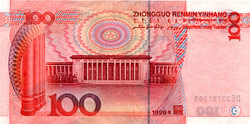 Jul. 9 – China’s ethnic minorities account for only 8.5 percent of the population, but still number over 113 million. And while many are scattered to the outer boundaries of the nation, living in the high plateaus of Tibet or in the mountains of South China, their existence as a part of the political fabric of the People’s Republic of China can be see on one of the core documents of the nation, its currency.
China’s currency is the renminbi or “people’s money,” and while the current generation of banknotes has done away with images of various ethnic minorities in favor of Chairman Mao, the notes continue to retain some ethnic flavor, in the form of written language.
The words “People’s Bank of China” appears in several languages including in simplified Chinese on the face of the note, along with the denomination in Arabic numerals and Chinese financial characters (not the normal simplified Chinese for the numbers 1-10). There is also a representation of the denomination in Chinese braille on the bottom right face of the note. On the reverse, “People’s Bank of China” appears in pinyin (Zhonguo Renmin Yinhang) and, since they were first introduced in 1955, four of China’s minority languages, Mongol, Tibetan, Uighur and Zhuang.
A quick overview of these languages:
Traditional Mongolian script was adapted from Uighur at the beginning of the 13th century and continues to be the co-official language in the autonomous region of Inner Mongolia. While the script remains in use today in Inner Mongolia, the nation of Mongolia adopted the Cyrillic script of the Russian alphabet (plus two characters) in the 1940s.
Tibetan is derived from the ancient Indian Brahmi script. Although spoken Tibetan can vary throughout the region, the written language is consistent throughout.
Uighur is a Turkic language spoken primarily in Xinjiang though it is also spoken in by small groups of ethnic Uighurs in Kazakhstan, Kyrgyzstan, Uzbekistan Afghanistan and Western Mongolia. In China, an Arabic-derived alphabet is used to write Uighur, though there are other alphabets in use outside of Xinjiang.
The Zhuang language is from the Tai group of languages and is used by the Zhuang people who mostly inhabit Guangxi Zhuang Autonomous Region in South China. Zhuang use to be written with logographs, very similar to the Vietnamese language. The language was Romanized in 1957 by the Chinese government who standardized the language (with some special letter remaining). The language was fully converted to a Latin alphabet in 1982.
Related Reading
A Brief History of the Bank of China
- Previous Article SAFE Regulates Domestic Banks Engaged in FDI
- Next Article China Now A Multilateral Play