Other Briefings
China’s New Infant Food Safety Campaign Signals a Shift Toward Continuous Compliance
China’s latest infant food safety campaign signals a broader shift toward continuous compliance and data-driven enforcement. Manufacturers, foreign brands, and companies using contract manufacturing arrangements should prepare for stricter oversight of product standards, labeling, supply chain management, and food safety governance.
China has signaled a new phase of food safety enforcement for infant complementary foods, with regulators shifting from traditional product inspections toward continuous, data-driven oversight of manufacturers, brand owners, and distributors.

The nationwide “Growth Protection” campaign launched by the State Administration for Market Regulation (SAMR) on May 29, 2026 introduces stricter scrutiny across licensing, manufacturing, labeling, marketing, contract production, and supply chain management. While many of the underlying requirements are not entirely new, the campaign significantly increases expectations for ongoing compliance, traceability, and accountability.
For foreign-invested manufacturers, international infant nutrition brands, and companies relying on contract manufacturing in China, obtaining approvals and meeting product standards is no longer sufficient. Regulators increasingly expect businesses to demonstrate that food safety controls are functioning continuously, risks are actively managed, and responsibilities can be traced to specific individuals throughout the supply chain.
This article examines the key elements of the campaign and what they mean for companies operating in China’s infant complementary food market.
Policy background: China’s food safety oversight is becoming more proactive
The “Growth Protection” campaign reflects a broader regulatory trend in China. Historically, food safety enforcement often focuses on licensing reviews, product testing, and corrective action after violations were identified. Increasingly, however, regulators are seeking to monitor risks throughout the production and distribution process.
The campaign introduces measures designed to ensure that food safety management is embedded into day-to-day business operations. These include stricter production licensing reviews, enhanced internal accountability requirements, more frequent inspections, expanded product testing, and greater use of digital supervision tools.
As a result, compliance is evolving from a point-in-time exercise into an ongoing operational requirement. Businesses must not only comply with regulatory standards but also demonstrate that compliance systems are functioning continuously and effectively.
Key regulatory action under the campaign
Higher barriers to market entry and license maintenance
One of the campaign’s key priorities is strengthening production licensing requirements.
SAMR will revise the production licensing review rules for complementary infant foods and conduct comprehensive on-site inspections of existing manufacturers. Regulators will assess whether production facilities continue to meet licensing requirements regarding plant layout, manufacturing processes, equipment, and management systems.
Importantly, the campaign makes clear that licensing will no longer be viewed as a one-time approval. Companies with repeated inspection issues or failed product testing results may face increased scrutiny during license renewal procedures.
For foreign-invested manufacturers operating facilities in China, this means production licenses will become subject to more dynamic and continuous review. Companies may need to reassess whether their facilities, documentation, and operational procedures remain aligned with evolving regulatory expectations.
New emphasis on accountability and food safety governance
Perhaps the most significant aspect of the campaign is its focus on corporate food safety governance.
Regulators will require companies to strengthen internal food safety management structures and ensure that designated food safety directors and food safety officers are properly appointed and trained.
The action plan reinforces China’s existing “daily control, weekly inspection, and monthly scheduling” framework, which requires companies to conduct routine risk management activities and maintain detailed records.
Businesses are expected to:
- maintain dynamic risk control lists;
- conduct regular self-inspections;
- document corrective actions;
- establish closed-loop risk management procedures; and
- ensure accountability can be traced to specific personnel.
For multinational companies, this represents a shift from compliance based primarily on policies and procedures toward compliance based on demonstrable execution and recordkeeping.
In practice, regulators are increasingly likely to ask not only whether a company has a food safety policy, but whether it can prove that the policy is being implemented consistently.
Stricter requirements under updated national standards
The campaign also places significant emphasis on implementing China’s updated national standards for infant cereals and canned complementary foods, namely GB 10769-2025 (for cereal-based complementary foods for infants and young children) and GB 10770-2025 (for canned complementary foods for infants and young children).
Under the new standards, manufacturers must comply with revised requirements relating to ingredients and product composition.
The action plan specifically prohibits the use of certain materials, including:
- honey;
- irradiated ingredients; and
- hydrogenated oils and fats.
Companies are also encouraged to establish internal quality standards that exceed national minimum requirements.
Foreign brands should pay particular attention to these provisions. Products developed for overseas markets may not automatically satisfy China’s updated requirements, particularly where formulations, ingredient sourcing, or manufacturing practices differ from local standards.
As a result, some companies may need to develop China-specific product formulations or conduct comprehensive compliance reviews of existing products.
Labeling and marketing face increased scrutiny
Another major focus area is labeling and promotional claims.
The action plan reiterates longstanding restrictions on health-related claims for infant complementary foods and prohibits labels or marketing materials that explicitly or implicitly suggest products can:
- improve intelligence or cognitive development;
- enhance immunity or resistance;
- protect intestinal health; or
- prevent or treat diseases.
Regulators also plan to investigate products marketed as suitable for infants and young children without a clear legal or regulatory basis.
The implications extend beyond product packaging. E-commerce listings, livestream promotions, social media content, and other marketing materials may also come under greater scrutiny.
This could present particular challenges for international brands whose global marketing strategies frequently emphasize concepts such as immune support, gut health, or brain development. Claims that may be acceptable in other jurisdictions could create compliance risks in China.
Companies should therefore review not only product labels but also digital marketing content and third-party promotional activities.
Greater oversight of contract manufacturing arrangements
The campaign also strengthens supervision of contract manufacturing arrangements, a business model widely used by both domestic and foreign brands.
Under the plan, both the commissioning party and the contract manufacturer will be held accountable for product safety. Regulators emphasize that businesses cannot use outsourced production arrangements to transfer or evade food safety responsibilities.
Authorities specifically identify manufacturers with frequent contract production activities as higher-risk entities that may face increased inspections.
For foreign brands that rely heavily on Chinese original equipment manufacturers (OEMs), this means stronger supplier oversight may be required. Companies should consider reviewing quality agreements, auditing procedures, supplier qualification processes, and ongoing monitoring mechanisms.
More inspections, more testing, and smarter enforcement
The campaign outlines a significant expansion of regulatory oversight activities.
Authorities will increase inspection frequency for higher-risk enterprises, particularly those that:
- recently obtained production licenses;
- have a history of regulatory issues;
- rely heavily on contract manufacturing; or
- produce multiple product categories.
Regulators also plan to explore quarterly testing coverage for all licensed infant complementary food manufacturers.
In addition, China will continue expanding the use of digital supervision tools. The action plan encourages manufacturers to connect with “Internet Plus AI” regulatory systems and supports broader use of artificial intelligence in food safety oversight.
These developments suggest that regulators will increasingly rely on digital records, traceability systems, and data-driven monitoring tools to identify risks and target enforcement activities.
What foreign businesses should do now
The “Growth Protection” campaign demonstrates that China’s infant food regulatory framework is entering a new phase characterized by continuous monitoring, enhanced accountability, and more sophisticated enforcement.
For foreign-invested manufacturers, international brands, and cross-border operators, priority actions should include:
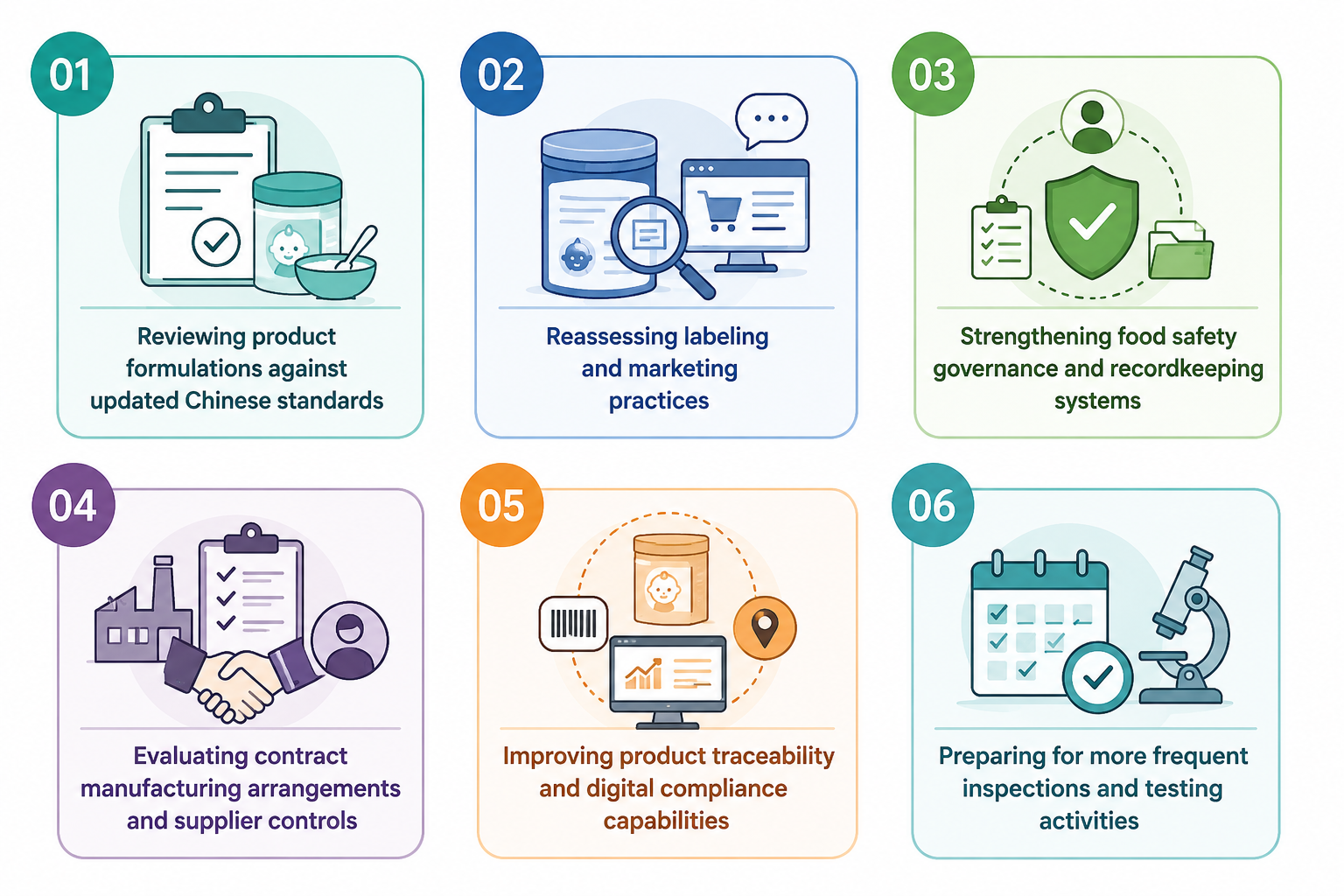
Ultimately, the campaign signals that compliance in China’s infant nutrition sector is no longer limited to obtaining regulatory approvals. Instead, regulators increasingly expect businesses to demonstrate ongoing operational control, comprehensive risk management, and full accountability throughout the supply chain.
How Dezan Shira & Associates can help
China’s latest infant food safety campaign underscores the growing importance of continuous compliance, supply chain oversight, and regulatory readiness. For foreign manufacturers, brand owners, distributors, and investors, navigating evolving food safety requirements requires robust operational controls and proactive risk management.
Dezan Shira & Associates, an Ascentium Company, can support companies throughout the product lifecycle, helping them align business operations with China’s increasingly sophisticated regulatory framework.
Our services include:
- Product formulation and regulatory compliance reviews against Chinese food safety standards;
- Food safety licensing and regulatory approvals for manufacturing and distribution activities;
- Labeling, advertising, and marketing compliance assessments;
- Contract manufacturing (OEM) due diligence and supplier compliance reviews;
- Food safety management system implementation;
- Regulatory health checks and inspection-readiness assessments;
- Supply chain compliance and risk management advisory; and
- Market entry, corporate establishment, tax, and operational support for food and beverage businesses expanding into China and across Asia.
Whether you are launching a new infant nutrition product, reviewing existing compliance programs, or expanding production operations in China, our team can help identify regulatory risks and develop practical compliance strategies tailored to your business objectives.
Also Read:
- China Issues New Production Licensing Rules for Infant Formula Liquid Milk
- New Standards for FSMP Infant Formula in China: Key Compliance Deadlines and Registration Guidance
- GAC New Overseas Food Manufacturer Registration Rules Effective June 1: A Guide for Exporters



For multi-disciplinary projects, we deploy blended taskforce models combining technical expertise to address diverse challenges across jurisdictions. This approach enables clients to resolve cross-functional issues efficiently, make informed decisions, and manage growth with confidence in China’s fast-evolving regulatory and commercial environments.
About Us
China Briefing is one of five regional Asia Briefing publications. It is supported by Dezan Shira & Associates, a pan-Asia, multi-disciplinary professional services firm that assists foreign investors throughout Asia, including through offices in Beijing, Tianjin, Dalian, Qingdao, Shanghai, Hangzhou, Ningbo, Suzhou, Guangzhou, Haikou, Zhongshan, Shenzhen, and Hong Kong in China. Dezan Shira & Associates also maintains offices or has alliance partners assisting foreign investors in Vietnam, Indonesia, Singapore, India, Malaysia, Mongolia, Dubai (UAE), Japan, South Korea, Nepal, The Philippines, Sri Lanka, Thailand, Italy, Germany, Bangladesh, Australia, United States, and United Kingdom and Ireland.
For a complimentary subscription to China Briefing’s content products, please click here. For support with establishing a business in China or for assistance in analyzing and entering markets, please contact the firm at china@dezshira.com or visit our website at www.dezshira.com.
- Previous Article Hong Kong Tax Filing: Is Your Business Ready for E-Filing, iXBRL, and IRD Compliance?
- Next Article