Other Briefings
European Business in China: Key Takeaways from the EU Chamber’s 2026 Survey
The EU Chamber China 2026 Business Confidence Survey reveals a modest but significant inflection point in European business sentiment, as the proportion of companies reporting a worsening environment fell for the first time in five years, even as challenges around market access, regulatory barriers, and economic slowdown persist.
The EU Chamber of Commerce in China’s 2026 Business Confidence Survey has recorded a modest increase in optimism among European companies in what could be a positive turning point of business sentiment in China.
This “inflection point” comes as China’s economy has shown remarkable resilience in the face of an increasingly volatile global economy and trade environment, offering businesses much-needed stability despite the country’s overall economic slowdown.
The intensity of the deterioration of confidence in China’s business environment has eased for several key metrics year-on-year for the first time since the country ended its zero-COVID policy.” – EU Chamber of Commerce in China Business Confidence Survey 2026
While optimism has increased, European companies continue to face a range of challenges that subdue overall investment outlooks, including a slowing economy, market access and regulatory barriers, and ambiguous and inconsistent application of laws and regulations.
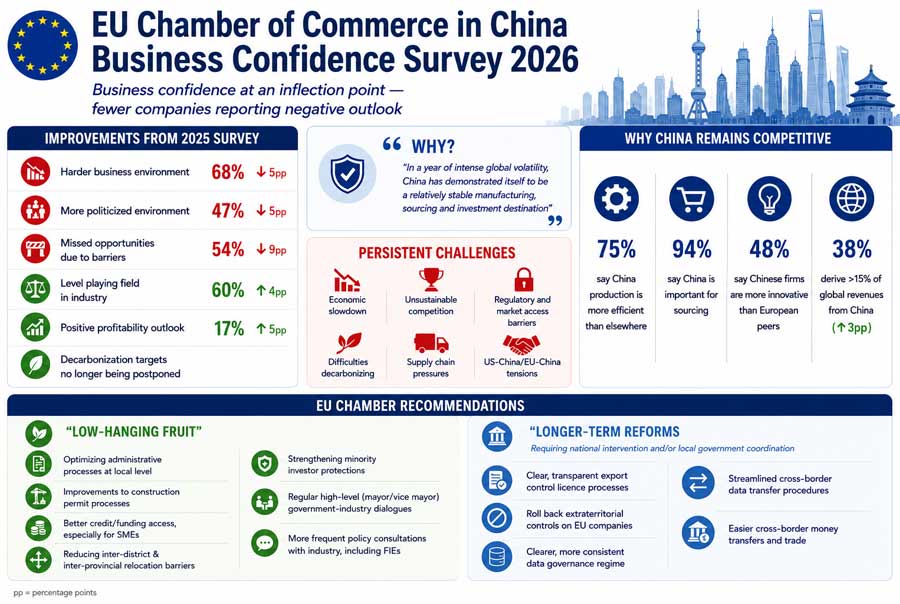
Number of businesses reporting harder business environment drops
A majority of companies (68 percent) surveyed continue to report that doing business in China has become more difficult in 2025 compared to the previous year. This marks the fifth consecutive year in which over half of the companies responded in this manner.
However, the overall percentage of respondents who reported a worsening business environment shrank for the first time since 2021. Meanwhile, the percentage that said it had improved increased by two percentage points, suggesting sentiment is beginning to improve for the first time since the start of the COVID-19 pandemic.
Despite this marginal improvement, a majority of businesses reported a worsening business environment in their sector in 2025, except for those in the environment and retail sectors. These include:
- 76 percent in the automotive industry, due to unsustainable price wars
- 64 percent in civil engineering and construction, due to government debt and the real estate crisis
- 76 percent in the medical device industry, due to pricing pressures, limited progress on reimbursement programs, and regulatory uncertainty
- 74 percent in the IT and telecom industry, due to stringent localization requirements
- Two-thirds in the maritime industry, due to geopolitical and trade instability
Main challenges to business outlook in China
China’s economic slowdown continues to be the most-cited challenge expected to negatively impact future business. However, the overall percentage of companies that selected this as a challenge dropped by 14 percentage points to 57 percent from the previous survey.
This proportion was higher for companies in consumer-facing industries: 68 percent of respondents in retail and 72 percent of respondents in F&B selected this as one of their top challenges for the future outlook. The lowest proportion was found in the aviation and aerospace industry (25 percent) and the IT and telecom industry (42 percent).
Meanwhile, the second-most cited challenge was competition from private domestic competitors, which 47 percent of respondents chose. This proportion was highest among companies in the machinery and medical device sectors (both 76 percent), reflecting the high saturation of the domestic industries in China.
45 percent of companies cited geopolitical risks and conflicts as a key challenge, a drop of two percentage points from the previous survey. The industry most concerned with this challenge was aviation and aerospace (63 percent), followed by automotive (63 percent), while the environment and the civil engineering and construction industries were lowest at 18 percent.
Outlooks on market access and regulatory barriers
The survey found overall improvements to sentiment toward market access and regulatory barriers in China. In the 2026 survey, the proportion of companies that reported missed business opportunities due to market access restrictions and regulatory barriers dropped by nine percentage points year-on-year to 54 percent. This proportion remains higher than before the pandemic, with only 42 percent of companies reporting these barriers in 2019.
While market access barriers affect all industries, the impact varies greatly. The EU Chamber notes that industries of strategic value that are subject to requirements for localization and “buy China” initiatives are particularly affected. 89 percent of companies in the medical device industry and 84 percent in the pharmaceuticals industry reported missed business opportunities due to market access and regulatory barriers.

Those least impacted are consumer-facing sectors, such as retail and F&B, and certain heavy industrial sectors, such as machinery and chemicals manufacturing.
In a similar vein, companies deemed “strategic” by the Chinese government, such as IT and telecommunications, and aviation and aerospace, were more likely to report unfavorable treatment compared to domestic companies, while those not in the strategic category were more likely to say they were treated equally.
The environmental sector was the most likely to say that FIEs received favorable treatment, which “partly reflects European companies’ expertise in technology and management practices related to the green transition”, according to the Chamber.
Despite the continued challenges, more respondents said that market access barriers had eased in 2025, with 48 percent reporting market opening compared to 44 percent in 2024.
Overall, 65 percent of companies reported they did not face any market access or regulatory barriers in 2025, unchanged from the previous year.
China remains crucial market for many companies despite fragile business confidence
The EU Chamber notes a subdued sentiment toward the attractiveness of China as an investment destination among European companies:
- 53 percent ranked China as a top-three destination for current investments and 53 percent ranked it as a top-three destination for future investments, the lowest and joint lowest figures recorded on record for these metrics, respectively.
- 14 percent have no current investments planned for China, the highest figure on record.
These views differ greatly across industries, with fewer companies in industries that have difficult operating environments for European companies, such as IT & telecom, ranking China as a top-three destination compared to those with fewer obstacles, such as retail.
Despite this, China continues to be a crucial destination for sourcing and production for many companies, as well as for revenue streams:
- 70 percent said pre-EBIT earnings were positive in 2025, up two percentage points year-on-year
- 37 percent generate over 15 percent of global revenue from the Chinese mainland
- 75 percent characterize China’s production as more efficient than the rest of the world’s
- 94 percent say China is an important sourcing destination, citing good speed of delivery, cost, reliability, quality, and global compatibility
This contrast presents a paradox for European companies, as operational and commercial dependencies on China persist despite a growing wariness about committing fresh capital to the market.
What China can do to improve business confidence for EU companies
The EU Chamber notes positive developments for improving the business environment for foreign companies in China in the 15th Five-Year Plan (FYP), the Chinese government’s development blueprint for the years 2026 to 2030. These include an emphasis on stable and high-quality growth over a growth-at-all-costs mode, as well as ensuring national treatment for FIEs, addressing over-capacity and unfair competition, boosting domestic consumption, and balancing imports and exports.
At the same time, it highlights concerns such as an emphasis on self-sufficiency, which may result in industrial policy planning requiring localization and prioritizing domestic companies in strategic sectors. It notes that these types of policies have historically harmed European companies’ competitiveness in China, due to a lack of access to government procurement and an uneven playing field in certain sectors.
The Chamber recommended a combination of “low-hanging fruit” and longer-term structural reforms to address European companies’ pain points and further improve business sentiment. The “low-hanging fruit” involves small improvements to administrative processes that can be implemented at the local level, including improving processes for obtaining construction permits, increasing access to credit and funding, eliminating inter-district and inter-provincial roadblocks for relocation, and greater protection for minority investors. It also suggests improving mechanisms for communication with foreign companies, such as committing to regular, high-level government-industry dialogues for communication with chambers of commerce and company representatives, and increasing the frequency of industry policy consultations.
While some larger structural challenges are harder for the government to address in the short term, the Chamber nonetheless identifies areas where progress can be made without requiring major system overhauls. These include improving the export control licence application process, streamlining cross-border data transfer procedures and other measures to ease international data flows, and facilitating cross-border money transfers and cross-border trade processes.



With the region’s rapid economic growth and diverse regulatory environments, businesses must navigate shifting costs, complex compliance frameworks, and conflicting information. Our professionals support investors with actionable data on Asia’s industrial landscape, location analysis, supply chain diversification, and market entry strategy. We also offer business partner matching services and assist in identifying optimal investment destinations through cross-country competitiveness benchmarking.
About Us
China Briefing is one of five regional Asia Briefing publications. It is supported by Dezan Shira & Associates, a pan-Asia, multi-disciplinary professional services firm that assists foreign investors throughout Asia, including through offices in Beijing, Tianjin, Dalian, Qingdao, Shanghai, Hangzhou, Ningbo, Suzhou, Guangzhou, Haikou, Zhongshan, Shenzhen, and Hong Kong in China. Dezan Shira & Associates also maintains offices or has alliance partners assisting foreign investors in Vietnam, Indonesia, Singapore, India, Malaysia, Mongolia, Dubai (UAE), Japan, South Korea, Nepal, The Philippines, Sri Lanka, Thailand, Italy, Germany, Bangladesh, Australia, United States, and United Kingdom and Ireland.
For a complimentary subscription to China Briefing’s content products, please click here. For support with establishing a business in China or for assistance in analyzing and entering markets, please contact the firm at china@dezshira.com or visit our website at www.dezshira.com.
- Previous Article IR56B Compliance in Hong Kong: How Employers Can Avoid IRD Follow-Ups
- Next Article