Other Briefings
Shanghai’s Offshore Finance Plan: What It Covers and Why It Matters
China’s financial regulators have jointly released the Action Plan for Advancing Offshore Finance Development in Shanghai, marking a significant step in the country’s effort to deepen financial opening while maintaining systemic control. Issued by the PBOC, NDRC, NFRA, CSRC, SAFE, and the Shanghai Municipal Government, the plan positions Shanghai, particularly Pudong, as a testing ground for a modern offshore financial system aligned with global standards.
A phased roadmap for offshore financial development
The action plan sets out a clear long-term roadmap.
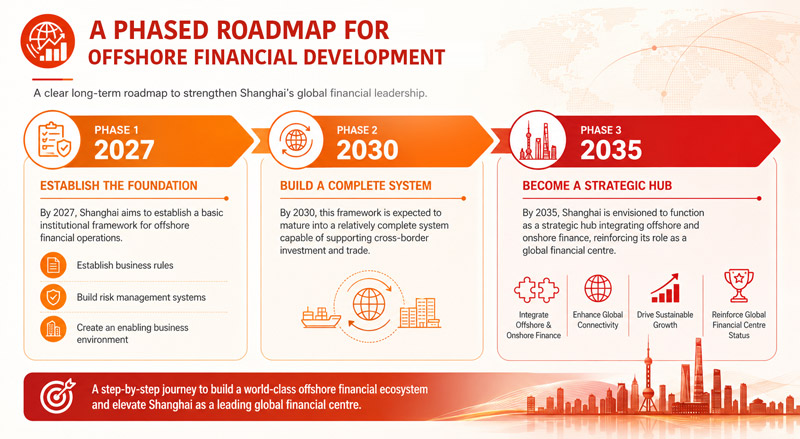
At its core, the plan reflects a dual objective: supporting Chinese enterprises in their global expansion while advancing RMB internationalization. At the same time, it underscores the importance of balancing openness with financial security, an ongoing theme in China’s regulatory approach.
Institutional design: controlled liberalization
A key feature of the plan is its “controlled opening” framework. Offshore financial activities will be piloted primarily in Pudong, with mechanisms such as entity-eligibility restrictions, account segregation, and functional clustering to ensure that risks remain contained.

Financial operations will rely heavily on existing infrastructure, such as Free Trade (FT) accounts and Offshore Accounts (OSA). The regulatory principle guiding capital flows is summarized as “first-line liberalization, second-line control, full traceability, and risk containment.” In practice, this means cross-border flows can be facilitated more freely, but movements between offshore and domestic systems remain tightly monitored.
This design reflects China’s broader preference for “quasi-offshore” models, allowing offshore-like flexibility within a ring-fenced domestic environment, rather than adopting a fully liberal offshore regime akin to Hong Kong or Singapore.
Priority business areas: Targeted expansion
The plan adopts a gradual and selective approach to business expansion.
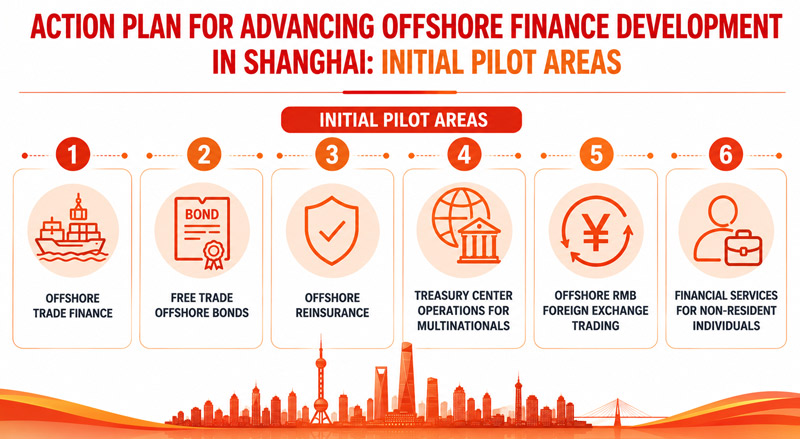
These are areas where both policy demand and operational foundations already exist, reducing implementation risk. Over time, the scope may expand to higher-value segments such as offshore asset management, cross-border investment products, and family office services.
Notably, the plan emphasizes support for multinational treasury centers, encouraging global firms to centralize their liquidity and capital management functions in Shanghai. This aligns with broader efforts to strengthen the city’s role in global capital allocation.
Digital and RMB dimensions
Another strategic pillar is the integration of digital finance infrastructure, particularly the cross-border use of the digital RMB. The establishment of a digital RMB international operations center in Shanghai could support new payment and settlement models, especially in offshore trade and finance.
At the same time, the plan seeks to expand the use of RMB in offshore transactions, enhance non-USD currency trading, and improve the availability of RMB-denominated assets. This reinforces China’s long-term goal of increasing the currency’s global role—albeit incrementally and within a managed framework.
Implications for businesses
For companies, especially those engaged in cross-border operations, the plan offers several potential benefits.
First, it improves financing and treasury efficiency. Firms operating globally may be able to centralize funding, manage liquidity, and conduct offshore borrowing or bond issuance more flexibly via Shanghai structures.
Second, it reduces transaction friction in trade and investment. Offshore trade finance and cross-border settlement reforms could lower costs and improve speed, particularly for firms involved in commodity trading or complex supply chains.
Third, it strengthens RMB-based operations, enabling companies to reduce exposure to foreign exchange volatility and diversify funding sources.
That said, participation will likely be selective and conditional. Eligibility criteria, compliance requirements, and reporting obligations remain significant, particularly given the emphasis on risk control, data reporting, and anti-arbitrage measures.
Implications for individuals
For individuals, the impact will be more gradual but still notable in the medium term.
The plan includes measures to facilitate financial services for non-resident individuals, such as easier account opening and access to cross-border financial products in designated zones. Over time, this could extend to offshore wealth management, global asset allocation, and more sophisticated financial services.
However, for ordinary Chinese mainland residents, the immediate effects are limited. Access to offshore financial products and capital account liberalization remains tightly controlled, and any expansion in this area is likely to proceed cautiously.
A step toward global integration with Chinese characteristics
Overall, the Shanghai offshore finance action plan represents a careful but meaningful evolution in China’s financial opening strategy. Rather than replicating traditional offshore centers, it seeks to create a hybrid model, which combines international functionality with domestic regulatory oversight.
For policymakers, the plan provides a controlled environment to test reforms. For businesses, it offers new opportunities but is tempered by regulatory complexity. And for Shanghai, it reinforces its ambition to move beyond a domestic financial hub toward a more globally integrated role.
The success of this initiative will ultimately depend on execution: whether Shanghai can deliver both efficiency and predictability while maintaining the regulatory safeguards that define China’s financial system.
How Dezan Shira & Associates can help
Dezan Shira & Associates, an Ascentium company, supports foreign companies and individuals navigating China’s evolving business landscape. The firm advises on market entry structuring, cross-border transactions, and treasury center setup. It also provides tax planning, compliance, and reporting support under China’s regulatory framework. For individuals, services cover visas and work permits, tax residency, and foreign exchange compliance. With strong local expertise, the firm helps clients translate policy developments into practical and compliant strategies. To arrange a consultation, please contact our local advisory team.



Whether launching, restructuring, or expanding, we ensure our clients benefit from coordinated input across legal, HR, tax, and financial teams. From startup to exit, our advisory scales with your business—designed to meet both immediate needs and long-term goals.
About Us
China Briefing is one of five regional Asia Briefing publications. It is supported by Dezan Shira & Associates, a pan-Asia, multi-disciplinary professional services firm that assists foreign investors throughout Asia, including through offices in Beijing, Tianjin, Dalian, Qingdao, Shanghai, Hangzhou, Ningbo, Suzhou, Guangzhou, Haikou, Zhongshan, Shenzhen, and Hong Kong in China. Dezan Shira & Associates also maintains offices or has alliance partners assisting foreign investors in Vietnam, Indonesia, Singapore, India, Malaysia, Mongolia, Dubai (UAE), Japan, South Korea, Nepal, The Philippines, Sri Lanka, Thailand, Italy, Germany, Bangladesh, Australia, United States, and United Kingdom and Ireland.
For a complimentary subscription to China Briefing’s content products, please click here. For support with establishing a business in China or for assistance in analyzing and entering markets, please contact the firm at china@dezshira.com or visit our website at www.dezshira.com.
- Previous Article How to Legally Hire Over-Age Workers in China: A Practical Guide (Part I)
- Next Article SAMR’s Extraterritorial M&A Review: Five Enforcement Trends Foreign Deal Teams Must Prepare For