Other Briefings
China Draft Trademark Law Amendment 2026: Key Proposed Changes for Foreign Brands
China’s proposed Trademark Law amendment for 2026 could significantly reshape how foreign brands protect and manage their IP in China by introducing stricter, more evidence-based scrutiny across the trademark lifecycle, if adopted in substantially its current form. If passed in its current form, businesses may need to place greater emphasis on portfolio discipline.
For foreign brands operating in or entering China, 2026 is a pivotal year for trademark strategy. The draft fifth amendment to the PRC Trademark Law (hereinafter, the “draft Trademark Law amendment”) was discussed and approved in principle by the State Council in November 2025 and has since entered the legislative review process of the National People’s Congress.

In general, if enacted, these proposed changes could contribute to a more evidence-driven trademark environment, where portfolio discipline, use records, agent oversight, and active monitoring now determine how defensible a brand’s China position will be.
This guide summarizes key proposals contained in the current draft amendment, where the main commercial risks sit, and practical preparatory measures foreign brand owners may wish to consider to prepare for the amended law.
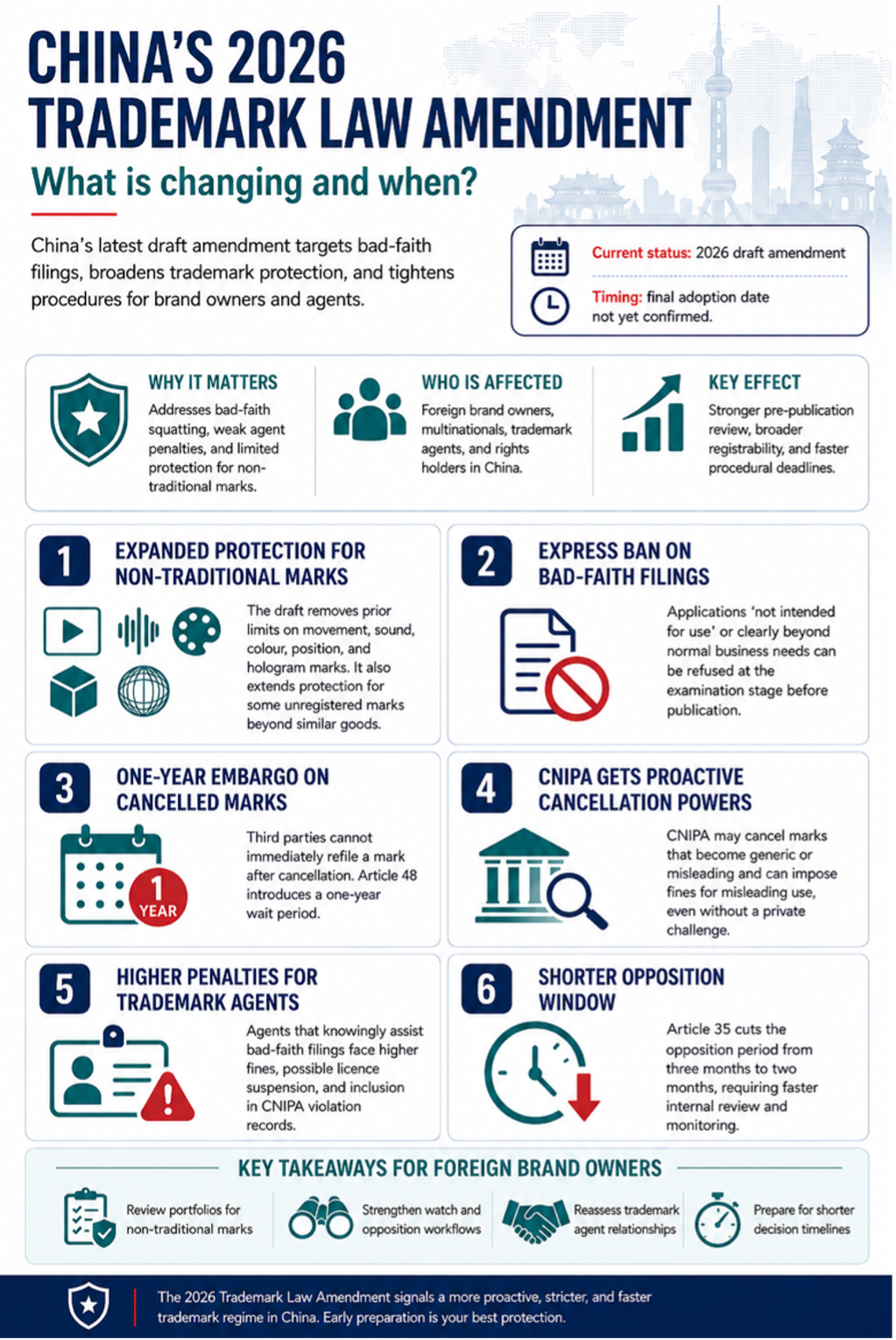
China’s Trademark Law amendment legislative timeline
- November 14, 2025: The State Council discussed and passed in principle the revised draft of the Trademark Law, and decided to submit it to the NPC Standing Committee for deliberation.
- December 26, 2025: The fifth amendment to the Trademark Law was published for public consultation.
- December 27, 2025 – February 9, 2026: Public consultation period.
- Final adoption: No timing confirmed yet. China’s 2026 Legislative Work Plan does not include the Trademark Law amendment, which some observers note could affect the timing of formal promulgation
Importantly, the draft amendment remains subject to further revision and formal promulgation procedures before taking legal effect.
What is changing?
The current draft proposes expanding protection for certain non-traditional marks, proposes introducing a one-year filing embargo in certain circumstances involving cancelled trademarks on cancelled trademarks, further strengthens proposed rules targeting bad-faith filings, and increases penalties for trademark agents who facilitate abusive applications. If adopted, the draft may create a more demanding compliance environment for foreign brand owners, but it also creates new opportunities.
| Key Proposed Changes in the China’s Trademark Law Amendment | ||
| Change | Provision | Practical impact for foreign brand owners |
| Expanded mark types | Draft Article 14 | Movement, sound, colour, position, and hologram marks are proposed to be expressly recognized as registrable categories, subject to applicable distinctiveness and registrability requirements. The draft may broaden protection mechanisms relating to certain distinctive marks and prior rights in some circumstances. |
| Anti-bad-faith filing regime | Draft Article 4 | Applications “not intended for use” or that “clearly exceed normal business needs” may face refusal during examination prior to publication. |
| Quarantine on cancelled marks | Draft Article 48 | One-year filing embargo would restrict certain re-filings involving cancelled marks for a proposed one-year period for the same or similar goods. |
| CNIPA proactive cancellation | Draft Article 56 | The draft would expand circumstances under which CNIPA may initiate cancellation procedures or administrative enforcement measures involving generic or misleading marks. |
| Agent liability | Draft (multiple articles) | The draft proposes increased penalties, including potentially higher fines, practice restrictions, and public compliance records for trademark agents involved in bad-faith filings. |
| Shorter opposition window | Draft Article 35 | The draft proposes reducing the opposition period from three months to two months from publication. |
Why the amendment matters to foreign brands
The 2026 amendment is not simply a tougher compliance regime for foreign companies. It reflects a broader shift in how China is trying to clean up trademark abuse, strengthen legitimate rights, and modernize brand protection. For foreign brand owners, the changes create both higher expectations and more effective enforcement tools, depending on how prepared the business is before entering or expanding in China.
First-to-file remains, but enforcement is shifting toward good-faith owners
China is expected to retain its first-to-file trademark framework under the current draft amendment. What is evolving, however, is the treatment of bad-faith filings. The amendment strengthens the ability of authorities to refuse applications that are not intended for genuine use or that clearly exceed normal business needs, with the apparent policy objective of addressing large-scale trademark squatting earlier in the examination process. It also makes it harder for opportunistic partners or agents to preempt legitimate brand owners through misuse of relationships.
For foreign brands, the implications are increasingly evidence-driven. Companies that file early, retain ownership centrally, and manage distribution through licensing rather than assignment may be in a stronger position to enforce their rights. Those with documented use history, market presence, and a clean portfolio may be better positioned to challenge suspected bad-faith filings. By contrast, brands that delay registration may still face difficulties proving prior use, reputation, or legitimate commercial interest, limiting their ability to benefit from these enhanced protections.
New protections may benefit global brands with distinctive assets
For the first time, movement, sound, color, position, and hologram marks are explicitly registrable, creating new opportunities for multinational companies with established global branding systems. Businesses in consumer products, luxury goods, automotive, entertainment, technology, and retail sectors may gain broader tools to protect distinctive brand elements that previously fell outside traditional word and logo registrations.
Registrability would still depend on compliance with applicable distinctiveness and examination standards under PRC trademark practice.
Brand management and monitoring become more operationally important
The reduction of the opposition period from three months to two months means companies will have less time to detect and respond to problematic filings. Businesses that rely on occasional portfolio reviews may miss critical deadlines entirely. Regular trademark monitoring, faster internal escalation procedures, and coordinated China filing strategies may increasingly become important operational components of China trademark risk management.
But the same amendment strengthens CNIPA’s ability to proactively cancel generic or misleading marks and introduces a one-year embargo preventing third parties from re-filing on cancelled marks.
Over time, policymakers appear to intend these mechanisms to reduce problematic applications over time reaching publication. The brands that benefit most will be those with monthly monitoring in place to act within the compressed window when it matters.
Genuine commercial use will carry greater weight
The draft amendment appears to place greater emphasis on evidence supporting genuine commercial use, which creates real exposure for brands holding registrations without current commercial activity. But it also gives legitimate owners a sharper instrument to cancel squatted marks that have never been used commercially. That is to say, brands with clean, actively used portfolios gain an offensive tool and brands with dormant registrations face a new vulnerability.
See also: Standard Use of Trademarks in China: Compliance Requirements and Legal Risks
Conclusion
The core message throughout is that if enacted in substantially its current form, the amendment may reduce some of the procedural flexibility previously available in trademark portfolio management that previously existed around predictable ones. Foreign brands with disciplined portfolios, current use records, and active monitoring may benefit from stronger enforcement and anti-abuse mechanisms. Those without that discipline could face increased scrutiny regarding use evidence and portfolio management practices.
Portfolio audits, agent due diligence, use-evidence hygiene, and active monitoring are the four pillars. Brands that build these into their China operations now will be in a strong position if the draft Trademark Law amendment gets passed in its current form.
How can Dezan Shira & Associate help? Given the complexity of China’s trademark examination standards and the evolving practice of the CNIPA and the courts, foreign brand owners are encouraged to seek guidance from experienced local professionals. A qualified local agent, such as Dezan Shira & Associates, can provide practical, China-specific advice on portfolio audits, evidence management, agent due diligence, and overall brand protection strategy. To arrange a consultation, please contact our experts at china@dezshira.com



With over three decades of experience, Dezan Shira and Associates is a leading intellectual property service provider in China and broader Asia, offering a deep understanding of IP registration, trademark protection, and market entry consulting. Our dedicated advisors help businesses manage IP risk services, safeguard innovations, and maximize the value of their intangible assets.
About Us
China Briefing is one of five regional Asia Briefing publications. It is supported by Dezan Shira & Associates, a pan-Asia, multi-disciplinary professional services firm that assists foreign investors throughout Asia, including through offices in Beijing, Tianjin, Dalian, Qingdao, Shanghai, Hangzhou, Ningbo, Suzhou, Guangzhou, Haikou, Zhongshan, Shenzhen, and Hong Kong in China. Dezan Shira & Associates also maintains offices or has alliance partners assisting foreign investors in Vietnam, Indonesia, Singapore, India, Malaysia, Mongolia, Dubai (UAE), Japan, South Korea, Nepal, The Philippines, Sri Lanka, Thailand, Italy, Germany, Bangladesh, Australia, United States, and United Kingdom and Ireland.
For a complimentary subscription to China Briefing’s content products, please click here. For support with establishing a business in China or for assistance in analyzing and entering markets, please contact the firm at china@dezshira.com or visit our website at www.dezshira.com.
- Previous Article Hong Kong’s IPOs Rebound as Chinese Tech Taps New Source of Capital
- Next Article EU-China Relations After the 2024 European Elections: A Timeline