Other Briefings
China’s Export in January-April 2026: Supply-Chain Implications for Foreign Companies
China’s January-April export growth is impressive but the real implication lies in the structural shifts beneath the surface. Trade patterns, product composition, and regional partnerships are being rapidly reshaped. As advanced manufacturing exports rise and ASEAN integration deepens, businesses must prioritize supply chain transparency, compliance, and risk reviews to remain competitive in this evolving landscape.
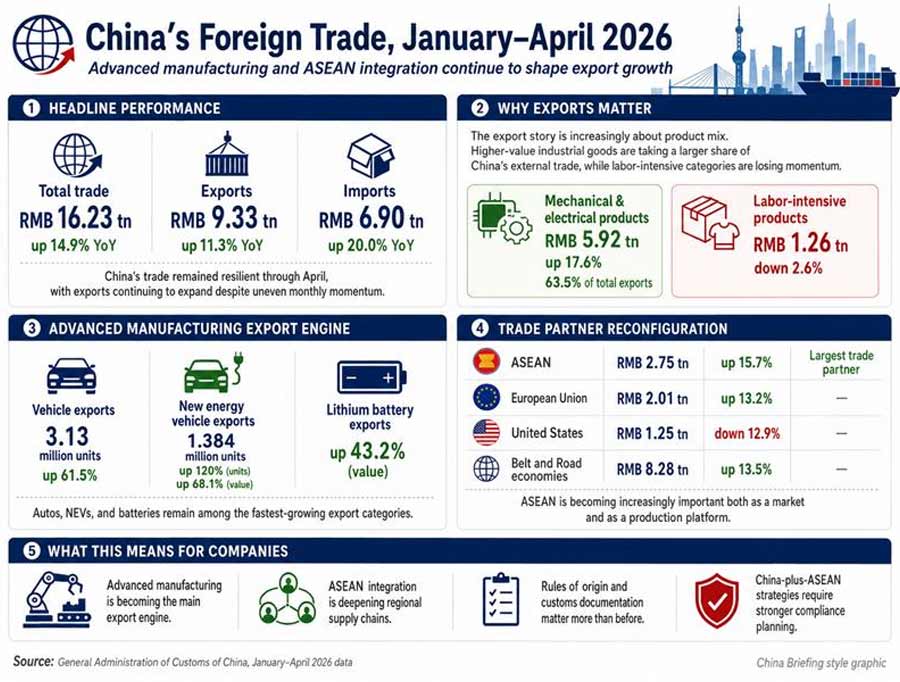
China’s exports reached RMB 9.33 trillion (US$1.37 trillion) in the first four months of 2026, up 11.3 percent year-on-year, according to monthly trade data released by the General Administration of Customs (GACC) on May 9, 2026. Exports accounted for the larger part of total goods trade of RMB 16.23 trillion over the period.

The headline growth rate, however, is the least informative part of the release. Beneath it lies a clear restructuring of what China sells abroad and where its export supply chains run: a shift toward capital- and technology-intensive goods, a more integrated ASEAN production base, and a sharper set of origin-compliance risks. For companies exposed to Chinese supply chains, it is these structural shifts, rather than the headline figure, that carry the operational consequences.
Advanced manufacturing has become a key export engine
The composition of export growth offers a clearer indication of how China’s external competitiveness is evolving. The expansion of advanced industrial exports is increasing competitive pressure in sectors where scale, technology, and manufacturing depth play a decisive role. It is also drawing greater attention to supply-chain exposure, overcapacity concerns, and the origin of goods produced across multiple jurisdictions.
In January-April 2026, total exports reached US$1.34 trillion, up 14.5 percent year-on-year, but machinery and transport equipment did the heavy lifting: at roughly US$735 billion, it made up about 55 percent of all exports and grew 24.3 percent, well ahead of the overall rate.
Underneath the aggregate, the mix is unmistakably high-value:
- Electrical machinery and parts is the single largest export line, at about US$282 billion, up 37.2 percent. Semiconductors were a standout within it, up roughly 66.5 percent year-on-year in just the first two months, as reported by Reuters.
- Road vehicles (US$97 billion, up 30.1 percent) and office and data-processing machines (US$86 billion, up 31.2 percent) grew at comparable rates, riding overseas demand for vehicles and computing hardware.
- Labor-intensive lines moved the other way: apparel slipped 0.7 percent to about US$46 billion, and footwear fell 8.8 percent to roughly US$14 billion.
The export base is concentrating in the categories with the highest engineering content and shedding weight in the lowest.
| Breakdown of China’s Exports by Key Product Categories and Performance (Jan-Apr 2026) | |||
| Category | Value | YoY | Commercial read |
| Machinery & transport equipment (all) | ~US$735 bn (~55% of exports) | +24.3% | The dominant export engine |
| Electrical machinery & parts | ~US$282 bn | +37.2% | Largest single line; components and devices |
| Road vehicles | ~US$97 bn | +30.1% | Fastest-scaling finished-goods category |
| Office & data-processing machines | ~US$86 bn | +31.2% | Rides computing and AI-hardware demand |
| Apparel | ~US$46 bn | −0.7% | Labor-intensive; flat |
| Footwear | ~US$14 bn | −8.8% | Labor-intensive; contracting |
| Source: GACC monthly customs statistics, Composition of Imports and Exports by Section and Division | |||
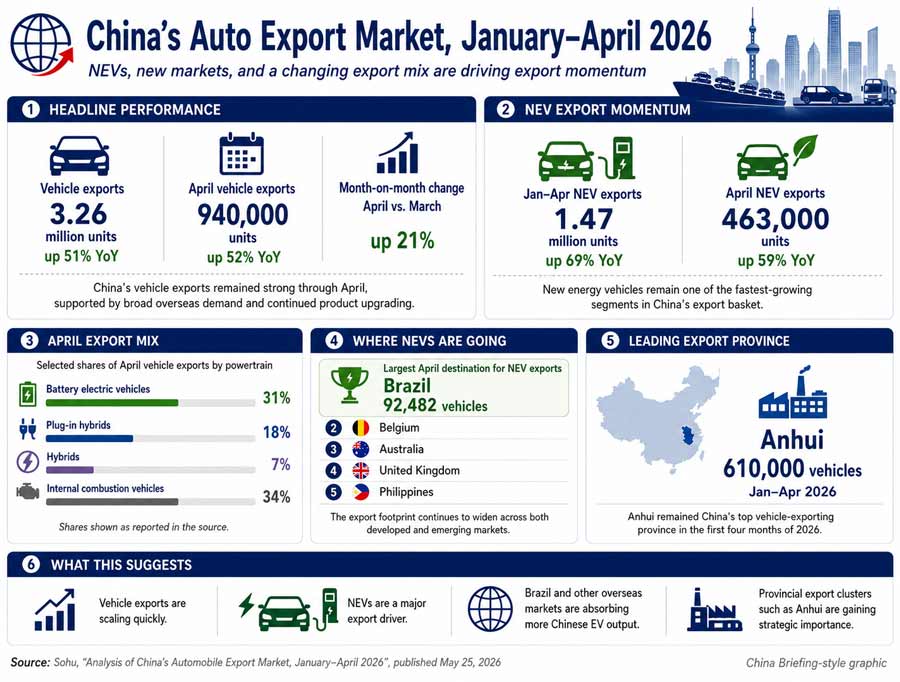
The vehicle complex shows the same pattern in unit terms. Total vehicle exports reached 3.13 million units in January-April, while NEVs made up about 44 percent of vehicle exports over the period, and close to half in April alone (roughly 430,000 of 901,000 units), confirming a structural tilt toward higher-value, electrified exports rather than a one-off.
ASEAN-focused partner reconfiguration is changing supply chains
If the product mix is the “what,” the destination data are the “where”, and the divergence among China’s major export markets is now wide enough to treat as a planning assumption rather than a reaction to tariff headlines.
ASEAN sits at the center of that shift. The bloc is already China’s largest trading partner, and it absorbed the fastest-growing share of Chinese exports early in the year: shipments to the region rose about 29.4 percent year-on-year already over the first two months of the year, even as exports to the United States contracted under higher tariffs.
On the customs data, Vietnam alone took US$72.4 billion of Chinese exports in January-April, the largest single ASEAN destination, followed by Thailand (US$41.2 billion), Malaysia (US$40.4 billion), and Indonesia (US$29.7 billion). For comparison, exports to the European Union reached US$200.7 billion and to the United States US$133.4 billion over the same period.
ASEAN should not, however, be read as a single phenomenon. The 2026 shift runs through three distinct channels:
- Genuine intermediate-goods integration (the largest): Chinese components, machinery, and subassemblies feed ASEAN-based manufacturing for both regional consumption and re-export. This is structural, not tactical.
- China-origin investment in ASEAN production platforms: Chinese manufacturers are establishing or expanding facilities in Vietnam, Thailand, Malaysia, and Indonesia, pairing upstream strength with regional assembly and new export gateways.
- Transshipment (the smallest, and most fragile): Routing finished or near-finished Chinese goods through a third country without enough real transformation to justify a change of origin.
The first two channels are robust to enforcement pressure; the third is not. That distinction determines how durable ASEAN’s role as a substitute market actually is, and where compliance risk will concentrate.
Rules of origin are now a strategic supply-chain issue
Because enforcement is tightening exactly where the transshipment channel overlaps with genuine integration, rules of origin have stopped being a narrow customs task. They now bear on tariff treatment, anti-circumvention exposure, public-procurement eligibility, and whether a regional manufacturing footprint is considered commercially credible, most acutely in clean-tech and automotive value chains.
The enforcement signals are already concrete:
- Vietnam instructed companies to tighten control over the origins of goods and materials, after Washington raised concerns about Chinese products being relabeled as Vietnamese.
- The US applies a substantial-transformation test for country-of-origin determinations, and US Customs and Border Protection guidance is explicit that simple relabeling or minor processing does not qualify.
- European policy is moving the same way, with several EU member states pressing Brussels for higher local-content and added-value thresholds on goods rerouted through third countries.
What this means for companies operating in or sourcing from China
The shifts in China’s export structure and partner network carry direct operational consequences for companies embedded in China-linked supply chains.
First, supply chain mapping and visibility are becoming non-negotiable. As production fragments across China and ASEAN, understanding the full bill of materials, supplier tiers, and transformation steps is essential. Companies that cannot clearly document where value is added risk misclassifying origin, exposing themselves to tariffs, penalties, or shipment delays.
Second, rules-of-origin compliance must be treated as a core supply chain function, not a downstream customs check. The line between legitimate regional manufacturing and transshipment is tightening. Firms should reassess whether their current production setups meet “substantial transformation” thresholds in key markets and ensure supporting documentation can withstand scrutiny from customs authorities.
Third, regionalization strategies need to be grounded in operational substance, not just geography. Shifting assembly to ASEAN alone is no longer sufficient. Businesses must ensure that local operations involve meaningful processing, workforce deployment, and value addition to secure durable tariff treatment and policy alignment.
Fourth, supplier and investment strategies should reflect the tilt toward advanced manufacturing. As China consolidates its position in high-value sectors, companies sourcing from or competing with Chinese suppliers need to evaluate technology dependencies, capacity concentration risks, and potential exposure to sector-specific trade measures.
Finally, proactive risk monitoring and periodic supply chain reviews are critical. Enforcement dynamics, particularly in the US and EU, are evolving alongside trade patterns. Companies should establish regular audit cycles, scenario-test tariff and compliance exposure, and align internal trade, procurement, and legal teams around a unified supply chain risk framework.
In this environment, competitiveness increasingly depends on how well companies can design, document, and defend their supply chains in a more complex and enforcement-driven global trade system.
When should companies seek advisory support?
Professional review is especially useful where companies rely on China-ASEAN sourcing arrangements, multi-country bills of materials, toll manufacturing, regional assembly, or export models that depend on preferential tariff treatment. Businesses should also consider external support when entering new ASEAN markets, restructuring supplier networks, or assessing exposure to US and EU trade-remedy measures.
Dezan Shira & Associates supports companies across China and Southeast Asia with supply-chain mapping, rules-of-origin review, tariff and customs advisory, sourcing optimization, location analysis, and China-plus-one planning. Our teams help businesses assess where value is created across their production networks, strengthen supplier documentation, and design operating structures that can withstand closer customs scrutiny.
For companies managing cross-border production and exports from Asia, a supply-chain review can help reduce origin-compliance risk, improve customs readiness, and ensure regional manufacturing strategies remain commercially viable as trade rules continue to evolve.



Dezan Shira & Associates advises on company establishment and legal incorporation across multiple Asian jurisdictions. Combined with our tax planning expertise, we offer a fully integrated corporate establishment solution.
About Us
China Briefing is one of five regional Asia Briefing publications. It is supported by Dezan Shira & Associates, a pan-Asia, multi-disciplinary professional services firm that assists foreign investors throughout Asia, including through offices in Beijing, Tianjin, Dalian, Qingdao, Shanghai, Hangzhou, Ningbo, Suzhou, Guangzhou, Haikou, Zhongshan, Shenzhen, and Hong Kong in China. Dezan Shira & Associates also maintains offices or has alliance partners assisting foreign investors in Vietnam, Indonesia, Singapore, India, Malaysia, Mongolia, Dubai (UAE), Japan, South Korea, Nepal, The Philippines, Sri Lanka, Thailand, Italy, Germany, Bangladesh, Australia, United States, and United Kingdom and Ireland.
For a complimentary subscription to China Briefing’s content products, please click here. For support with establishing a business in China or for assistance in analyzing and entering markets, please contact the firm at china@dezshira.com or visit our website at www.dezshira.com.
- Previous Article How Much Should You Pay Your Employees in China?
- Next Article