Other Briefings
China Tightens Contract Food Manufacturing Rules: What Foreign Companies Need to Know
New measures on contract food manufacturing in China take effect on December 1, 2026, making brand owners jointly responsible for food safety alongside their manufacturers. We outline the qualification, contract, reporting, supervision, and labeling requirements, as well as the steps foreign companies should take to comply.
Food safety has become a top priority in China, with steadily tightening regulations placing a growing compliance burden on F&B companies. Errors in production can lead to heavy fines, recalls, and reputational damage among a consumer base increasingly alert to food quality issues.

At the end of 2025, China’s market regulator released new measures governing contract food manufacturing, the first dedicated regulation for a sector central to many foreign brands’ China supply chains. Under the rules, brand owners share responsibility for the safety of the food produced and must vet, supervise, and report on their manufacturers. The measures take effect December 1, 2026, giving companies a one-year window to prepare.
Note that the measures only apply to companies located in China – including foreign-owned ones – commissioning production of food for sale in China. Companies commissioning production directly from overseas, or manufacturing solely for export, must instead follow the import and export provisions of China’s Food Safety Law.
What do the new rules say?
The new rules explicitly place the burden of responsibility for the safety of the food produced under contract on both the brand owner and the contract manufacturer. The two sides also have legal obligations to vet each other’s qualifications, processes, and capabilities, both before entering into an arrangement and during production.
What counts as food produced under contract? Food produced under contract includes both OEM models, in which the contracted party manufactures and processes the food based on the brand owner’s requirements and technical specifications before affixing the brand owner’s trademark, and ODM models, in which the manufacturer uses its own production technology or product designs but utilizes the brand owner’s trademark.
The responsibilities vary depending on the specifics of the arrangement:
| Area | Brand owner | Contract manufacturer | |
| Qualifications and documentation |
|
Obtain a food production license (food items being commissioned for production must align with the categories and product varieties specified in this license) | |
| Capabilities |
|
Possess the corresponding production capacity and the capability to ensure food safety | |
| Food safety and food safety management |
|
Same obligations | |
| Staffing | Must appoint appropriate food safety management personnel and prepare documents including:
|
Same obligations | |
| Supervision and monitoring | Must supervise the contracted party’s production activities | Must accept the brand owner’s supervision | |
| Vetting | Must verify the other parties’ qualification documents and food safety assurance capabilities.
Records of the verification must be kept for a period of 6 months after the expiry of the final batch of products produced under contract, or at least 2 years from the date of manufacture of the final batch of contracted products where there is no expiry date. |
Same obligations | |
| Record retention | The following records must be made and retained:
Duration: Minimum 6 months from expiry of the final batch of contracted products, or 2 years where there is no expiry date. |
Duration: Minimum 6 months from expiry of the final batch of contracted products, or 2 years where there is no expiry date. |
|
In addition to the general obligations, the two parties have specific responsibilities regarding the safety of the materials used for the food production depending on who supplies the materials:
| Scenario | Brand owner | Contracted manufacturer |
| General | Responsible for the compliance with laws and food safety standards of any food ingredients, additives and food-contact packaging materials provided | Responsible for the compliance of any such items it provides |
| Where the brand owner supplies materials | Must not refuse, obstruct or interfere with the contracted party’s inspection and recording of incoming goods | Must inspect and record goods upon receipt |
| Where contracted party procures materials independently | Must supervise the contracted party’s procurement activities and its incoming inspection and recording | Must inspect and record goods upon receipt |
What is the process for producing food under contract?
With the new rules standardizing requirements for contract food manufacturing, there is now a clear, compliant process for companies entering into such arrangements.
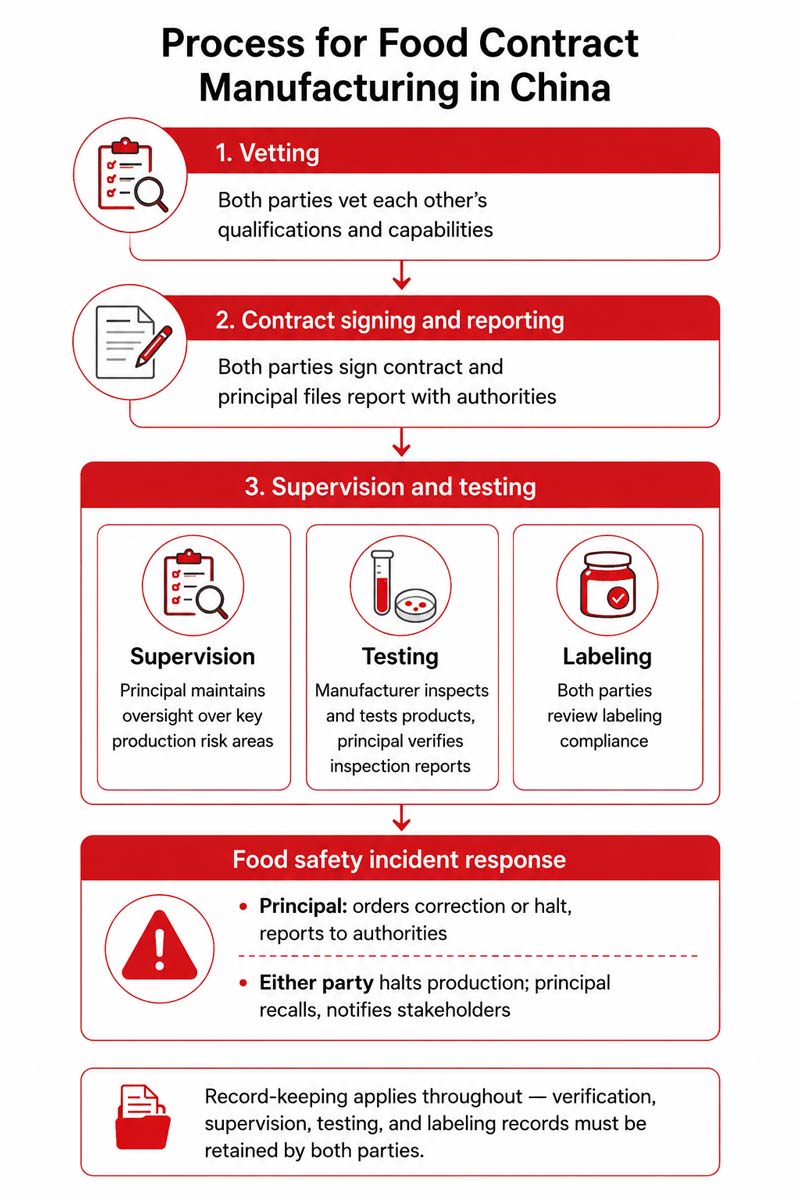
1. Vetting and record-keeping
Vetting a manufacturer’s qualifications for food production is a legal obligation of any company entering into a contract arrangement.
The first step in the process is to gather the necessary documentation and verify that the manufacturer has the necessary food production and operation license required to carry out the manufacturing activities. The foods produced under contract must align with the scope of products that are specified on this license.
Note that in this process, the manufacturer is also required to vet the brand owner’s licenses and capabilities, meaning the company must have the necessary documentation at hand and be ready to provide it to the manufacturer.
The brand owner must also vet the manufacturer’s production capacity and food safety assurance capability before entering into an agreement.
2. Contract signing and reporting
Companies must enter into a written contract for contract food production before any production activities can commence. The contract must generally contain the following:
- The qualifications of the brand owner and the contracted manufacturer;
- The name, variety, and applicable standards of the food to be produced under contract;
- The methods for procuring and supplying the raw materials, food additives, packaging materials in direct contact with food, and so on;
- The content, methods, and frequency of the brand owner’s supervision over the contracted party’s production activities;
- Procedures and liability regarding the handling of food safety accidents or food safety emergencies; and
- Other food safety matters agreed upon by the parties.
The two parties must report the contracted production arrangement to the county-level market supervision and administration department in their respective localities within ten working days of executing the contract. A template for this report can be found in the annex of an official Q&A released by SAMR.
3. Supervision and inspection
During production, the brand owner is required to carry out ongoing supervision of the manufacturer’s production activities, verification and testing of the products themselves, and periodic evaluation of food safety, and must also take action if any problems are found.
Supervising production
To supervise the manufacturer’s production activities, the brand owner can either carry out on-site inspections by sending their own personnel or by contracting a third-party organization to do so on their behalf. The brand owner can – and is encouraged to – use technological solutions to carry out ongoing supervision.
The scope of supervision should generally include the manufacturer’s risk management and control with respect to matters such as premises environment, equipment and facilities, personnel management, raw materials, key production stages, inspection and testing, transport and delivery, and management of labels and instruction manuals.
The brand owner must record the supervisory work, and the records must be confirmed by both parties and retained separately.
Testing
In parallel, the manufacturer is required to inspect the food products and retain inspection records and product samples. The brand owner can request the manufacturer to provide samples as needed or as agreed in the contract and retain the samples themselves.
While this is the responsibility of the manufacturer, the brand owner is still required to verify the factory inspection report provided by the manufacturer and take samples for testing as needed to ensure food safety.
Labeling
Both parties are required to review the labeling of the food produced under contract to ensure they comply with standards and regulations.
For pre-packaged foods manufactured under contract, the label must prominently display the name, address, and contact information of the client and the name and address of the manufacturer, preceded by phrases such as “Client/Contractor” or “Client Unit/Contractor Unit”.
Evaluating and escalating
The brand owner is required to periodically inspect and evaluate the safety status of the food produced under contract. If the production conditions of the manufacturer change and no longer meet food safety requirements, the brand owner must require the manufacturer to immediately take corrective measures.
If there is a potential risk of a food safety incident, the brand owner must require the manufacturer to immediately cease the contracted production activities and report the incident to the county-level market supervision and management department where the manufacturer is located.
Legal liabilities
Failure to fulfil obligations or comply with the rules for food contract manufacturing arrangements can result in warnings and fines ranging from RMB 2,000 to RMB 100,000.
For serious violations penalized under the Food Safety Law, the authorities may confiscate products and illegal income, impose fines of up to 20 times the value of the goods, suspend the business, and revoke licenses.
Depending on the violation, liability may fall on the brand owner, the manufacturer, or both, with heavier penalties where the brand owner pressured the manufacturer or failed to supervise it, or where the manufacturer knowingly produced non-compliant food or evaded supervision.
How can foreign companies get started in food contract manufacturing in China?
For foreign companies already using contract manufacturers in China, the priority is to bring existing arrangements into compliance before the December 1, 2026 deadline. This means auditing current agreements against the new requirements, such as verifying the manufacturer’s license scope and food safety capabilities, updating contracts, filing reports with local regulators, revising product labels, and implementing supervision, testing, and record-keeping processes. Arrangements structured as trademark licensing or franchising should also be reviewed, as these fall under the rules where they function as contract manufacturing.
For companies looking to enter the space, the new measures provide a clear roadmap and guidelines for vetting manufacturers and overseeing the production process. The starting point is establishing a qualified Chinese entity and obtaining the appropriate food production or operation license or pre-packaged food filing, followed by careful vetting of candidate manufacturers in line with the requirements.
Navigating licensing requirements, manufacturer due diligence, and ongoing compliance obligations can be complex, particularly for companies new to the Chinese market. Dezan Shira & Associates‘ teams on the ground in China can support foreign food companies at every stage, from market entry and entity setup to supplier vetting and compliance program design. Contact us at china@dezshira.com to discuss your plans.



Whether launching, restructuring, or expanding, we ensure our clients benefit from coordinated input across legal, HR, tax, and financial teams. From startup to exit, our advisory scales with your business—designed to meet both immediate needs and long-term goals.
About Us
China Briefing is one of five regional Asia Briefing publications. It is supported by Dezan Shira & Associates, a pan-Asia, multi-disciplinary professional services firm that assists foreign investors throughout Asia, including through offices in Beijing, Tianjin, Dalian, Qingdao, Shanghai, Hangzhou, Ningbo, Suzhou, Guangzhou, Haikou, Zhongshan, Shenzhen, and Hong Kong in China. Dezan Shira & Associates also maintains offices or has alliance partners assisting foreign investors in Vietnam, Indonesia, Singapore, India, Malaysia, Mongolia, Dubai (UAE), Japan, South Korea, Nepal, The Philippines, Sri Lanka, Thailand, Italy, Germany, Bangladesh, Australia, United States, and United Kingdom and Ireland.
For a complimentary subscription to China Briefing’s content products, please click here. For support with establishing a business in China or for assistance in analyzing and entering markets, please contact the firm at china@dezshira.com or visit our website at www.dezshira.com.
- Previous Article EU-China Relations After the 2024 European Elections: A Timeline
- Next Article China Monthly Tax Brief: June 2026