Other Briefings
Entering Hong Kong: Operational Roadmap for Chinese Mainland Enterprises
Hong Kong remains a key gateway for Chinese Mainland enterprises seeking global expansion, international financing, and offshore structuring. This guide explains the operational steps, tax considerations, and compliance requirements for establishing a Hong Kong business.
Hong Kong as an international gateway for Chinese Mainland enterprises

Hong Kong continues to serve as one of the most important international business hubs for Chinese Mainland enterprises seeking to expand globally. Its open financial markets, strong legal framework based on common law principles, and connectivity to international capital markets make it a preferred base for companies pursuing cross-border investment, financing, and trade.
For Chinese Mainland enterprises, Hong Kong often functions as a strategic platform for:
- Global fundraising and capital markets access
- Offshore corporate structuring and treasury management
- Regional headquarters for Asia-Pacific operations
- International trade coordination
The territory’s position within the Greater Bay Area (GBA) further strengthens its role as a bridge between the Chinese Mainland and global markets.
How Chinese Mainland enterprises Use Hong Kong for Global Expansion
One of the most common expansion strategies used by the Chinese Mainland companies is to establish a Hong Kong entity as an international holding and financing platform. The city’s financial infrastructure, convertible currency, and international legal system make it particularly attractive for firms seeking global capital and overseas investment opportunities.
Example: the Chinese Mainland companies raising international capital
Many Chinese Mainland firms list their shares on the Hong Kong Exchanges and Clearing (HKEX), enabling them to raise capital from global investors while maintaining strong ties with the Chinese Mainland market.
Hong Kong has long served as a leading offshore listing venue for Chinese companies. The city’s capital markets allow Chinese Mainland enterprises to access international investors while benefiting from regulatory familiarity and geographic proximity.
Example: Hong Kong as a global holding company platform
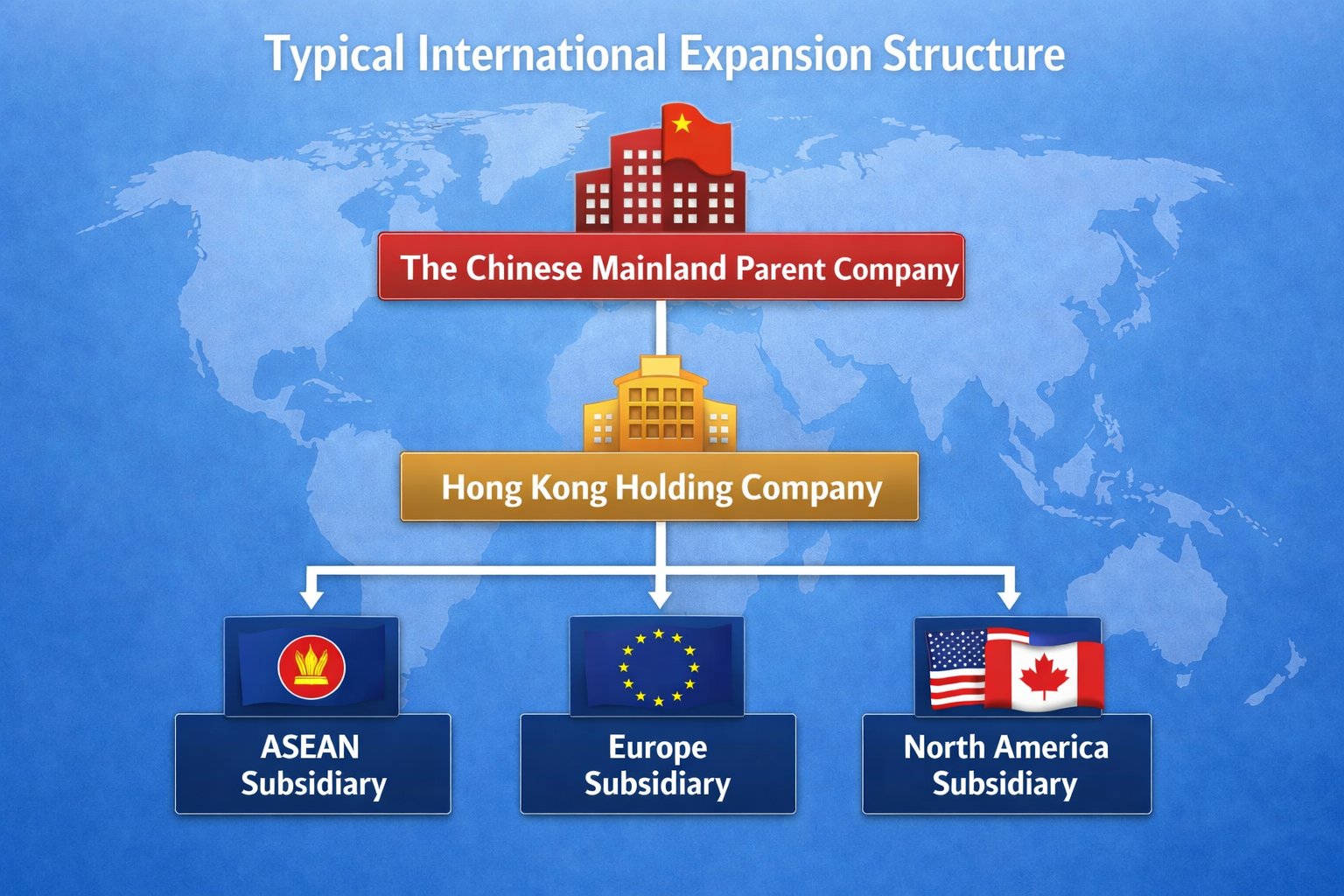
A typical expansion structure may involve:
Chinese Mainland Parent Company → Hong Kong Holding Company → Overseas Subsidiaries
This structure enables companies to:
- Manage cross-border investments
- Raise foreign currency financing
- Facilitate mergers and acquisitions abroad
- Streamline global treasury operations
Strategic considerations before market entry
Before establishing operations in Hong Kong, Chinese Mainland enterprises should determine the strategic role the Hong Kong entity will play within their corporate structure.
Typical functions include:
- International holding platform: Many companies establish a Hong Kong holding entity to facilitate overseas acquisitions and investments.
- Global treasury and financing: Hong Kong’s mature banking sector and international financial infrastructure allow firms to manage foreign currency transactions and raise capital.
- Regional headquarters: Companies may centralize Asia-Pacific management, supply chain coordination, and sales functions in Hong Kong.
- Cross-border trade management: Hong Kong is frequently used to structure global supply chains and manage international trade flows.
Executives should evaluate:
- Will the Hong Kong entity serve as a holding company or operational subsidiary?
- Will it generate revenue locally or operate primarily offshore?
- Will the company require capital markets access?
Operational risks for Chinese Mainland enterprises
| Risk Area | Description | Who Should Monitor |
| Banking due diligence | Hong Kong banks conduct strict AML and beneficial ownership checks when opening accounts | CFO / Treasury teams |
| Tax residency risk | Improper structuring may create unexpected tax exposure in Hong Kong or the Chinese Mainland China | Tax directors |
| Corporate transparency | Significant Controllers Register requires disclosure of beneficial owners | Legal / compliance teams |
| Cross-border compliance | The Chinese Mainland regulatory requirements for outbound investment must be considered | Corporate strategy teams |
Dezan Shira & Associates can assist Chinese Mainland enterprises with:
- Market entry strategy
- Corporate structuring
- Tax planning and compliance
- Cross-border regulatory approvals
Contact experienced advisors to evaluate the most effective structure for your Hong Kong expansion: Hongkong@dezshira.com
The Chinese Mainland outbound investment considerations
The Chinese Mainland companies expanding overseas must often comply with outbound investment regulations administered by Chinese authorities.
Relevant regulators include:
- National Development and Reform Commission (NDRC)
- Ministry of Commerce of the People’s Republic of China (MOFCOM)
- State Administration of Foreign Exchange (SAFE)
These approvals may be required when Chinese Mainland enterprises establish offshore holding structures or acquire overseas assets.
Hong Kong remains a critical international gateway for Chinese Mainland enterprises seeking global capital, efficient corporate structuring, and access to international markets. With the right planning and compliance framework, companies can use Hong Kong as a launchpad for overseas expansion while maintaining close integration with the Chinese Mainland operations.
Choosing the right business structure
Chinese Mainland enterprises can establish several types of legal entities in Hong Kong, depending on their operational needs.
| Structure | Typical Use Case | Advantages | Limitations |
| Private limited company | Full operations | Limited liability, tax efficiency | Compliance obligations |
| Branch office | Extension of the Chinese Mainland parent | Easier setup | Parent liable for debts |
| Representative office | Market research | Simple presence | Cannot generate revenue |
Private limited company
The most common vehicle for foreign and Chinese Mainland investors is a private limited company.
Key requirements include:
- At least one director
- At least one shareholder
- Company secretary
- Registered office in Hong Kong
Read more: Types of Companies in Hong Kong
Step-by-step company incorporation process
For Chinese Mainland enterprises entering Hong Kong, the incorporation process is relatively efficient and can often be completed within several days.
Step 1: Select a company name
Names must be approved by the Companies Registry.
Step 2: Prepare incorporation documents
Required documents typically include:
- Incorporation form
- Articles of association
- Director and shareholder identification documents
- Registered office details
Step 3: Submit application to Companies Registry
Applications may be submitted electronically through the e-Registry system.
Step 4: Obtain a Business Registration Certificate
Companies must register with the Inland Revenue Department (IRD).
Step 5: Open a corporate bank account
Banks typically conduct due diligence on beneficial ownership and corporate structure.
Read more: Hong Kong Company Registration: Private Limited Company Set-Up Guide
Tax framework and financial advantages
Hong Kong’s tax system is widely viewed as one of the most business-friendly globally.
Key features:
- Territorial taxation principle
- No VAT or sales tax
- No capital gains tax
- No withholding tax on dividends or interest
- No tax on dividends received
The corporate profits tax currently applies only to income sourced in Hong Kong.
Profits tax rates
| Tax Category | Rate |
| First HK$ 2 million profits | 8.25% |
| Remaining profits | 16.5% |
Important considerations
Chinese Mainland enterprises must carefully assess:
- Source of income rules
- Transfer pricing compliance
- Tax residency risk
Hong Kong tax advantages compared with major economies
| Tax Category | Hong Kong | Singapore | Dubai |
| Corporate tax | 16.5% | 17% | 9% (federal corporate tax on business net profits exceeding AED 375,000) |
| Capital gains tax | None | Generally non-taxable | None |
| VAT | None | 9% | 5% |
| Dividend withholding tax | None | None | None |
Read more: Taxation & Accounting in Hong Kong
Corporate governance and compliance requirements
Companies incorporated in Hong Kong must comply with ongoing regulatory obligations.
Key compliance requirements include:
- Appointment and maintenance of a company secretary and registered office in Hong Kong (ongoing requirement)
- Compliance with economic substance/transfer pricing documentation, where applicable
- Annual returns filing with the Companies Registry (Form NAR1)
- Preparation of audited financial statements (unless exempt as a dormant company)
- Profits tax return filing with the IRD
- Maintenance of a Significant Controllers Register
- Holding of annual general meetings (AGMs) unless exempted (for example, for single-member companies)
- Proper maintenance of statutory books and records (for example, registers of directors, shareholders, and charges)
- Business registration certificate renewal on an annual or three-year basis
- Timely notification of changes (for example, directors, company secretary, registered office) to the Companies Registry
Hong Kong entities are frequently used in multinational corporate structures because of the jurisdiction’s tax neutrality and strong legal protections.
Common mistakes the Chinese Mainland companies make when entering Hong Kong
Mistake 1: Underestimating banking compliance requirements
Hong Kong banks apply strict anti-money laundering (AML) and beneficial ownership checks, which can delay corporate bank account approvals.
Mistake 2: Incorrect tax structuring
Some companies assume Hong Kong profits are automatically tax-exempt.
However, Hong Kong applies a territorial tax system, meaning companies must prove that income is sourced outside Hong Kong to qualify for offshore tax treatment.
Mistake 3: Ignoring the Chinese Mainland outbound investment rules
The Chinese Mainland companies establishing overseas entities may need approvals or filings with Chinese regulators, as mentioned in earlier sections.
Mistake 4: Weak corporate governance practices
Hong Kong companies must maintain transparency requirements such as a Significant Controllers Register, which tracks beneficial ownership.
Immigration and talent mobility
Executives relocating to Hong Kong must obtain appropriate visas.
The Investment Visa / Entrepreneur Visa allows entrepreneurs to establish or join a business in Hong Kong.
Applicants must demonstrate:
- A viable business plan
- Financial resources
- Potential economic contribution
Operational challenges for Chinese Mainland enterprises
Despite its advantages, the Chinese Mainland companies may face several challenges when expanding into Hong Kong.
Common issues include:
- Banking compliance: Banks conduct strict due diligence on corporate structures.
- Tax structuring complexities: Improper structuring may lead to unexpected tax exposure.
- Corporate governance expectations: Hong Kong maintains high transparency standards for listed and private companies.
- Cross-border regulatory compliance: Businesses must ensure alignment between the Chinese Mainland and Hong Kong legal frameworks. Professional advisory support is often required to structure operations efficiently.
For business support across these compliance requirements, reach our experts at: Hongkong@dezshira.com
Hong Kong’s role in the Greater Bay Area strategy
Hong Kong plays a critical role in China’s Greater Bay Area integration strategy, which links Hong Kong, Macao, and nine cities in Guangdong province into a major economic cluster.
For Chinese Mainland enterprises, this integration provides opportunities to:
- Access global capital markets
- Expand internationally through Hong Kong platforms
- Strengthen cross-border supply chains
|
Why Chinese Mainland Enterprises Choose Hong Kong |
|
| Advantage | Explanation |
| International capital markets |
Access to global investors |
| Convertible currency | Free movement of capital |
| Common law system | Legal transparency |
| Global financial hub | Mature banking and financial services |
| Greater Bay Area integration | Strong ties with the Chinese Mainland China |
Conclusion
Hong Kong remains a highly attractive destination for Chinese Mainland enterprises seeking to internationalize their operations. Its transparent regulatory framework, favorable tax system, and access to global capital markets make it a powerful launchpad for cross-border expansion.
However, successful market entry requires careful planning, appropriate corporate structuring, and ongoing regulatory compliance.
With the right operational roadmap and professional guidance, the Chinese Mainland companies can leverage Hong Kong’s advantages to support regional and global growth.



Our Business Advisory service supports companies in establishing and growing their presence in Hong Kong, Asia’s leading international business and financial hub. We provide advice on corporate structuring, company formation, due diligence, commercial and employment contracts, intellectual property protection, and M&A transactions, helping businesses navigate Hong Kong’s regulatory environment and leverage its role as a gateway to the Chinese Mainland and the wider Asia?Pacific region.
About Us
China Briefing is one of five regional Asia Briefing publications. It is supported by Dezan Shira & Associates, a pan-Asia, multi-disciplinary professional services firm that assists foreign investors throughout Asia, including through offices in Beijing, Tianjin, Dalian, Qingdao, Shanghai, Hangzhou, Ningbo, Suzhou, Guangzhou, Haikou, Zhongshan, Shenzhen, and Hong Kong in China. Dezan Shira & Associates also maintains offices or has alliance partners assisting foreign investors in Vietnam, Indonesia, Singapore, India, Malaysia, Mongolia, Dubai (UAE), Japan, South Korea, Nepal, The Philippines, Sri Lanka, Thailand, Italy, Germany, Bangladesh, Australia, United States, and United Kingdom and Ireland.
For a complimentary subscription to China Briefing’s content products, please click here. For support with establishing a business in China or for assistance in analyzing and entering markets, please contact the firm at china@dezshira.com or visit our website at www.dezshira.com.
- Previous Article China’s New GAC Overseas Food Manufacturer Registration Rules: What Exporters Need to Know Before June 1, 2026
- Next Article