Other Briefings
China’s New GAC Overseas Food Manufacturer Registration Rules: What Exporters Need to Know Before June 1, 2026
On March 18, 2026, China’s General Administration of Customs (GAC) published GAC Announcement [2026] No.27 (hereinafter, Announcement No.27), releasing the implementation details for GAC Decree No. 280 (hereinafter, Decree No.280), the new regulation governing the registration of overseas food manufacturers that export to China. The announcement, which came just 75 days before the June 1, 2026 enforcement date, confirms the product lists, customs declaration requirements, and the official registration system that overseas producers must use.

Decree No.280 replaces the existing GAC Decree No.248, which has governed overseas food manufacturer registration since 2021. The new framework is not a minor administrative update. Rather, it introduces a restructured, risk-tiered registration system, changes how renewals work for most producers, creates a new group registration pathway, and brings cold storage facilities into scope for the first time. It also introduces specific customs declaration fields that will be mandatory from June 1, and shipments that do not meet these requirements could be rejected at the Chinese border.
For food exporters currently registered under Decree No.248, the key reassurance is that existing valid registrations carry over and do not need to be reapplied for. But the new rules affect how those registrations are renewed, how declarations are filed, and in some cases, which registration pathway applies going forward.
Who is affected: scope and key exclusions
Decree No.280 applies to overseas enterprises that produce, process, or store food destined for export to China as cargo, specifically food entering the Chinese domestic market for human consumption or as ingredients for food processing.
Two important exclusions are worth noting upfront:
- Food additives and food-related products (packaging materials, containers, cleaning agents, and similar items) are outside the scope of Decree No.280 and governed by separate frameworks.
- Cross-border e-commerce (CBEC) retail imports are currently exempt. GAC’s March 18 announcement clarifies that the new declaration requirements apply only to goods imported “in cargo form”. Since CBEC is treated as personal use imports rather than cargo, those shipments are not currently subject to the GAC registration requirement. This is an important distinction for businesses selling directly to Chinese consumers through platforms like Tmall Global or JD Worldwide.
Two categories have been brought into scope under Decree No.280 that were not previously covered or were covered differently:
- Overseas cold storage facilities: Facilities used to store land-animal-sourced foods and aquatic products before export to China now require registration. Specifically, this covers cold storage warehouses used to store these product types. This is a new obligation for logistics operators that was not present under Decree No.248.
- Note on primary agricultural products: Several raw/primary agricultural product categories that were previously on the official recommendation list under Decree No.248, including fresh and dehydrated vegetables and dried beans, oil seeds, and unroasted coffee and cocoa beans, have been removed from the Decree No.280 product lists. These categories are now governed separately under GAC Announcement [2025] No.219, which regulates the registration of primary agriculture products exporters. Exporters of these products should consult that announcement for their specific requirements.
The three registration pathways: Which one applies to you
Decree No.280 introduces a tiered, risk-based structure with three distinct registration routes. Understanding which pathway applies to your business is the first practical step.
Pathway 1: Registration upon official recommendation
This pathway applies to producers of the 17 product categories on the list of products that require official recommendation for registration (hereinafter, official recommendation list). These are higher-risk food categories where GAC requires both a competent authority inspection and an official recommendation before registration is granted.
The 17 categories on the official recommendation list include:
- Meat and meat products
- Casings
- Edible bird’s nests and products
- Bee products
- Eggs and egg products
- Edible oils and fats
- Stuffed pasta
- Edible grains
- Grain milling products and malt
- Dehydrated vegetables
- Seasoning powders
- Nuts and seeds
- Dried fruits
- Foods for special dietary uses
- Health foods
- Dairy products
- Aquatic products
Compared to the previous Decree No.248 list, several primary agricultural product categories have been removed, including fresh vegetables and dried beans, oil seeds, and unroasted coffee and cocoa beans.
It should be noted that the official recommendation list is subject to dynamic adjustment. The above 17 categories will remain effective unless and until amended or repealed by a subsequent GAC announcement.
Under the previous Decree No.248, the competent authority of the exporting country was required to submit the registration application to GAC on the company’s behalf. Decree No.280 changes this: companies can now submit their application directly to GAC after obtaining the competent authority inspection report and recommendation letter. This removes a procedural step that had previously created delays when authorities were slow to forward applications.
Pathway 2: Self-application registration
This pathway applies to producers of food categories not on the official recommendation list. Companies apply directly to GAC through the China Import Food Enterprises Registration system (CIFER), submitting an application form, identity documentation (such as a business license or equivalent issued by the relevant home country authority), and a compliance declaration. GAC may request additional information on the company’s food safety management systems, production type, and production capacity.
Pathway 3: List registration (new under Decree No.280)
This is an entirely new pathway introduced by Decree No.280, available only to producers in countries that have signed food safety cooperation agreements with China and whose food safety management systems have been formally recognized by GAC. Under this route, the exporting country’s competent authority compiles a list of enterprises and submits it to GAC as a batch registration. Companies do not need to apply individually.
This significantly reduces the administrative burden per company and shortens registration timelines. Whether this pathway is available to producers in a given country depends on the bilateral arrangements in place, though this information is not currently available in open resources. Exporters should check with their national food safety or customs authority to determine whether their country has an arrangement with GAC that enables list registration.
|
Comparison of the Three Registration Pathways |
|||
| Who applies? | Producers of the 17 higher-risk categories on the official list | Producers of food categories not on the official list | Producers from countries with recognized bilateral food safety agreements with China |
| How is the application submitted? | Company submits directly to GAC after obtaining an inspection report and a recommendation letter from the home country’s competent authority (new under Decree No.280 — previously the authority had to submit) | The company applies directly to GAC via the CIFER system, submitting the application form, identity documents, and a compliance declaration | The home country competent authority submits a batch list of enterprises to GAC — companies do not apply individually |
| Auto-renewal available? | Yes, for most categories. Meat and meat products, and birds’ nests require active renewal (3-12 months before expiry) | Yes, auto-renews at expiry | Renewal handled by the competent authority via updated list submissions |
Registration renewal: The key change that existing registrants need to act on
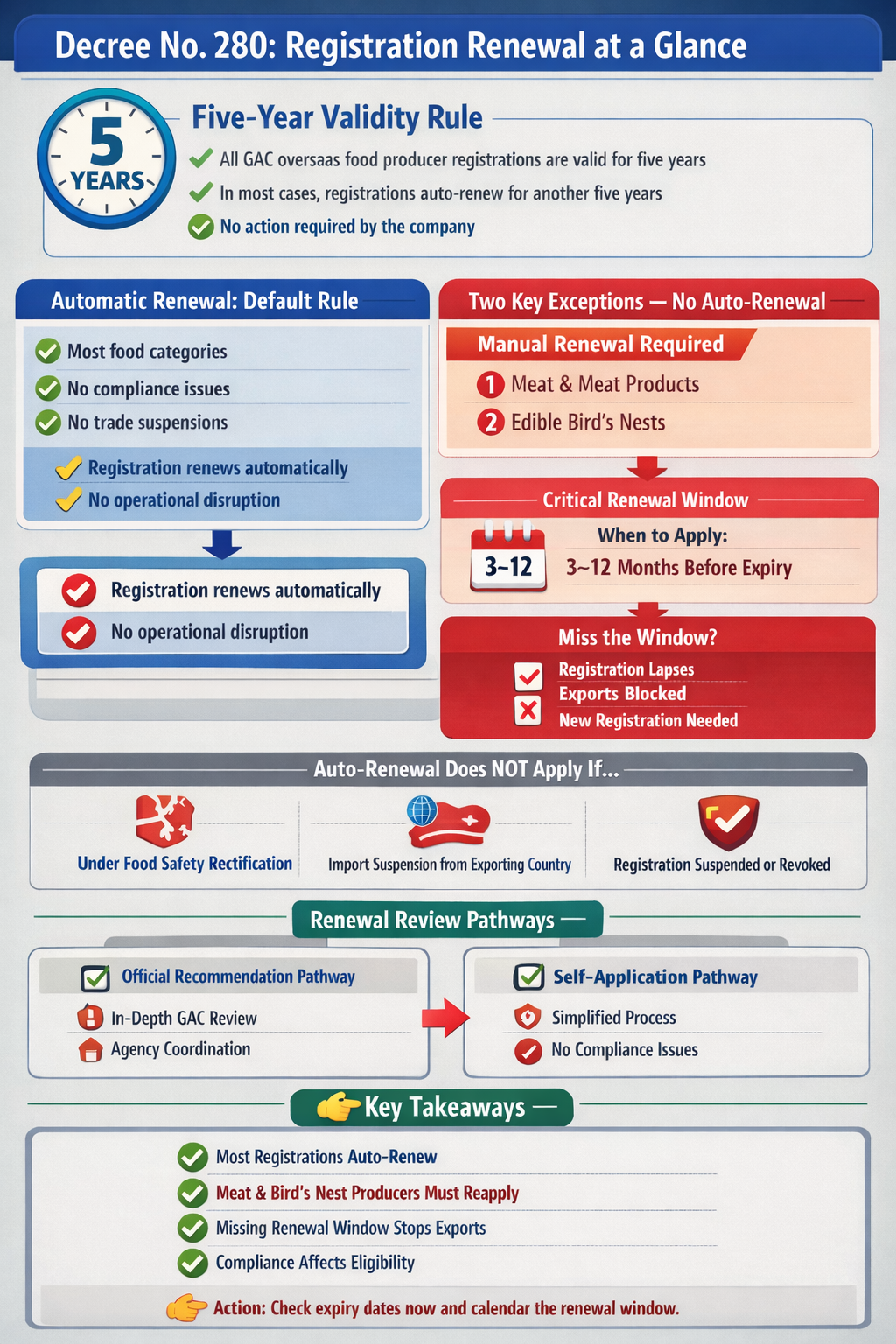
One of the most practically significant changes in Decree No.280 is the shift to automatic renewal as the default for most food categories. Under Decree No.248, all registrations had to be actively renewed before expiry, which led to many unintentional lapses. The new framework reduces this administrative burden substantially, but with an important exception that certain producers must not overlook.
Under Decree No.280, at the end of a registration’s five-year validity period, the registration automatically renews for another five years in most cases. No action is required by the company.
Nevertheless, two food categories are specifically excluded from automatic renewal and require companies to submit an active renewal application, including:
- Meat and meat products; and
- Edible bird’s nests and products.
For these two categories, the renewal application must be submitted between three and 12 months before the registration expiry date. Failure to apply within this window will result in the registration lapsing, which would block exports until a new registration is obtained. Producers in these categories should check their registration expiry dates immediately and calendar the renewal window.
Auto-renewal will also not apply in the following circumstances, even for categories not on the non-auto-renewal list:
- The enterprise is currently in a rectification period due to food safety non-compliance;
- GAC has suspended imports from the enterprise’s country for the relevant food category; or
- The enterprise’s registration has been suspended, revoked, or cancelled.
For enterprises on the official recommendation pathway, GAC will conduct a review as part of the renewal process. For self-application enterprises, renewal is largely administrative unless there are outstanding compliance issues.
*By Asia Briefing, AI-powered.
Customs declaration requirements: How to file correctly from June 1
From June 1, 2026, all food imported into China as cargo for human consumption or as food processing ingredients must include two specific pieces of information in the customs declaration that were not previously mandatory. Incorrect or missing entries will result in GAC rejecting the declaration, meaning shipments cannot clear customs. GAC has also explicitly warned that false declarations will be subject to legal penalties.
| Field | Location on Customs Declaration | What to Enter |
| Registration number | “Product qualifications” (产品资质) → “Imported food overseas producer registration” certificate column (License category code: 519) | The overseas producer’s GAC registration number in China, matching the declared country of origin. |
| Purpose | “Commodity filing” (商品填报) → “Purpose” (用途) column | Enter: 食用 (edible / for human consumption) |
Both fields must be completed for every covered shipment. The registration number entered must correspond to the producer of the specific goods being imported and must match the declared country of origin.
GAC Declaration Requirements for Imported Food & Validity Period
The following rules apply after the June 1 enforcement date:
- Official recommendation pathway: Products manufactured during a registration’s validity period can still be declared for import even if the registration has since expired, provided the products remain within their shelf life.
- Self-application pathway: The registration must be currently valid at the time the import declaration is submitted. There is no equivalent production-date grace period.
- Suspended/revoked registrations: Shipments that departed from the country of origin before the date of suspension, revocation, or cancellation are not affected and can still be declared for import.
Importers and customs brokers should update declaration templates and internal procedures before June 1. The registration number format and the specific field locations within the declaration form should be confirmed with your customs broker, as declaration software platforms may handle these differently.
The registration system: Where and how to apply
GAC has designated a single official system for all registration-related activities: the Import Food Overseas Producer Registration Management System (进口食品境外生产企业注册管理系统), accessible at: https://cifer.singlewindow.cn.
Through this system, enterprises can:
- Apply for new registrations;
- Submit changes to existing registrations;
- Apply for renewal (for non-auto-renewal categories or where manual renewal is needed);
- Check application progress and GAC review comments;
- Look up their registration number, validity period, and status; and
- Query product categories and their corresponding HS codes and supervision identification codes.
GAC has explicitly warned businesses to be alert to fraudulent websites impersonating the official system. Always access the registration system via the official GAC website or the CIFER system URL above. There is no fee charged by GAC for any registration-related activity. Any platform charging for the registration itself (as distinct from professional service fees) should be treated with caution.
Key dates and action checklist
| Date | What Happens |
| October 14, 2025 | Decree No. 280 published by GAC |
| March 18, 2026 | Implementation Announcement No.27 published: product lists, declaration requirements, and system guidance released |
| June 1, 2026 | Decree No.280 takes effect; Decree No.248 (2021) is repealed. New customs declaration fields (code 519, “食用”) become mandatory for all covered food imports |
| Ongoing from June 1 | Existing valid Decree No.248 registrations remain valid; auto-renewal applies at expiry for eligible categories |
Before June 1, businesses exporting food to China should work through the following checklist:
| Checklist for Businesses Exporting Food to China Before June 1 | |
| ☐ | Identify which of the three registration pathways applies to your products (official recommendation list, self-application, or list registration) |
| ☐ | Confirm your existing GAC registration is still valid and check its expiry date |
| ☐ | If you produce meat/meat products or bird’s nests and nests products: check expiry date and calendar your renewal window (3–12 months before expiry) |
| ☐ | Update your customs declaration templates to include the registration number under license category code 519 and “食用” in the purpose field |
| ☐ | Brief your customs broker on the new declaration requirements before June 1 |
| ☐ | Verify your registration number and details in the official CIFER system (https://cifer.singlewindow.cn) |
| ☐ | If you export primary agricultural products (such as, fresh vegetables, oil seeds, unroasted coffee/cocoa): check requirements under the separate Announcement [2025] No. 219 |
| ☐ | If you operate a cold storage facility for land-animal-sourced foods or seafood: confirm whether registration is required under the new rules |
Frequently asked questions
- My products are currently registered under Decree No.248. Do I need to re-register under Decree No.280?
No. Existing valid registrations issued under Decree No.248 automatically carry over under Decree No.280 and remain valid until their expiry date. You do not need to submit a new registration application. What changes is how renewals are handled going forward (see the renewal section above) and how you complete the customs declaration from June 1.
- I sell to Chinese consumers through a CBEC platform. Does Decree No.280 apply to me?
Not currently. GAC’s March 18 implementation announcement confirms that the new declaration requirements apply to food imported “in cargo form” for entry into the domestic Chinese market. Cross-border retail e-commerce shipments are treated as personal-use imports rather than cargo, and are therefore not currently subject to the GAC registration requirement under Decree No.280. However, you should monitor this area: the regulatory treatment of CBEC food imports has been subject to ongoing discussion, and this exemption could change.
- My country has a food safety agreement with China. Can I use the list registration pathway?
Possibly, but not automatically. Eligibility for list registration requires both that a bilateral food safety cooperation agreement exists and that GAC has formally recognized your country’s food safety management system. The competent authority in your country would also need to be willing and able to compile and submit a batch list to GAC. Check with your national food safety authority or customs agency to determine whether this pathway is available for your specific product category and country. If it is available, it offers a significantly lighter administrative burden than an individual application.
- What happens if my registration expires and I miss the renewal window?
The consequence depends on which pathway you are on. For categories eligible for auto-renewal, expiry triggers automatic renewal. For meat/meat products and bird’s nest producers (the two non-auto-renewal categories), a registration that is not renewed within the required window will lapse. An expired registration means your products cannot be legally imported into China until a new registration is obtained. The registration process takes time, so a lapse could result in a meaningful gap in market access.
- How do I find my GAC registration number?
Your GAC registration number can be found through two channels: the official CIFER registration system (https://cifer.singlewindow.cn) by logging in and checking your enterprise’s registration details, or via the GAC official website’s “Registered Overseas Food Producer” public list (进口食品境外生产企业注册名单). If you are uncertain whether your registration is currently active or what your registration number is, the CIFER system is the authoritative source.
- What exactly should I enter in the customs declaration fields, and what happens if I get it wrong?
In the “Product qualifications” section of the declaration, under the “Imported food overseas producer registration” certificate column, enter the GAC registration number that corresponds to the producer of the goods, using license category code 519. In the “Commodity filing” section under the “Purpose” field, enter “食用” (meaning edible / for human consumption). If either field is missing or incorrectly completed, GAC will not accept the declaration. The shipment will be held up. If the information is deliberately falsified, GAC has indicated it will pursue legal penalties. The practical implication is that both your internal teams and your customs broker need to have these requirements confirmed and built into their procedures before June 1.
- My company operates a cold storage facility for food products. Are we now required to register?
It depends on what you store. Decree No.280 brings overseas cold storage facilities into scope where the facility is used to store land-animal-sourced foods or aquatic products. The requirement applies specifically to cold storage warehouses for these product types. If your facility stores other food categories exclusively, the registration requirement under Decree No.280 does not currently apply, though you should verify this against the specific product categories you handle. Cold storage operators handling covered products should register through the CIFER system ahead of the June 1 deadline.
A note on staying current
GAC has stated that the product lists, non-auto-renewal categories, and cold storage scope are subject to dynamic management, which means that they can be updated over time as GAC adjusts risk assessments. The June 1, 2026 framework is the starting point, not a fixed end state. Exporters in affected categories should monitor GAC announcements for any revisions to the lists after implementation.



Whether launching, restructuring, or expanding, we ensure our clients benefit from coordinated input across legal, HR, tax, and financial teams. From startup to exit, our advisory scales with your business—designed to meet both immediate needs and long-term goals.
About Us
China Briefing is one of five regional Asia Briefing publications. It is supported by Dezan Shira & Associates, a pan-Asia, multi-disciplinary professional services firm that assists foreign investors throughout Asia, including through offices in Beijing, Tianjin, Dalian, Qingdao, Shanghai, Hangzhou, Ningbo, Suzhou, Guangzhou, Haikou, Zhongshan, Shenzhen, and Hong Kong in China. Dezan Shira & Associates also maintains offices or has alliance partners assisting foreign investors in Vietnam, Indonesia, Singapore, India, Malaysia, Mongolia, Dubai (UAE), Japan, South Korea, Nepal, The Philippines, Sri Lanka, Thailand, Italy, Germany, Bangladesh, Australia, United States, and United Kingdom and Ireland.
For a complimentary subscription to China Briefing’s content products, please click here. For support with establishing a business in China or for assistance in analyzing and entering markets, please contact the firm at china@dezshira.com or visit our website at www.dezshira.com.
- Previous Article US-China Relations in the Trump 2.0 Era: A Timeline
- Next Article