Other Briefings
Hong Kong Budget 2026-2027: Driving Growth Through Technology and Innovation
The Hong Kong Budget 2026 sets out a comprehensive strategy to drive high-quality, inclusive growth through innovation, finance, and deeper regional integration with the Chinese Mainland. Against a backdrop of global trade volatility, the 2026 Budget outlines measures to support businesses and individuals, accelerate infrastructure and technology development, and reinforce the city’s role as an international trade and financial hub.
Hong Kong’s government budget for the fiscal year 2026-27 (the “Budget”), delivered by the Financial Secretary Paul Chan on February 25, 2026, sets out a comprehensive policy blueprint focused on strengthening economic resilience and accelerating innovation and technology development. This year’s Budget, which has been given the theme “Driving High-quality, Inclusive Growth with Innovation and Finance”, follows a year of major upheaval and volatility in global trade that, while somewhat stabilized, continues to this day.
2026 marks the first year of China’s 15th Five-Year Plan, and the Budget outlines efforts to align with this national economic blueprint that will cover the period from 2026 to 2030. Notably, Chan announced that Hong Kong will, for the first time, formulate its own local five-year plan, indicating that the region’s development trajectory will align more closely with national policy priorities in the coming years.
Hong Kong’s Economy in 2025
Overview and forecasts
In 2026, Hong Kong will seek to further deepen and broaden economic development, implementing “more proactive” macro policies and seeking to expand domestic demand while advancing the development of emerging and high-tech sectors.

Based on the better-than-expected 3.5 percent GDP growth recorded in 2025, the government forecasts that Hong Kong’s economy will expand by 2.5 to 3.5 percent in 2026, with the underlying inflation rate and the headline inflation rate reaching 1.7 percent and 1.8 percent, respectively. The economy is then projected to grow by an average of 3 percent per year in real terms from 2027 to 2030, with an average underlying inflation rate of 2 percent.
Total government expenditure for the 2026 to 2027 period is projected to increase by about 6.9 percent to HK$843.4 billion (US$107.9 billion), with the ratio to nominal GDP estimated to be 24.2 percent.
Meanwhile, recurrent expenditure will increase by 4.8 percent to HK$599.7 billion (US$76.7 billion), of which around 60 percent will be allocated to healthcare, social welfare, and education. Non‑recurrent expenditure will increase by 36.9 percent to HK$40.5 billion (US$5.2 billion).
Tax policies
Vowing to preserve the region’s simple and low-rate tax regime, the government will introduce and extend a series of modest tax relief measures for households in 2026, along with a package of preferential tax policies for targeted businesses and industries.
To raise revenue, the government will also raise stamp duty on high-value residential property transactions and continue to implement the Pillar Two Global Minimum Tax, which has been in force since financial years (FYs) starting on or after January 1, 2025.
In his speech, Chan additionally stated that he will will establish and chair an Advisory Committee on Tax Policy which will be tasked with ensuring tax policy is calibrated to foster economic development through consultation with commercial, industrial, and professional sectors.
Tax relief for individuals and businesses
The major adjustment in this year’s tax relief policy is the doubling of the ceiling on the 100 percent reduction in salaries tax and profit tax for individuals and businesses. The policy is now:
- A 100 percent reduction in salaries tax and tax under personal assessment for the 2025-26 year of assessment (YA), capped at HK$3,000 (384) (up from HK$1,500/US$192).
- A 100 percent reduction in profit tax for the assessment year 2025-26 by 100%, capped at HK$3,000 (up from HK$1,500).
Similarly, the allowance enhancement policy for standard Comprehensive Social Security Assistance (CSSA) payments, Old Age Allowance, Old Age Living Allowance, or Disability Allowance has been extended from a half-month to a full-month extra allowance for YA 2025-26.
Rate concessions for domestic and non-domestic properties will continue to be provided for the first two quarters of the 2026-27 FY, subject to a ceiling of HK$500 (US$64) for each rateable property. This measure is estimated to involve about 3.15 million domestic properties and 440,000 non‑domestic properties.
| Category | Details | |
| Individual and corporate tax reductions YA 2025-26 | Salaries tax | A 100% reduction in salaries tax and tax under personal assessment for YA 2025-26, capped at HK$3,000 per case. |
| Profits tax | A 100% reduction in profits tax for YA 2025-26, capped at HK$3,000 per case. | |
| Property transaction incentives | Rates concessions | Concessions for both domestic and non-domestic properties for the first two quarters of the 2026-27 FY, with each property type subject to a HK$500 ceiling. |
| Additional social support | Allowance enhancements | An extra month allowance for standard CSSA payments, Old Age Allowance, Old Age Living Allowance, or Disability Allowance. Similar arrangements are implemented for the Working Family Allowance. |
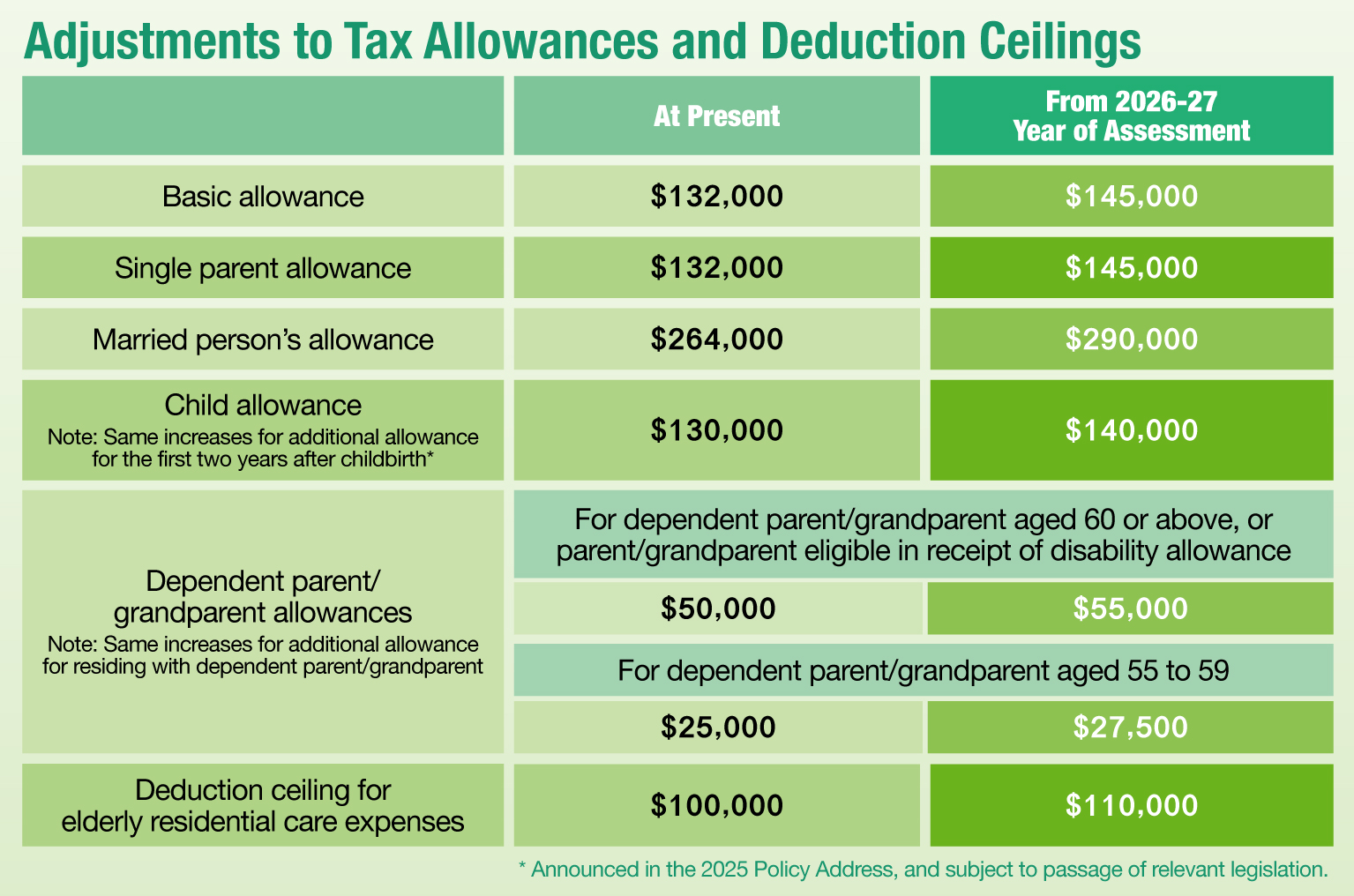
The government also plans to increase basic allowances from YA 2026-27, including those for single parents, children, and dependents. The deduction ceiling for elderly residential care expenses will also be raised for taxpayers whose parents or grandparents are admitted to eligible residential care homes.
These changes were announced in the 2025 Policy Address issued in September and will be subject to the passing of relevant legislation.
Raising stamp duty and implementing Pillar Two Global Minimum Tax
The government will also implement two tax schemes to increase revenue: an increase in stamp duty on residential property and the implementation of the 15 percent Global Minimum Tax under the OECD’s BEPS 2.0 framework.
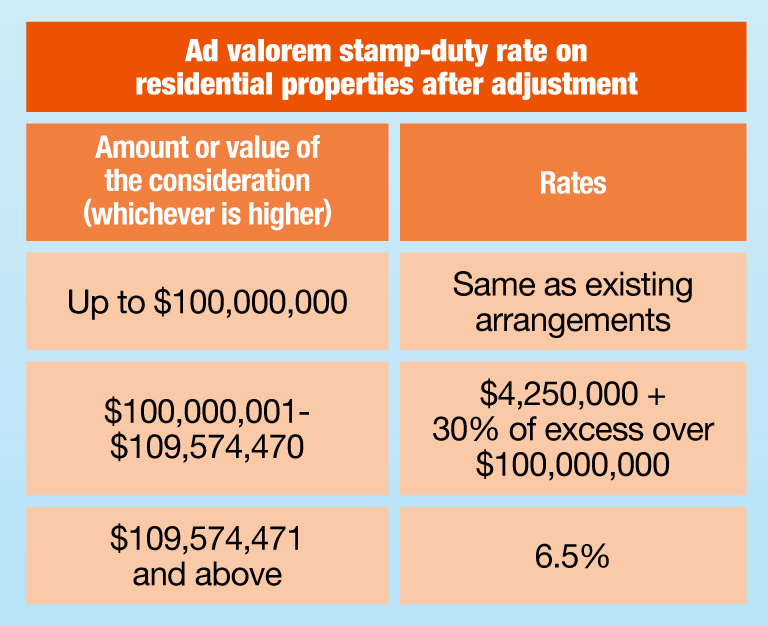
With retrospective effect from February 26, 2026, upon passage of the amendment bill by the LegCo, stamp duty rates on residential property transactions valued above HK$100 million (US$12.8 million) will be raised from 4.25 percent to 6.5 percent. This will affect about 0.3 percent of residential property transactions, and will increase revenue by about HK$1 billion (US$127.9 billion) per year.
Meanwhile, the government will also continue to implement the Pillar Two Global Minimum Tax under the OECD’s BEPS 2.0 framework. In 2025, Hong Kong amended the Inland Revenue Ordinance to align with the requirements of the Pillar Two GloBE Rules, with the rules applying to fiscal years beginning on or after January 1, 2025. Under the rules, multinational enterprise (MNE) groups with consolidated annual revenue of at least €750 million are required to pay top-up taxes if their effective tax rate falls below the minimum 15 percent.
According to the Secretary, the implementation of these rules is expected to bring in an additional HK$15 billion (US$1.9 billion) in tax revenue per year starting from FY 2027-28.
Support for businesses and SMEs
As announced in the 2025 Policy Address, the government will roll out preferential policy packages in the coming year to support businesses and investment. The government has now formulated a preliminary framework that will take into consideration the potential positive impact a business may have on Hong Kong, including its industry, technology level, and potential economic and employment contributions.
According to Chan, the policy tools will include land grant arrangements, financial subsidies, and tax incentives, with preferential tax rates being levied either at a half‑rate or 5 percent. An amendment bill will be introduced in 2026 to implement these packages.
Separately, the government has also announced a series of other tax policies to support businesses in 2026, with some already in place. These policies include:
- Introduce legislation in 2026 to provide tax deduction arrangements for capital expenditure in purchasing intellectual property
- Allocate HK$28 million (US$3.6 million) for the Hong Kong Technology and Innovation Support Centre to provide patent evaluation and implement a two-year Pilot Patent Valuation Support Scheme
- Allocate HK$52 million (US$6.6 million) for the Intellectual Property Academy on a two-year pilot basis
- Inject a further HK$200 million (US$25.6 million) into the Dedicated Fund on Branding, Upgrading and Domestic Sales (BUD Fund), which assists Hong Kong-based companies in capitalizing on opportunities in the Chinese Mainland and ASEAN countries, and raise the funding ceiling of “Easy BUD” to HK$150,000 per application.
- Continue to provide loan guarantees to enterprises through the SME Financing Guarantee Scheme, and increase the total loan guarantee commitment under this scheme by HK$20 billion (US$2.6 billion). Additionally, extend the application period for the 80% Guarantee Product to the end of March 2028 and the application period for the principal moratorium arrangement to mid-November this year.
Policies priorities for industry development
AI and strategic industries
The Budget places considerable emphasis on expanding the development and utilization of AI, outlining ambitions to develop local AI capabilities and increase adoption, and more broadly to “popularise the understanding and use of AI by all levels of society”.
As part of this drive, the Secretary has announced that he will establish and chair a Committee on AI+ and Industry Development Strategy, which will be responsible for formulating plans and strategies to foster industry development as well as the transformation and development of industries through AI.
The government will also allocate HK$50 million (US$6.4 million) to an initiative to enhance AI literacy, in which public institutions will organize AI application courses, seminars, and competitions for the public to enhance “their AI awareness and application skills, and to be responsible AI users”. Civil servants will also be required to undergo AI training.
HK$100 million (US$12.8 million) will also be earmarked for the newly-established AI Efficacy Enhancement Team, which will help to “accelerate Government digital technol AI technologies to “accelerate Government digital transformation with leading technologies”.
Infrastructure, industrialization, and strategic industries
Another focus of the budget is industrialization and infrastructure development. Though the city’s services sector – in particular financial services – have traditionaly underpinned the economy, the government is now seeking to expand its high-end manufacturing footprint, most notably by earmarking HK$220 million (US$28.1 million) to establish the “first national manufacturing innovation centre outside the Mainland”. The facility, which will be built at Yuen Long InnoPark, will be led by the Hong Kong Microelectronics Research and Development Institute and focus on semiconductor R&D.
In 2026, the government will also launch the New Industrialisation Elite Enterprises Nurturing Scheme to support targeted high-growth enterprises and nurture emerging and future industry companies, and has introduced a HK$10 billion (US$1.3 billion) Innovation and Technology Industry Oriented Fund for investment in emerging fields such as life and health technology, AI and robotics, and future industries.
In the realm of infrastructure development, the government has allocated HK$1 billion for the Construction Innovation and Technology Fund to promote I&T’s industry-wide application, and HK$100 million for the Building Technology Research Institute to support studies reviewing construction standards and exploring AI applications.
Trade and logistics
Hong Kong will seek to further strengthen its position as a major trade and logistics hub by deepening collaboration with countries in the Global South, in particular. In his speech, Chan stated that Hong Kong will explore the signing of investment agreements with Saudi Arabia and Egypt, after having already concluded negotiations on such agreements with Qatar, Bangladesh, and Peru, and will seek to further expand its network of Comprehensive Avoidance of Double Taxation Agreements (CDTA).
The city will also seek to expand its position as an international aviation hub by entering into new air services agreements and expanding traffic rights with regions such as the Middle East, Central Asia, Africa, and South America, while further aligning with the national maritime development strategy to elevate its status as an international maritime centre.
The Budget outlines specific initiatives to develop the maritime industry in 2026, including:
- Establish an Economic and Trade Office (ETO) in Kuala Lumpur and expand the ETO coverage to Latin America and Central Asia
- Introduce an amendment bill in the first half of the year to enhance tax concession measures for the maritime service industry and provide a half‑rate tax concession to eligible commodities traders.
- Introduce an amendment bill to improve existing ship registration arrangements, including permitting dual registration to cater to the diverse operating models of international maritime enterprises.
- Through legislative amendment to be introduced this year, provide government subsidies of around HK$34 million (US$4.3 million) to provide port dues concessions for vessels powered by green fuel, as well as those carrying green fuels, to develop Hong Kong as a green maritime fuel bunkering and trading center.
- Amend relevant legislation to extend current arrangements under the Air Transhipment Cargo Exemption Scheme to other sea transhipment and sea-air transhipment modes in order to facilitate more inland cargo for export through Hong Kong.
- Launch the Future Innovative Logistics Acceleration Scheme to drive the transformation of the logistics industry, enhance the interconnectivity of logistics data, and develop Hong Kong into an international smart logistics hub.
Alignment with the 15th Five-Year Plan
In his speech, Chan stated that Hong Kong “must embrace the 15th Five-Year Plan with an innovative mindset, fostering new quality productive forces in accordance with local conditions”, invoking the Chinese mainland policy term for innovative and emerging industries.

The 15th Five-Year Plan proposals, which outline the fundamental principles for the development plan that will be officially implemented following the Two Sessions meetings in March, call for promoting “the long-term prosperity and stability of Hong Kong and Macao” and for supporting the further integration of the development of the two special administrative regions with the rest of the country.
The proposals also specifically call for strengthening cooperation in areas such as trade, science and technology, and culture, as well as supporting Hong Kong in building an international innovation and technology center.
In his speech, Chan announced that Hong Kong will, for the first time, formulate its own five-year plan, to be drawn up by a “cross-bureau, cross-departmental task force” with him at the helm. While no further details were provided on the content of this plan, he separately outlined several areas in which Hong Kong will support the implementation of the Mainland’s 15th Five-Year Plan, including:
- Leveraging Hong Kong’s strong basic research capabilities, strengths in innovative industries such as AI, and position as an international finance center, contribute to building a modernized industrial system and accelerate China’s technological self-reliance.
- Leveraging its unique position as an autonomous transport and logistics hub under the “One Country, Two Systems” principle to foster two-way trade and investment, serve as a connecting platform for companies to go global and to bring in foreign investment.
- Attract high-end talent from around the world and nurture local talent and expertise through its universities and international environment.
While China’s 31 mainland provinces, municipalities, and autonomous regions are required to formulate their own local five-year plans modelled after the national document, in the years since the handover from Britain, Hong Kong has implemented economic plans through a range of mechanisms such as annual policy addresses, industry-specific plans, and longer-term development initiatives.
The decision to launch its own five-year plan, which will presumably be similarly modelled after the national plan, suggests a more proactive effort to align its medium-term development strategy with Beijing’s policy priorities. This means Hong Kong will increasingly focus on the issues that are important to Beijing – as indicated in Chan’s speech – including technological advancement and self-sufficiency, in particular in areas such as AI and semiconductors, as well as industrial upgrading, boosting domestic consumption, and RMB internationalization.
About Us
China Briefing is one of five regional Asia Briefing publications. It is supported by Dezan Shira & Associates, a pan-Asia, multi-disciplinary professional services firm that assists foreign investors throughout Asia, including through offices in Beijing, Tianjin, Dalian, Qingdao, Shanghai, Hangzhou, Ningbo, Suzhou, Guangzhou, Haikou, Zhongshan, Shenzhen, and Hong Kong in China. Dezan Shira & Associates also maintains offices or has alliance partners assisting foreign investors in Vietnam, Indonesia, Singapore, India, Malaysia, Mongolia, Dubai (UAE), Japan, South Korea, Nepal, The Philippines, Sri Lanka, Thailand, Italy, Germany, Bangladesh, Australia, United States, and United Kingdom and Ireland.
For a complimentary subscription to China Briefing’s content products, please click here. For support with establishing a business in China or for assistance in analyzing and entering markets, please contact the firm at china@dezshira.com or visit our website at www.dezshira.com.
- Previous Article China’s MIIT Introduces New Technology Contract Registration Requirements for 2026
- Next Article US-China Relations in the Trump 2.0 Era: A Timeline