Other Briefings
Post-M&A Integration in China: Where Most Deals Fail – and How to Get It Right
Post-M&A integration is where most China deals ultimately succeed or fail, as operational, cultural, and governance challenges emerge after closing. A structured, cross-functional approach helps investors manage these risks and turn acquisitions into sustainable success.
The uncomfortable reality in China M&A is that value erosion rarely originates in deal structuring or due diligence. Instead, it emerges after closing, when operational realities begin to diverge from the transaction model, and management attention is consumed by challenges that were underestimated, deferred, or simply not visible during the deal process.
Post-acquisition integration is where transactions truly succeed or fail.
Integration starts early, but does not end in 100 days

Effective integration begins during due diligence, not after signing. While most acquirers now recognize the need for a pre-closing integration roadmap, too many still treat integration as a short-term exercise limited to the first 100 days.
In practice, early-stage planning, covering operational control, workforce communication, financial reporting alignment, systems integration, and key customer and supplier continuity, is only the starting point. Assumptions made at the deal stage frequently prove incomplete once tested against live operating conditions.
Successful acquirers take a different approach. They treat integration as a phased and evolving process:
- Phase 1: Stabilization – securing business continuity and minimizing disruption immediately post-closing
- Phase 2: Alignment – implementing group standards across governance, reporting, and operations
- Phase 3: Optimization – continuous performance tracking, refinement, and corrective intervention
This model recognizes that integration risks do not disappear after transition—they simply become operational.
Human factor: Bridging governance and local reality
Delivering successful integration in China requires experienced post-acquisition managers who can operate across two environments simultaneously:
- The foreign parent’s governance, compliance, and reporting expectations
- The local Chinese operating environment, where informal structures and relationship-driven practices are often embedded
These managers must remain actively engaged well beyond the initial transition period, ensuring that integration measures are not only implemented but also sustained and adjusted as needed.
Cultural integration is not a one-time exercise
Cultural integration is often underestimated and treated as a one-off alignment exercise. In China, this is a critical misstep.
Founder-led businesses frequently rely on:
- Informal decision-making structures
- Personal authority and relationship-based management
- Long-tenured employees with undocumented operational knowledge
This creates a unique integration challenge. Preserving institutional knowledge while introducing group-level controls, reporting discipline, and accountability requires a balanced approach:
- Cultural sensitivity to maintain continuity and trust
- Operational rigor to meet international standards
- Intervention capability when initial integration efforts do not deliver
Without sustained attention, cultural misalignment can quietly undermine performance long after closing.
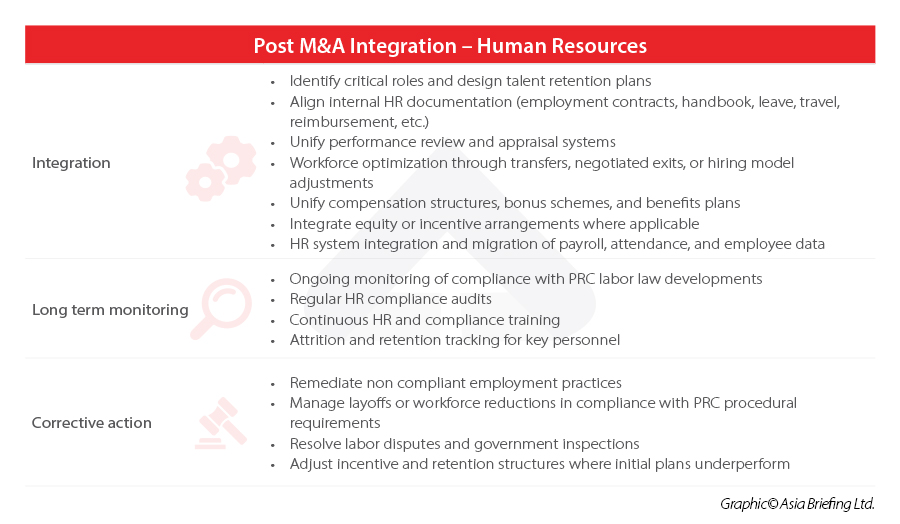
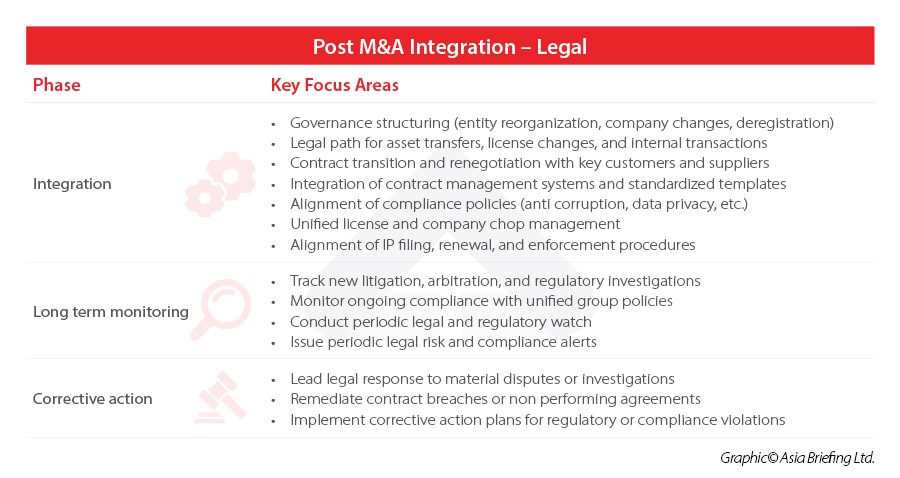
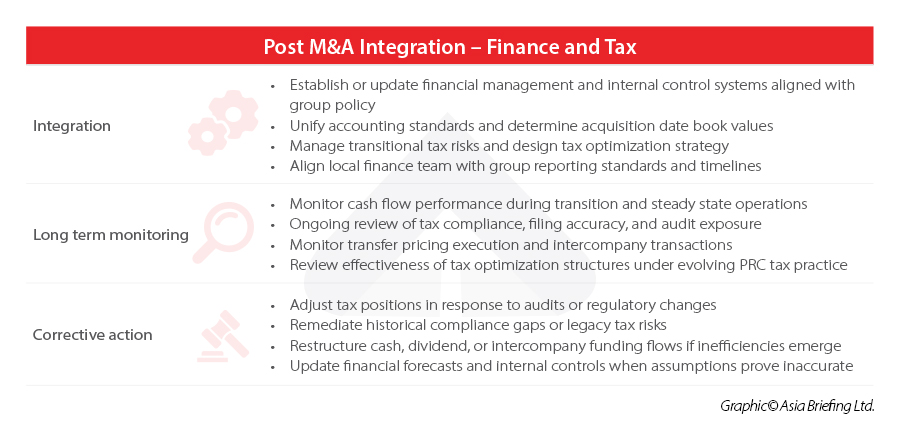
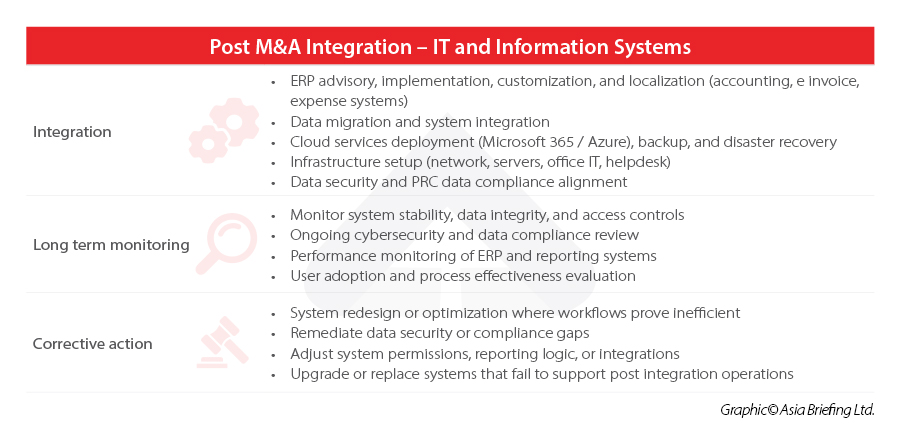
Post-M&A integration: Functional priorities
Effective integration requires coordination across multiple business functions. In China, the complexity lies not only within each function but also in how they interact.
The full-service advantage in China M&A
China manufacturing acquisitions sit at the intersection of legal, financial, operational, and regulatory complexity. It is precisely at this intersection where most deal risks and integration failures arise.
- A tax-efficient structure may create operational constraints
- A legal risk identified in due diligence may impact valuation assumptions
- An operational integration plan may conflict with labor law requirements
Advisory teams that operate in silos often fail to capture these interdependencies.
In contrast, integrated advisory platforms combining legal, tax, HR, and financial expertise deliver measurably stronger outcomes. By aligning these disciplines throughout the transaction lifecycle, they enable:
- Faster deal execution
- Reduced post-closing surprises
- More effective and sustainable integration
This integrated approach is particularly critical in China, where regulatory complexity and operational nuance demand coordinated, cross-functional execution.
How Dezan Shira & Associates can help
Dezan Shira & Associates, an Ascentium company, provides end-to-end M&A advisory support across all stages of the deal lifecycle, including target evaluation, due diligence, financial and tax modeling, regulatory compliance, and transaction execution.
Our blended advisory teams integrate in-house legal, tax, HR, and financial expertise to deliver cohesive, insight-driven solutions for both buy-side and sell-side projects, ensuring transactions are not only completed but positioned for long-term success.
To learn more about our service, please click here.



Navigating M&A transactions in Asia involves regulatory challenges, limited transparency, and complex market entry conditions. Our mergers and acquisitions advisory team delivers strategic, cross-functional support to help clients identify value-driven targets, manage risk, and build strategic partnerships across the region.
About Us
China Briefing is one of five regional Asia Briefing publications. It is supported by Dezan Shira & Associates, a pan-Asia, multi-disciplinary professional services firm that assists foreign investors throughout Asia, including through offices in Beijing, Tianjin, Dalian, Qingdao, Shanghai, Hangzhou, Ningbo, Suzhou, Guangzhou, Haikou, Zhongshan, Shenzhen, and Hong Kong in China. Dezan Shira & Associates also maintains offices or has alliance partners assisting foreign investors in Vietnam, Indonesia, Singapore, India, Malaysia, Mongolia, Dubai (UAE), Japan, South Korea, Nepal, The Philippines, Sri Lanka, Thailand, Italy, Germany, Bangladesh, Australia, United States, and United Kingdom and Ireland.
For a complimentary subscription to China Briefing’s content products, please click here. For support with establishing a business in China or for assistance in analyzing and entering markets, please contact the firm at china@dezshira.com or visit our website at www.dezshira.com.
- Previous Article EU-China Relations After the 2024 European Elections: A Timeline
- Next Article