Other Briefings
Building and Maintaining Tax Health in China: A Complete Guide for Foreign Companies
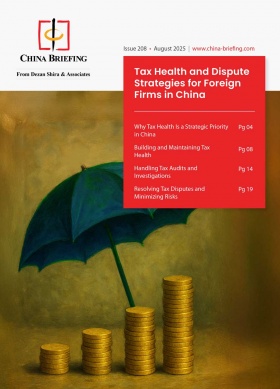
Building and maintaining tax health in China requires robust planning, accurate implementation, and regular reviews. In this article, we outline practical, high-impact strategies that foreign companies can adopt to build a strong, efficient, and low-risk tax posture in China.
As discussed in our previous article, “Tax Health in China: A Strategic Imperative for 2025 and Beyond”, the concept of “tax health” has become increasingly important for foreign-invested enterprises (FIEs) operating in China’s evolving tax landscape. To safeguard operations and minimize tax exposure, companies must move beyond basic compliance and adopt a proactive, structured approach to tax management. The article provides practical guidance on how to build a strong, low-risk tax posture in China.
Defining tax health
In today’s China, tax health goes beyond simple compliance. Instead, it reflects the overall strength, stability, and defensibility of a company’s tax position in the eyes of regulators. From our experience working with FIEs, a company’s tax health is best evaluated through three interrelated pillars:
- Efficiency: A tax-healthy company makes strategic use of available tax incentives, exemptions, and deferrals to lawfully reduce its tax burden and improve liquidity. Equally important, however, is ensuring that tax rules are correctly interpreted and applied. Misunderstanding policies or adopting overly conservative positions can result in unnecessary overpayment of taxes – an avoidable cost in a competitive market.
- Risk control: This involves proactively identifying potential exposures, managing uncertain or sensitive tax positions through advance rulings, and implementing robust internal controls to prevent errors and inconsistencies.
- Credibility: Under China’s credit-based tax administration model, credibility matters. Companies that demonstrate a history of timely and accurate filings, full disclosure, and constructive engagement with tax authorities are more likely to benefit from streamlined procedures and preferential treatment. Strong credibility translates into fewer inspections, quicker refund processing, and eligibility for “green channel” policy privileges.
To put it simply, a truly “tax healthy” company should excel across all three dimensions. It maintains strong internal systems to manage risk, actively pursues lawful savings opportunities, and cultivates regulatory goodwill, positioning itself as a trusted taxpayer in the local jurisdiction.
Strategies for building and maintaining tax health in China
Tax health is not achieved through a single compliance task – it requires continuous attention, strategic planning, and cross-functional coordination. This section outlines a set of focused, high-impact actions that foreign companies can take to strengthen their tax posture across the three core dimensions of tax health. While not exhaustive, the strategies below reflect best practices observed among well-managed FIEs in China.
Strengthen internal tax governance
Effective tax governance starts with structure and accountability. FIEs should establish clearly defined roles and responsibilities for tax matters across departments, supported by documented procedures for tax-sensitive decisions such as pricing, cost allocations, incentive applications, and restructurings. A sound governance framework ensures that tax is embedded into operational planning – not handled reactively. At a minimum, this includes:
- Appointing a tax lead or internal owner for oversight and coordination;
- Establishing review and escalation mechanisms for tax-related risks; and
- Ensuring regular cross-department communication between finance, HR, and legal.

By institutionalizing tax risk management, companies are better positioned to identify exposures early, respond to regulatory changes, and avoid inconsistent or isolated decision-making.
For smaller FIEs or those newly entering the China market, who may not yet have a full-fledged finance or tax team in place, engaging a third-party virtual CFO service can be a practical and cost-effective solution. This arrangement allows companies to assign a dedicated tax professional to serve as their interim tax head, filling critical governance and compliance gaps. This will ensure tax obligations are properly managed and help the business build a scalable structure that aligns with China’s regulatory expectations from the outset.
Leverage digital tools to enhance compliance and control
As China’s tax administration becomes increasingly digitalized, it’s also important for FIEs to leverage technologies to strengthen compliance, improve control, and drive efficiency. Manual processes or siloed systems increase the risk of discrepancies, late filings, and overlooked risks.
Leveraging digital tools in tax management usually involves deploying relevant systems, such as ERP, or integrating relevant technologies, such as AI capabilities, to enhance their internal tax and accounting management, which are usually capable of supporting real-time reporting and auditability. Key areas to focus on include:
- Integrating ERP systems with Golden Tax System interfaces;
- Automating value-added tax (VAT)-related processes, such as fapiao collection, validation, and cross-checking; and
- Using anomaly detection tools to flag inconsistencies in employee expenses, intercompany transactions, or declaration patterns.
By building a strong digital foundation, companies can minimize human error, streamline tax operations, and stay ahead of audit risks in China’s data-driven compliance landscape.
To be noted, while a unified, company-wide digital system offers comprehensive automation, modular and progressive automation and digitalization are practical solutions for small and medium-sized enterprises facing cost constraints.
Example: ERP-as-a-service – A ready-built, one-stop ERP solution In contrast to more complex ERP localization efforts – such as customizing a global ERP system for China – ERP-as-a-service provides a ready-built, cloud-hosted ERP platform delivered by a service provider. This model allows businesses to access ERP functionalities over the Internet and pay through a monthly or annual subscription, commonly referred to as Software-as-a-Service (SaaS) ERP. ERP-as-a-service providers handle configuration, maintenance, upgrades, data security, and hosting, allowing businesses to focus on operations while benefiting from: This solution is particularly well-suited to smaller enterprises seeking the advantages of integrated business processes without the complexity and cost of full-scale ERP implementation. However, it should be noted that ERP-as-a-service may offer limited customization. Companies requiring highly tailored functionality may need to weigh this limitation against the cost and speed advantages.
Maximize preferential tax policies – with discipline
China offers a broad array of tax incentives for eligible enterprises to incentivize or encourage a particular economic activity, including tax exemptions, reductions, lower rates, refunds, credits, and deferrals. While these incentives can significantly improve a company’s tax efficiency, improper application or insufficient documentation may result in claw-backs, penalties, or reputational risks. FIEs must therefore approach incentive planning with precision and discipline.
For most preferential tax policies, taxpayers may self-assess their eligibility and directly apply the benefit at the time of pre-payment or final settlement, without needing prior approval from the tax bureau. However, a correct and up-to-date understanding of eligibility criteria is essential.
For FIEs, maintaining tax health means ensuring that:
- All eligible incentives are fully and accurately claimed;
- Incentives are not misapplied due to a misunderstanding of qualifying conditions; and
- Supporting documentation is properly retained in anticipation of future tax bureau reviews.
To successfully benefit, companies should conduct a feasibility analysis, maintain comprehensive supporting documents (including payroll, contracts, and R&D records), and align claims with financial statements. Importantly, companies must avoid common mistakes such as:
- Relying on outdated qualification criteria;
- Inconsistencies between financial and tax declarations; and
- Failing to report in accordance with the required timeline.
Precision, not aggressiveness, is the hallmark of sustainable tax efficiency.
Conduct regular tax health self-assessments
Internal tax health reviews are another effective tool for identifying hidden exposures, preventing costly errors, and improving readiness for tax audits. While the strategies introduced earlier are all essential components of a sound tax management strategy, regular tax health checkups serve a distinct and indispensable function: they bring all the moving parts together into a structured, forward-looking review process.
To be more specific, a tax health check provides a comprehensive, internal checkpoint that evaluates whether all tax systems, decisions, and practices are actually working together as intended. It helps companies:
- Detect unintended gaps or mismatches, for example, between ERP-generated data and manual tax filings, or between incentive claims and the underlying financial records;
- Test the effectiveness of controls and compliance routines that may otherwise be assumed to be functioning correctly;
- Reassess risk areas that evolve over time, such as new intercompany transactions or changes in business models, which may introduce exposure not covered by existing systems or routines;
- Identify inconsistencies that only surface across functions, such as HR, procurement, and finance—something digital tools or isolated workflows may not flag; and
- Proactively correct issues before they escalate, instead of discovering them reactively through audits, system failures, or missed deadlines.
In short, tax health reviews are not just another control – they are the coordinating mechanism that ensures all tax-related activities remain aligned, accurate, and adaptable. Without this regular self-check, even the most well-designed systems and incentives can become blind spots over time.
What to include in a tax health review
A well-designed tax health assessment should cover all high-risk and high-value areas of a company’s tax operations. For FIEs, typical focal points include:
- Tax filing and reporting processes: Evaluating whether deadlines are met, systems are properly integrated, and roles and responsibilities are clearly defined across departments.
- VAT compliance: Reviewing the consistency and accuracy of VAT fapiao issuance, input verification, and offset calculations to ensure alignment between transaction records and tax declarations;
- Transfer pricing: Assessing whether intra-group transactions follow the arm’s-length principle and are supported by up-to-date local file documentation, especially in light of China’s heightened scrutiny of intangible assets and service charges;
- Cross-border payments: Verifying the correct application of withholding tax on outbound payments, such as service fees, interest, royalties, and dividends, and ensuring proper documentation (for example, contracts, tax residency certificates) is in place; and
- Incentive eligibility: Confirming qualification for and compliance with preferential policies, such as R&D super deductions or reinvestment deferral benefits, with supporting materials properly retained for future audits.
Who should conduct the assessment, and how often
Ideally, tax health reviews should be conducted annually. For more complex operations or during periods of significant business change, such as restructuring, expansion, or changes in personnel, mid-year or ad hoc reviews may also be warranted.
The assessments can be led by an internal finance or tax function, if sufficiently resourced, but external advisors are often engaged to bring in fresh perspectives, benchmark practices against industry standards, and ensure alignment with the latest tax enforcement trends. Small or newly established FIEs without an in-house tax team may consider appointing a third-party advisor or leveraging virtual CFO or tax director services to conduct the review.
Turning assessment into action
Tax health checks should not be treated as a box-ticking exercise. Findings should be documented and prioritized based on severity and impact, with clear follow-up actions and timelines for remediation. Moreover, patterns observed in recurring issues may indicate broader gaps in internal processes, system integration, or training, and present an opportunity to enhance overall governance and efficiency.
By conducting regular tax health assessments, companies gain the confidence of knowing they are operating within regulatory boundaries while also identifying opportunities to optimize tax positions, reduce unnecessary costs, and maintain credibility with tax authorities.
Proactively build credibility with local tax authorities
In China’s credit-based tax management regime, a company’s track record directly affects how it is treated by tax bureaus. High-credit taxpayers are more likely to enjoy administrative convenience, policy access, and reduced audit scrutiny. Key practices for strengthening tax credibility include:
- Ensuring timely, complete, and accurate filings across all tax types;
- Maintaining transparent and well-organized documentation that can withstand inspection;
- Demonstrating a constructive attitude during audits or inquiries; and
- Proactively engaging with tax authorities when making material changes (such as restructuring, large-scale incentives, or changes in business model).
Long-term relationships with local tax officials, built on trust and professionalism, can offer valuable support in interpreting policies or resolving ambiguities in grey areas.
|
Practical Measures to Build and Maintain Tax Health in China |
|
| Dimension | Key measures |
| Risk control | • Conduct regular, structured tax health checks covering key risk areas—such as transfer pricing, VAT invoicing, R&D claims, and outbound payments—to identify potential exposures early; • Seek advance rulings or clarifications from tax authorities when dealing with ambiguous or high-value transactions; • Establish automated checks within financial systems to flag inconsistencies or anomalies in real time (e.g., mismatches between fapiao issuance and accounting records); • Strengthen internal controls through SOPs and periodic reviews, especially around intercompany charges and employee benefits reporting. |
| Efficiency | • Review eligibility for national and local tax incentives regularly (e.g., high-tech enterprise status, super deductions, regional subsidies), and maintain documentation to support qualification; • Analyze cross-border business flows to utilize tax deferral or exemption mechanisms, such as those available for reinvested profits or treaty benefits; • Coordinate with business and finance teams to ensure tax policies are interpreted correctly—avoiding common pitfalls like missing out on VAT exemptions or overpaying due to outdated assumptions; • Reassess organizational structures periodically to ensure alignment with evolving tax-efficient practices (e.g., IP location, cost-sharing arrangements). |
| Credibility | • Maintain a spotless filing and payment history through disciplined internal timelines and multiple layers of review before submission; • Engage proactively with local tax officers through regular communication, status updates, and prompt, transparent responses to inquiries; • Monitor the company’s tax credit rating, address any deductions in real time, and aim to achieve Class A status, which grants access to simplified compliance procedures and reduced scrutiny; • Participate in government pilot programs or voluntary disclosure initiatives to demonstrate commitment to good-faith tax governance. |
Case spotlight
A European manufacturer operating in eastern China conducted a routine internal tax health check shortly after expanding its operations to a second city. Though the company maintained generally sound compliance, the internal review, led by its finance team in coordination with an external tax advisor, revealed discrepancies between the issuance of VAT fapiao and revenue recognition timelines in its ERP system.
The issue stemmed from inconsistent practices between its two branches: one location issued fapiao based on shipment dates, while the other relied on invoicing dates. This mismatch led to inaccurate monthly VAT filings that had gone unnoticed for several quarters. Though the financial impact was not immediately significant, the risk of audit-triggered penalties and late payment surcharges was real.
By identifying the issue early through the health check, the company was able to:
- Reconcile discrepancies and file corrected declarations with the local tax bureau;
- Avoid penalties by proactively disclosing the issue before any formal audit was initiated; and
- Standardize internal procedures and ERP configurations to ensure consistent VAT treatment across locations.
This case highlights the value of proactive tax risk detection. A self-initiated health check not only uncovered a hidden compliance vulnerability but also provided the company with a learning opportunity to strengthen internal controls. It also built credibility with local tax authorities by demonstrating a responsible and transparent tax governance posture.
Tax Health Checks and Risk Reviews
Dezan Shira & Associates’ tax advisory professionals can assist with identifying hidden exposures, validating incentive claims, improving documentation, and aligning internal controls with evolving tax rules. To learn how we can help your business, please contact: China@dezshira.com
About Us
China Briefing is one of five regional Asia Briefing publications. It is supported by Dezan Shira & Associates, a pan-Asia, multi-disciplinary professional services firm that assists foreign investors throughout Asia, including through offices in Beijing, Tianjin, Dalian, Qingdao, Shanghai, Hangzhou, Ningbo, Suzhou, Guangzhou, Haikou, Zhongshan, Shenzhen, and Hong Kong in China. Dezan Shira & Associates also maintains offices or has alliance partners assisting foreign investors in Vietnam, Indonesia, Singapore, India, Malaysia, Mongolia, Dubai (UAE), Japan, South Korea, Nepal, The Philippines, Sri Lanka, Thailand, Italy, Germany, Bangladesh, Australia, United States, and United Kingdom and Ireland.
For a complimentary subscription to China Briefing’s content products, please click here. For support with establishing a business in China or for assistance in analyzing and entering markets, please contact the firm at china@dezshira.com or visit our website at www.dezshira.com.
- Previous Article 了解印度税制:其与中国的主要差异
- Next Article EU-China Relations After the 2024 European Elections: A Timeline