Other Briefings
Green Product Labeling and Certification in China – Why and How to Do It
China green product labeling standards provide companies with a voluntary but increasingly strategic framework for demonstrating environmental compliance and sustainability credentials. As China advances toward its dual carbon targets, the voluntary system may transition into a mandatory requirement, making early certification a smart move for companies looking to stay ahead of regulation and stand out among eco-conscious consumers and clients.
China’s green product assessment standards provide a benchmark for evaluating the energy efficiency, environmental impact, resource consumption, and overall sustainability of products across a wide range of industrial and consumer categories.

While these assessment standards are currently voluntary, a mandatory assessment system may be imposed in the coming years as the country seeks to meet its dual carbon targets of reaching peak carbon emissions by 2030 and net zero by 2060.
At the same time, the standards provide a useful benchmark for companies that are already integrating sustainability standards into their current production chains, while helping to incentivize developers and producers to innovate to reduce the environmental impact of their products by providing benchmarks for efficiency and quality.
China’s green product labeling and certification
To obtain a green product label, a product must undergo certification by a third-party certification body.
A green product label proves that a product meets the green evaluation standards for a specific product or attribute. This includes both compliance with mandatory regulations and industry standards, as well as additional voluntary efficiency and environmental protection standards.
There are two main types of green product labels in China:
- Full green product certification: assessment by a certification body to determine whether all green attributes of a product meet the green product evaluation standards; and
- Partial green product certification: assessment by a certification body to determine whether certain green attributes of a product meet the green product evaluation standards.
Other types of environment labels, such as the China Environmental Label or the Green Building Materials Grading Certification Mark, may also be required.
A company must obtain a green product certificate before it can use the green product label on its products.
Green label logo and placement
The corresponding full or partial green product label must be placed on the product alongside the logo of the certification agency.
The two different types of green product labels are:
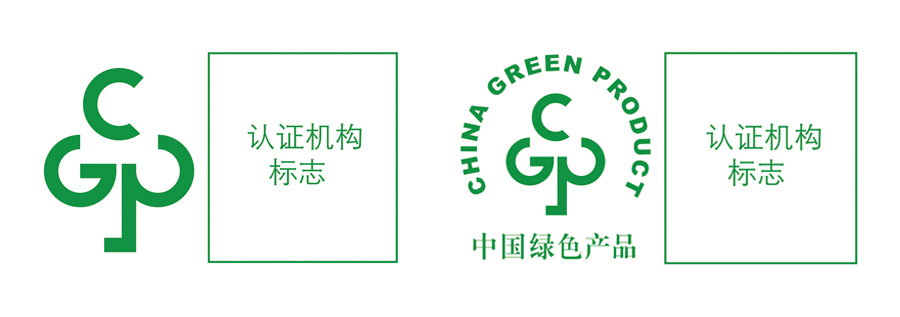
China’s Green Product Labels – Partial (Left) and Full (Right)
The green product label is usually green and can be enlarged or reduced proportionally, but must be clearly identifiable after placement.
Except where specific requirements are in place, certified companies can choose any manufacturing process to affix the green product logo, such as printing or molding, and can be affixed to the product itself, nameplate, packaging, and accompanying documents such as instruction manuals, certificates of conformity, and CDs. The label can also be displayed in prominent locations on operating systems and online sales platforms.
For products that have obtained both full and partial certifications, only the full certification label needs to be displayed. However, if multiple certification bodies were involved, the labels of all certification bodies should be displayed.
How are green products certified in China?
Certification is conducted based on product-specific assessment standards. To date, China has released 47 product-specific green assessment standards covering both industrial and commercial products, including cement, computers, household electric appliances, industrial refrigeration and air conditioning equipment, photovoltaic modules, textiles, footwear, and furniture.
In 2024, China issued the General Principles for Green Product Assessment, which specifies the basic principles, evaluation indicators, evaluation methods, and content framework for the product-specific evaluation standards.
While the standards are not mandatory, they do include compliance with mandatory environmental laws and regulations and industry standards, as a baseline requirement. The standards are based on an indicator system that covers:
- Basic requirements, including compliance with energy conservation and environmental protection laws and regulations, technological processes, management systems, and relevant product standards;
- Evaluation indicators, including five categories of primary indicators: resource, energy usage and efficiency, environmental impact, product quality, and carbon footprint; secondary indicators apply under each primary indicator;
- Other requirements that manufacturers are encouraged to meet.
The basic requirements for manufacturing companies and their products, which cover the mandatory laws and regulations, include but are not limited to:
- The pollutant emission status of the manufacturer, which must comply with relevant environmental protection laws and regulations, and meet the requirements of national and local pollutant emission standards, and there must have been no Level II or a above safely accidents or pollution incidents in the past three years (as specified in the Regulations on the Reporting, Investigation and Handling of Work Safety Accidents and the Classification Standards for Sudden Environmental Incidents);
- Total pollutant emissions control of the manufacturing company must comply with national and local pollutant emission control targets;
- The management of the manufacturer must establish and operate a quality management system, environmental management system, and/or energy management system in accordance with standards GB/T19001, GB/T24001, and/or GB/T23331;
- Product quality must meet relevant national or industry standards.
The evaluation indicators cover the following five main areas:
- Resource usage and efficiency: focuses on indicators related to the reduction and recycling of raw materials, packaging materials, and water resources.
- Energy usage and efficiency: focuses on indicators related to energy conservation and energy efficiency during product production or use.
- Environmental impact: focuses on indicators related to pollutant emissions during production, as well as the limited use of toxic and hazardous substances during production and use.
- Product quality: focuses on indicators affecting product quality, such as durability, upgradeability, comfort, safety, and intelligence.
- Carbon footprint: focuses on indicators related to carbon footprint quantification, low-carbon raw materials, processes, technologies, and equipment.
Note that not all product-specific standards contain all of the above categories.
Production companies should meet relevant incentive requirements, including but not limited to:
- Using recycled or renewable raw materials;
- Establishing and operating a carbon emission management system;
- Implementing extended producer responsibility; and
- Using clean energy, such as green electricity.
Below is an example of the green product assessment indicators for footwear.
|
Green Product Evaluation Indicators – Footwear |
|||||
| Primary indicator | Secondary indicator | Green benchmark product value | Green product value | ||
| Resources | Leather and fur | Not derived from wild animals | |||
| Artificial and synthetic leather | Solvent-free | Solvent-free and/or water-based | |||
| Asbestos fibers | Not used | ||||
| Packaging | Cardboard and paper used for final packaging of footwear products made from at least 90% recycled materials; plastics used for final packaging of footwear products made from at least 80% recyclable materials. | ||||
| Packaging recycling labels must comply with the provisions of GB/T 18455. | |||||
| Environment | Adhesive | Solvent-based adhesive usage amount a/(g/pair) | Not used | ≤25 | |
| Percentage of solvent-based adhesives used* | 0 | ≤10% | |||
| Limits of hazardous substances | Solvent-based adhesives |
|
|||
| Waterborne polyurethane adhesives |
|
||||
| Waterborne adhesives (excluding waterborne polyurethane adhesives) |
|
||||
| Quality | Outsole abrasion resistance/wear mark length/mm |
|
|
||
| Bonding strength between outsole and outsole (g/(N/cm)) | ≥40 | ≥30 | |||
| Carbon footprint | Provides product carbon footprint reports | ||||
| Note: The above is an abridged version of the standards provided for informational purposes only. | |||||
How to apply for certification
A company seeking to apply for green product certification can choose a qualified certification body and apply for certification by submitting the required materials.
The approved certification agencies can be found through the directory maintained by SAMR.
The process for certification is generally as follows:
- The company chooses a certification agency and applies for certification, submits required materials
- Once the application is accepted, the certification agency arranges sample testing and on-site inspections of the company
- If the products meet the certification requirements, the agency issues a certificate
- The certification agency conducts post-certification surveillance of certified products and their manufacturing enterprises to ensure continued product compliance with the certification requirements
Companies are responsible for ensuring the continued compliance of products with the green compliance standards. If a product or its manufacturing enterprises fail to continuously meet the requirements, the certification agency will suspend or revoke the certificate and publicize this decision.
The certificate will include the following basic information:
- Name and address of the certification applicant
- Name and address of the producer
- Name and address of the manufacturing enterprise
- Product name, series, model, and specifications
- Certification basis
- Certification mode
- Date of issuance and validity period
- Issuing body
- Certificate number
- Certification information of key indicators of green attributes of the certified product
- Other contents that need to be marked
A green product certificate is valid for five years.
Why get your product certified as green?
While certification is currently voluntary, there are several compelling reasons to opt in early. First, green product certification, or a comparable certification system, may become mandatory in the future. As China tightens its environmental regulations, it is highly likely that the current voluntary framework will eventually give way to mandatory requirements for at least some product categories. The building of a more comprehensive system through the formulation of product-specific standards is the first step in establishing a mandatory system in the future.
It is likely such a mandatory system would be rolled out gradually, at first affecting heavily polluting and hard-to-abate industries, such as building materials, before being rolled out to high-emitting consumer products, such as household appliances, and finally to smaller consumer items.
Complying now with voluntary standards will make the transition to the mandatory system much smoother, giving companies time to identify gaps in their production processes and build familiarity with certification requirements before they become legally binding.
But besides the possibility of a future legal requirement, there are several sound commercial reasons for opting in early. On the consumer side, consumers are becoming increasingly aware of the environmental impact of their purchasing choices, and a green label can set products apart from those of competitors and help better inform eco-conscious individuals.
The benefits for industrial producers are equally significant: certification can set the company apart from competitors and provide a concrete, government-backed credential that supports procurement decisions and supplier qualification processes. This may be especially important for companies that export to markets where environmental standards may already be obligatory or where many end customers have their own ESG requirements to meet, as China’s green product certification provides a standardized, recognized basis for substantiating environmental claims in those markets.



Established companies require dependable solutions to ensure strong risk management and compliance. We help clients create sustainable value in Asia by better addressing their areas of operational, financial, and reputational risk. Our Compliance and Risk Management teams specialize in fraud prevention, financial statement audits, sustainability and ESG compliance, special purpose reviews, and risk adviory and fraud investigation.
About Us
China Briefing is one of five regional Asia Briefing publications. It is supported by Dezan Shira & Associates, a pan-Asia, multi-disciplinary professional services firm that assists foreign investors throughout Asia, including through offices in Beijing, Tianjin, Dalian, Qingdao, Shanghai, Hangzhou, Ningbo, Suzhou, Guangzhou, Haikou, Zhongshan, Shenzhen, and Hong Kong in China. Dezan Shira & Associates also maintains offices or has alliance partners assisting foreign investors in Vietnam, Indonesia, Singapore, India, Malaysia, Mongolia, Dubai (UAE), Japan, South Korea, Nepal, The Philippines, Sri Lanka, Thailand, Italy, Germany, Bangladesh, Australia, United States, and United Kingdom and Ireland.
For a complimentary subscription to China Briefing’s content products, please click here. For support with establishing a business in China or for assistance in analyzing and entering markets, please contact the firm at china@dezshira.com or visit our website at www.dezshira.com.
- Previous Article US-China Relations in the Trump 2.0 Era: A Timeline
- Next Article