Other Briefings
Entering China: The Most Important Setup Decisions for Manufacturing Businesses
Early setup choices in China manufacturing shape operational flexibility for years. From entity structuring to tax and employment frameworks, getting these decisions right at the outset avoids costly constraints that are difficult, and sometimes impossible, to reverse.
Every experienced China hand will tell you the same thing eventually: the decisions made in the first six months of setting up a China manufacturing operation have consequences that last for years. Entity structure, registered business scope, capital contribution plan, employment framework, tax registration sequencing – these are not administrative formalities but strategic decisions. And getting them wrong creates constraints that are expensive, time-consuming, and sometimes genuinely painful to undo.

The good news is that China’s foreign investment framework has become more transparent and, in important respects, more accessible in recent years. The 2024 revision to the Foreign Investment Negative List eliminated the last remaining restrictions on foreign investment in manufacturing, making 100 percent foreign ownership of operations now effectively available across most manufacturing subsectors. The Action Plan for Stabilizing Foreign Investment, released by the State Council in early 2025, reaffirmed Beijing’s commitment to expanding market access and treating foreign and domestic investors on equal terms in unrestricted sectors.
The challenge is not access – it is structure – and the difference between a well-structured entry and a poorly designed one is substantial.
Entity structure: More decisions than it appears
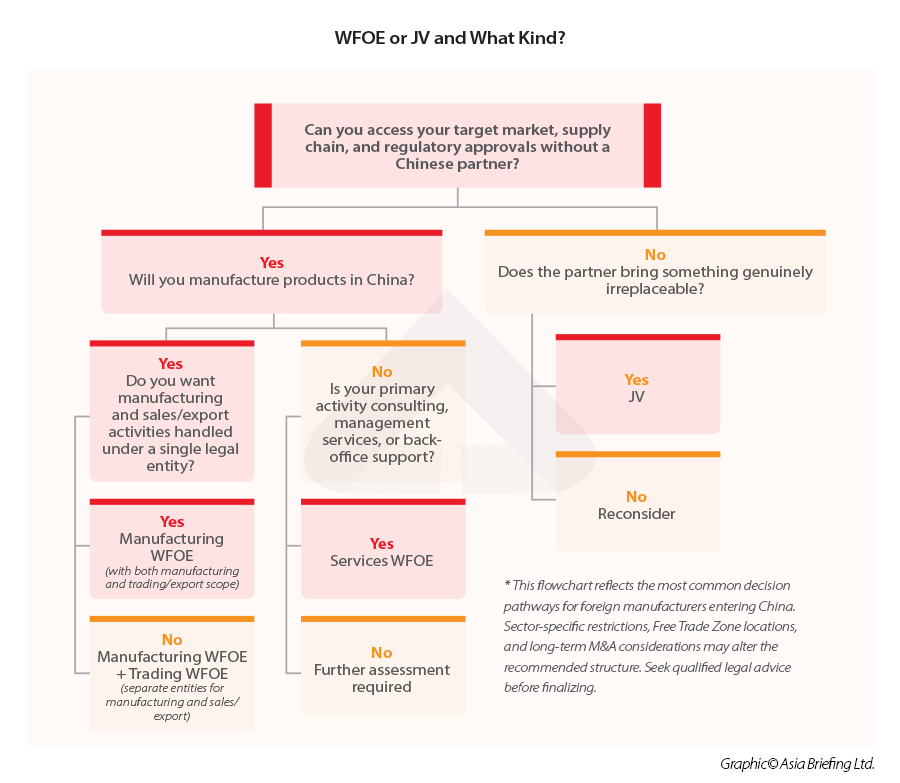
For foreign manufacturers entering China, the primary entity structure of choice typically comes down to a wholly foreign-owned enterprise (WFOE) or some form of joint venture (JV). In practice, the WFOE, established as a foreign-invested limited liability company (LLC) under China’s Company Law, has become the default choice for most manufacturers seeking operational control, clear intellectual property ownership, and straightforward profit repatriation. With manufacturing restrictions now eliminated from the Negative List, the WFOE path is cleaner and more accessible than it has ever been.
However, the WFOE-versus-JV decision, while significant, is only part of the structural equation. Within the WFOE framework itself, a range of additional considerations require careful planning – yet are often treated as secondary details rather than the strategic variables they are.
Registered capital and the five-year contribution rule
The revised Company Law, effective July 2024, requires newly established LLCs, including manufacturing WFOEs, to fully contribute their subscribed registered capital within five years of establishment, with specific transitional arrangements applying to existing entities. This sounds straightforward, but the implications extend into cash flow planning, banking relationships, and the cost of capital. Under-capitalizing at the outset to minimize upfront commitment is a common mistake, while over-subscribing without a credible funding plan creates a different set of problems. The capital plan needs to be modeled properly before the Articles of Association are finalized.
Business scope
The business scope registered with the market authority defines what activities the entity can legally conduct in China. Under-scoping, which means registering a narrow scope that fits the immediate need without anticipating future activities, is among the most common and avoidable setup errors. Expanding business scope post-registration is possible but requires regulatory engagement, creates administrative costs, and introduces delays at exactly the moment you want to be focused on operations. A well-advised setup process maps current activities, anticipated future activities, and any cross-border flows against the business scope from the beginning.
IP ownership and structure
Determining where IP sits and how it is licensed, valued, and transferred across a corporate structure that may include offshore entities, a China operating company, and potentially an overseas holding entity in Hong Kong, Singapore, etc., is a decision that cuts across tax, legal, and operational considerations. While China’s IP protection framework has strengthened significantly over the past decade, the level of protection in practice differs materially between entities that are well structured and those that have not addressed IP ownership strategically from the outset. This becomes especially critical in sectors where manufacturing know-how, product design, or process technology form the core of competitive advantage.
Export versus domestic orientation
A manufacturing WFOE structured primarily for export will have different customs registration requirements, value-added tax (VAT) refund eligibility, and regulatory interactions than one oriented toward domestic sales. This distinction matters more than many entrants realize, and a structure that serves one orientation well may create friction or outright barriers for the other. Companies that anticipate any meaningful domestic sales component should structure accordingly from the beginning, even if export dominates the initial model.
The JV question: When it still makes sense
The joint venture has fallen somewhat out of fashion as China has liberalized manufacturing access, and for good reason. Compared to WFOEs, JVs introduce governance complexity, profit-sharing obligations, and the perpetual challenge of aligning the strategic interests of parties who may have fundamentally different time horizons and objectives.
That case still exists, but it is narrower than it once was. A JV can make sense where a foreign manufacturer lacks capabilities that are genuinely decisive to commercial success: entrenched market access, privileged regulatory relationships, or established local supply chain control that cannot be replicated within a reasonable timeframe. In certain regulated or relationship-driven environments, a well-aligned Chinese partner can accelerate execution in ways a standalone WFOE may struggle to match. Moreover, under the current geopolitical environment, many investors are increasingly cautious about committing significant upfront capital, locking in long‑term balance sheet exposure, or building fully standalone operations from day one.
Where a JV is pursued, the key discipline is honesty about what the partner actually brings, and rigor about governance: exit mechanisms, deadlock provisions, IP protection clauses, and a clear-eyed view of what happens if the relationship deteriorates. JVs that are structured poorly at the outset, in the hope that goodwill and commercial alignment will resolve future conflicts, reliably produce difficult restructuring situations down the road.
The top five compliance traps
Even a well-structured entity can accumulate compliance problems quickly if day-to-day operations are not aligned with PRC legal requirements from the beginning. Five areas account for a disproportionate share of the compliance difficulties that foreign manufacturers encounter in the first two years of operation:
Licenses, permits, and regulatory certificates
Getting the entity registered is only the beginning. A manufacturing operation in China typically requires a layered set of approvals beyond the basic business license: environmental impact assessment sign-off before production commences, fire safety inspection, customs registration for any import or export activity, and sector-specific production permits where applicable. Foreign manufacturers frequently underestimate both the number of certificates required and the sequencing dependencies between them. Certain permits cannot be applied for until others are in place, and production cannot legally begin until the full set is obtained. The cost of getting this wrong ranges from operational delays to regulatory penalties and, in serious cases, forced suspension of production.
Facility strategy: lease, build-to-suit, or land acquisition
Where and how you house your manufacturing operation is a decision with legal, financial, and operational consequences that extend well beyond real estate. Leasing industrial space in an established development zone offers speed and flexibility but typically limits customization and may carry restrictions on permitted use that conflict with specific production activities. A build-to-suit arrangement, where a developer constructs specifications on land they hold, provides more control over the facility without the capital commitment of land acquisition, but contract terms require careful negotiation to protect the tenant’s position over a multi-year horizon. Acquiring land use rights and constructing independently offers the greatest long-term control and asset value, but involves a more complex approval process, higher upfront capital, and a significantly longer lead time before operations can begin. Each model has different implications for balance sheet treatment, repatriation of invested capital, and what happens to the facility if the business model changes.
Compliance policy
Establishing a legal entity is only the beginning. A manufacturing operation in China must implement a coherent set of internal compliance policies that align with PRC labor, environmental, workplace safety, anti‑corruption, and procurement regulations. This typically includes factory‑specific employment and working‑hour rules, health and safety and environmental protection systems tailored to production activities, procedures for handling regulated materials and transportation, and documented supplier selection, qualification, and ongoing evaluation mechanisms. Foreign manufacturers often underestimate both the breadth of operational compliance requirements and the need to localize global manufacturing standards to PRC‑specific rules. Missing or poorly adapted policies can lead to labor disputes on the shop floor, environmental or safety penalties, supply chain disruptions, or heightened exposure during regulatory and on‑site inspections.
IP protection: registration, control over production use, and OEM authorization
Manufacturing companies that rely on proprietary technology, production processes, tooling designs, or brand assets must secure IP protection early, as China’s first‑to‑file system poses real risks once manufacturing activities begin. Core manufacturing‑related IP, including patents, trademarks, industrial designs, software embedded in equipment, and process know‑how, should be registered in China or protected through enforceable contracts before production, outsourcing, or OEM arrangements are put in place. Technology licensing, OEM authorizations, and tooling ownership arrangements must be carefully structured to comply with PRC technology import/export and competition rules while clearly restricting use to approved manufacturing purposes. Foreign manufacturers often underestimate both registration lead times and the importance of aligning production‑focused IP arrangements with local regulatory and enforcement practices. Missteps can result in loss of control over production know‑how, disputes over ownership of process improvements, unauthorized parallel manufacturing, or limits on transferring manufacturing technology into or out of China.
Data localization and cross-border data requirements
China’s Personal Information Protection Law (PIPL) and Data Security Law (DSL), together with the associated regulations on cross-border data transfer, create obligations for manufacturing operations that many foreign entrants underestimate. If your China manufacturing operation processes personal data, including employee data, supplier contact data, or customer data of any kind, cross-border transfer of that data requires either a security assessment, a standard contractual clause arrangement, or other prescribed mechanisms. Companies that establish IT and data infrastructure without accounting for these requirements often find themselves needing to restructure data flows after the fact.
Incentive negotiation: The value most entrants leave behind
China’s industrial policy landscape offers a substantial menu of incentives to qualifying manufacturers: reduced CIT rates, land use rights at below-market rates, workforce training subsidies, utility pricing concessions, and, in some cases, direct grants. These incentives are real, they are material, and they are negotiable, but they require active and informed engagement with local government counterparts to access.
China’s current industrial policy environment has placed particular emphasis on green manufacturing, advanced manufacturing, and sectors aligned with China’s strategic industrial priorities. Manufacturers in these categories, broadly defined to include energy-efficient production processes, high-value-added outputs, and sectors listed in the Foreign Investment Encouraged Industries Catalogue, have access to preferential treatment that can meaningfully change the economics of a China investment.
Despite the National Unified Market initiative, local governments, particularly at the district and development zone level, retain considerable discretion over incentive packages. Understanding the negotiating landscape, such as what is available in which locations, what conditions apply, and how to structure an approach that is credible to local officials, is a distinct skill. Most foreign manufacturers underestimate both what is available and what it takes to access it. The difference between a negotiated incentive package and a default arrangement can run to millions of dollars over the life of an investment.
The incentive landscape is also a material input into the location decision itself. Two industrial parks in the same province may offer substantially different conditions for a given investor profile. This analysis needs to happen before location decisions are made, not after.
Getting the setup right
The picture that emerges from this review is not one of prohibitive complexity. China’s foreign investment framework in 2026 is more transparent, more accessible, and better documented than it was a decade ago. For manufacturers who approach the setup process with rigor, the pathway to a well-functioning China manufacturing operation is clearer than it may appear from the outside.
What the picture does confirm is that the decisions made at setup have long tails. The business scope registered today determines what the entity can do for years. The employment framework established for the first 50 employees defines the obligations that accrue as the workforce grows. The repatriation structure put in place at incorporation shapes what can be done with China-generated profits for the life of the entity.
These decisions deserve the time, expertise, and multi-disciplinary thinking they require. The cost of getting them right at the outset is a fraction of the cost of fixing them later.
How Dezan Shira & Associates can help
A well-planned corporate structuring and governance strategy enhances operational efficiency and ensures compliance. Dezan Shira & Associates advises on company establishment and legal incorporation in China and across multiple Asian jurisdictions. Combined with our tax planning expertise, we offer a fully integrated corporate establishment solution. To arrange a consultation, please contact our local advisory team.
Also read:
- How Foreign Investors Can Set Up a Company in China Entirely Online
- Wholly Foreign-Owned Enterprises in China: The Complete 2026 Setup Guide
- How to Prioritize IP Enforcement in China: A Step-by-Step Guide for Businesses



As one of Asia’s leading business setup consultants, we help companies structure entities to meet strategic goals and maximize operational efficiency, including cross-border asset transfers, M&A transactions, and corporate relocations.
About Us
China Briefing is one of five regional Asia Briefing publications. It is supported by Dezan Shira & Associates, a pan-Asia, multi-disciplinary professional services firm that assists foreign investors throughout Asia, including through offices in Beijing, Tianjin, Dalian, Qingdao, Shanghai, Hangzhou, Ningbo, Suzhou, Guangzhou, Haikou, Zhongshan, Shenzhen, and Hong Kong in China. Dezan Shira & Associates also maintains offices or has alliance partners assisting foreign investors in Vietnam, Indonesia, Singapore, India, Malaysia, Mongolia, Dubai (UAE), Japan, South Korea, Nepal, The Philippines, Sri Lanka, Thailand, Italy, Germany, Bangladesh, Australia, United States, and United Kingdom and Ireland.
For a complimentary subscription to China Briefing’s content products, please click here. For support with establishing a business in China or for assistance in analyzing and entering markets, please contact the firm at china@dezshira.com or visit our website at www.dezshira.com.
- Previous Article China Minimum Wage Standards 2026
- Next Article Expat Taxes in Hong Kong – A Brief Overview