Other Briefings
Labor Compliance in China 2026: Enforcement Trends and Documentation Risks
In August 2025, the Supreme People’s Court (SPC) released Judicial Interpretation II on the Application of Law in Labor Dispute Cases (Fa Shi [2025] No. 12), effective September 1, 2025, and paired it with typical cases to guide lower courts. The move standardizes outcomes on long‑contested issues, from when employers must offer open‑term contracts to how courts identify the “real employer” in co‑employment set‑ups, what makes non‑compete clauses enforceable, and why “salary in lieu of social insurance” is no longer a gray area. The result is a compliance environment judged less by what is written in a policy binder than by what an employer can evidence, clearly, consistently, and locally.
This article concentrates on a handful of determinative issues that now decide most cases. Rather than cataloging symptoms or broad “trends”, it unpacks what Interpretation II and recent policy developments actually change in day‑to‑day HR, payroll, and dispute handling, and how employers should adjust documentation and workflows to match.
Also read: China’s Labor Market in 2026: Wage Realignment, Mobility Shifts, and the New Talent Map
Two fixed terms or just a long extension?
For years, employers seeking flexibility argued they had only “extended” a first fixed‑term contract or “switched the contracting entity” within a group, so the count of consecutive contracts had not reached the trigger for a non‑fixed‑term (open‑term) obligation.
Article 10 of Judicial Interpretation II closes that door. Courts must now treat four scenarios as satisfying the “two consecutive fixed‑term contracts” rule once the extended or renewed term has expired:
- Accumulated negotiated extensions totaling at least one year;
- Automatic extensions agreed in advance that have run their course;
- Contracting‑entity swaps where the employee, not by their own cause, remains in the same job/site and the enterprise continues labor management; and
- Other avoidance behaviors that breach good faith.
The purpose is simple: where the relationship has walked and worked like two cycles, it will be treated as two cycles.

This national baseline interacts with existing local practice. In places such as Beijing, Jiangsu, and Shenzhen, courts historically counted extensions more aggressively (some used a six‑month threshold), while Shanghai long preferred a case‑by‑case inquiry into substance over form. By setting “accumulated one year” as a floor for negotiated extensions and expressly counting automatic extensions and entity swaps, Article 10 narrows divergence and raises predictability across regions, even as stricter local thresholds may continue to apply where they are already in force.
Shanghai is also moving closer to the national mainstream on what happens after two cycles. Local guidance and case signals in 2025 indicate that when two fixed‑term contracts have run and the employee requests an open‑term, courts are increasingly likely to expect the employer to agree unless a lawful ground for dismissal exists under Articles 39 or 40(1)(2) of the Labor Contract Law. The city’s earlier reputation for leaving employers more room not to renew upon second‑term expiry is giving way to the SPC’s broader emphasis on employment stability. In practical terms, the end of a second cycle should now be treated as a conversion checkpoint, not an exit lever.
Also read: Non-fixed-Term Labor Contract in China: Rules Further Clarified Under Judicial Interpretation II
What this means in practice
Judicial Interpretation II requires employers to move from ad hoc contract handling to planned, evidence‑based labor management. In practice, HR teams should use shorter initial fixed terms to assess suitability, while adopting longer, role‑specific renewals for key positions to avoid unintentionally triggering non‑fixed‑term obligations. Contract expiry must be managed early and proactively, with careful assessment, timely communication, and strict control over extensions, as cumulative extensions of one year or more may count as a new contract cycle.
Once an employee qualifies for a non‑fixed‑term contract, employers should plan for it rather than rely on expiry as an exit, strengthening disciplinary systems and performance management to preserve lawful termination pathways. Where fixed terms continue beyond two cycles, employers should retain clear evidence of employee‑initiated or mutually agreed renewals. Finally, HR policies must be dynamically adjusted to local judicial practices, especially for multi‑location operations, through continuous monitoring of regional court and arbitration trends.
Social insurance: “Cash‑out” arrangements are void and costly
Some employers have long relied on grey‑area social insurance arrangements to reduce short‑term costs or accommodate employee preferences. Common examples include paying part of the employer contribution as a cash allowance, excluding employees from social insurance during probation, or agreeing not to enroll employees who already participate in schemes elsewhere.
While these practices were sometimes tolerated in enforcement and unevenly treated by courts, Article 19 of the Judicial Interpretation II removes any remaining ambiguity. Agreements to waive social insurance or replace it with salary payments are expressly invalid, regardless of employee consent. Where an employer fails to contribute as required, employees may terminate the contract and claim statutory severance, even if they previously agreed to the arrangement. Subsequent back payments do not rectify the original violation, although employers may recover duplicative “social insurance subsidies” already paid. Typical cases released alongside the interpretation, including Zhu v. Security Company, demonstrate how courts are applying this principle.
This dovetails with an enforcement environment in which local labor and tax bureaus are increasingly data‑matching monthly individual income tax (IIT) filings with social insurance submissions to flag mismatched bases, delayed registrations, or probation exclusions. In 2025, inspections in major cities prioritized overtime and social insurance compliance. 2026 will see continued scrutiny and fewer soft landings. In such a setting, “good faith” arguments, such as “the employee wanted the extra cash” no longer dilute liability. The rule is strict, and the remedy (severance) is now clearly labeled.
What this means in practice
Social insurance compliance must now be treated as a core, non‑negotiable HR control, not a flexible compensation item.
Employers should assume that any deviation from statutory contribution requirements can directly trigger severance liability, rather than being resolved through later rectification. HR and payroll teams should regularly reconcile IIT filings with social insurance records, ensure contribution bases match contractual salaries, and enroll employees from day one, including during probation and internal transfers.
Legacy arrangements that convert social insurance into cash allowances should be eliminated from templates and policies. Where historical non‑compliance exists, employers should correct it promptly and retain clear documentation of back payments and reimbursement arrangements. In disputes, the ability to demonstrate timely correction and standardized compliance may mitigate risk, but it will no longer excuse liability arising from the original failure to contribute
Mixed employment and “who is the real employer?”
Group structures and outsourcing models often produce roles that are managed by one entity, paid by another, and listed on the payroll or social insurance of a third.
Article 3 of Judicial Interpretation II codifies how courts will determine the substance of such arrangements. Where a written labor contract exists, it will prevail. In its absence, tribunals will identify the actual employer based on labor management acts, including who assigns work, controls working hours, evaluates performance, pays wages, and contributes to social insurance. Where the facts indicate shared control and benefit, courts may impose joint liability for wages and benefits on affiliated entities, unless those responsibilities were lawfully allocated through agreements consented to by the employee. The target is clear: structures that shift workers among paper entities to avoid liability will no longer be adequate to shield employers from claims.
Commentary and practitioner analyses underline the same point: courts will emphasize management control and social insurance/wage evidence rather than labels such as “dispatch”, “outsourcing”, or “affiliation” when deciding who owes what. In effect, if the documents do not match how work is actually organized and supervised, businesses should expect a substance‑over‑form ruling, with joint liability for the affiliates involved.
Also read: Who’s the Employer? Managing Risks in Intra-Group and Mixed Employment Scenarios
What this means in practice
To mitigate legal risks arising from mixed or cross‑entity employment, businesses should prioritize clear employment structures, corporate separation, and strong documentation. Each legal entity within a group should operate independently in HR, finance, and daily management, with managers supervising only employees of their own entity and intercompany transactions conducted on an arm ’s-length basis.
Employment relationships should follow a clear “four‑in‑one” principle, whereby the same entity: (i) signs the labor contract, (ii) pays wages, (iii) contributes social insurance, and (iv) manages the employee’s work. Where cross‑entity work is unavoidable, employers should use formal secondment or part‑time arrangements, supported by intercompany agreements and the employee’s informed, written consent.
Throughout the employment lifecycle, employers should consistently identify the legal employer in contracts, payroll, attendance records, and social insurance filings. At termination, service history across affiliates should be carefully reviewed and documented. Ultimately, informal or undocumented staffing arrangements should be avoided, as courts will prioritize substance over form and may impose joint liability where responsibilities are blurred.
Over‑retirement‑age workers: From ambiguity to a rights list
Over‑retirement‑age workers refer to individuals who have exceeded the statutory retirement age but choose to continue working. This group has expanded rapidly as China begins implementing its gradual retirement age reform.
From January 1, 2025, China officially entered a phased retirement reform period. Unless otherwise specified, the statutory retirement age will be gradually extended over 15 years:
- For male employees and female employees previously retiring at 55, the retirement age is delayed by one month every four months, reaching 63 and 58, respectively.
- For female employees previously retiring at 50, the delay is one month every two months, reaching 55.
Employees who meet the minimum pension contribution period may opt for flexible early retirement of up to three years, but not below the original statutory retirement thresholds. Conversely, employees who reach the statutory retirement age may, with employer consent, choose flexible delayed retirement for up to three years.
The long-standing legal dilemma
Despite policy encouragement to retain older workers, legal protection for over‑retirement‑age workers has historically been weak. Under the current Labor Contract Law, once an individual begins lawfully receiving basic pension benefits, the labor contract is deemed terminated. As a result, over‑retirement‑age workers often fell outside the scope of labor law protection and were routinely classified under service relationships, limiting their access to labor arbitration and statutory remedies.
At the same time, the Decision on Implementing the Gradual Delay of the Statutory Retirement Age, adopted by the NPC Standing Committee in September 2024, explicitly requires employers hiring over‑retirement‑age workers to safeguard core rights, including remuneration, rest and leave, occupational safety and health (OSH), and work‑injury protection. This created a clear policy–law mismatch.
Judicial interpretation II ends the one-size-fits-all approach
This tension is mitigated in Judicial Interpretation II. Article 21 repeals the provision in Judicial Interpretation I that required disputes involving pension‑receiving retirees to be automatically treated as service contract disputes. The repeal signals an end to the former “one‑size‑fits‑all” judicial approach and opens the door to a more nuanced framework that recognizes and protects over‑retirement‑age workers’ rights in specific areas.
In practice, courts must now first assess the nature of the relationship rather than defaulting to a service‑contract classification. This marks a fundamental shift in judicial thinking, aligning adjudication with the broader retirement reform policy.
A rights‑list approach: MOHRSS draft regulations
Another significant development came on July 31, 2025, when the Ministry of Human Resources and Social Security (MOHRSS) released the Draft Provisional Regulations on the Protection of Basic Rights of Over‑Retirement‑Age Workers. Instead of focusing on whether the relationship is labeled a labor or service relationship, the draft adopts a “rights‑list” approach.
Under this framework, as long as an individual is subject to the employer’s management and provides paid labor, the employer must safeguard a defined set of core rights, regardless of how the relationship is named. These rights include labor remuneration, rest and leave, OSH, and work‑injury protection.
Crucially, Article 20 of the draft provides that disputes arising from these core rights fall under the Labor Dispute Mediation and Arbitration Law. This restores access to labor arbitration for over‑retirement‑age workers in these key areas, replacing the slower and costlier civil litigation route that previously applied.
Work‑injury insurance: Toward a national framework
Work‑injury protection has been one of the most contentious issues in over‑retirement‑age employment. While no unified national rule currently exists, several regions, including Shanghai, Sichuan, Hunan, and Liaoning, have already adopted local policies requiring work‑injury coverage for over‑retirement‑age workers.
The MOHRSS draft regulations also explicitly require employers to enroll over‑retirement‑age workers in work‑injury insurance, signaling that a nationwide scheme is taking shape.
What this means in practice
These developments reflect a fundamental shift in China’s approach to over‑retirement‑age employment, moving away from formalistic classification and toward substantive protection of core rights. For employers, compliance risk is no longer determined by whether the relationship is labeled as a labor or service arrangement, but by whether remuneration, rest and leave, occupational safety, and injury protection are effectively safeguarded and properly documented. Written agreements, appropriate job design, work‑injury insurance enrollment where available, and preparedness for labor arbitration will be central to managing over‑retirement‑age employment risks in 2026 and beyond.
In regions where over‑retirement‑age workers are not yet covered by statutory work‑injury insurance, employers should proactively explore alternative risk‑mitigation measures. These may include purchasing commercial accident or employer liability insurance, enhancing workplace safety training, adjusting job intensity, and strengthening internal incident‑response procedures. While such measures do not replace statutory obligations, they can help reduce exposure during the current policy transition period and demonstrate good‑faith compliance in the event of disputes.
Non‑compete clauses: Narrower targets, clearer remedies
Judicial Interpretation II narrows abuse of non‑compete clauses while confirming their value in appropriate roles.
Article 13 provides that where an employee did not know or access trade secrets or IP‑related confidential matters, a non‑compete does not take effect. Even for covered employees, overbroad scope, territory, or duration, out of proportion to the secrets the employee actually handled, can be partially invalidated.
Article 14 confirms that employers may agree in‑service non‑compete obligations with senior managers, senior technical staff, and others with confidentiality duties, and courts will not invalidate such clauses merely for lack of in‑service compensation (which is distinct from local practice on post‑employment compensation).
Article 15 provides that where a valid non-compete is breached, employers may recover both paid compensation and liquidated damages as agreed. Taken together, these provisions reward precision over boilerplate, requiring companies to align restrictive covenants with the confidential information that specific roles actually access.
What this means in practice
Employers may wish to move away from one‑size‑fits‑all non‑compete clauses and adopt a more tailored approach. In practice, this means considering the specific role and identifying the types of confidential information the employee is actually exposed to, such as client data, pricing models, formulas, or algorithms, and then calibrating the scope, territory, and duration of the non‑compete accordingly.
To support enforceability, companies can also consider maintaining basic records that reflect an employee’s access to sensitive information, for example, system permissions, document access, or project participation. This can help demonstrate why a non‑compete applies to a particular individual. Where non‑compete obligations are breached, agreements may reasonably provide for both the return of paid compensation and liquidated damages.
Double wage: Liability and defenses are now clearer
Judicial Interpretation II also addresses a frequent flashpoint: double wages arising from the failure to conclude a written labor contract on time. Article 6 standardizes calculation rules, requiring monthly calculation and pro rata adjustment based on actual workdays where the employment period is less than one month. Article 7 recognizes limited defenses where employers can prove force majeure, or demonstrate that the delay was caused by the employee’s intentional refusal or gross negligence. Article 8 further clarifies that where statutory protected periods trigger a continuation of the labor relationship, such as during medical treatment or a union office term, this will not be treated as a “no written contract” situation for purposes of double wage liability. Commentators note that these provisions reduce prior inconsistencies without relaxing the core obligation: employers must ensure contract execution within 30 days of commencement.
Also read: Double Wage Rules in China: Key Updates Under Judicial Interpretation II on Labor Disputes
Key takeaway
As China enters 2026, labor compliance outcomes are increasingly shaped not by abstract legal principles, but by how convincingly an employer can demonstrate that its documents reflect reality. Arbitrators and judges are less concerned with whether a company has the “right” clauses on paper, and more focused on whether contracts, internal rules, payroll records, and social insurance filings tell the same story as the way people are actually managed and paid.
Where compliance is internally consistent, disputes tend to narrow quickly. If the employment contract accurately reflects the employee’s role, the employee handbook aligns with the chosen working‑hour system, payroll and individual income tax filings match the contractual salary, and social insurance contributions are made on the correct base, the factual framework is usually clear. Similarly, when renewal decisions are planned and documented well in advance, rather than handled reactively at expiry, employers are better positioned to manage expectations and reduce litigation risk.
By contrast, disputes escalate when form and substance diverge. Common examples include employees working across group entities without formal secondment arrangements, social insurance bases set below contractual pay, or repeated “extensions” being used in place of proper renewals. Judicial Interpretation II explicitly empowers courts and arbitration panels to look beyond labels and identify the real employment arrangement, assigning responsibility accordingly. In such cases, incomplete or inconsistent documentation often becomes the employer’s weakest point.
Enforcement trends reinforce this direction. Labor inspections in 2025 placed particular emphasis on overtime compliance, probation practices, and social insurance participation, all of which are increasingly supported by digital data matching across tax and social security systems. This trajectory is expected to continue in 2026, with supervision becoming more localized and more evidence‑driven. Against this backdrop, good documentation should not be viewed as a bureaucratic burden, but as a frontline compliance tool, one that directly influences how risks are assessed, disputes are resolved, and liabilities are allocated.
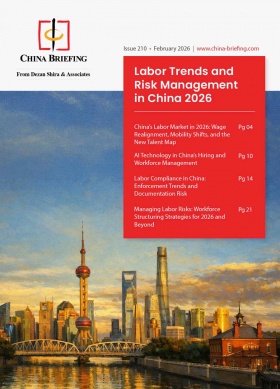
(This article was originally published in China Briefing Magazine: Labor Trends and Risk Management in China 2026, complimentary download is available.)



Building teams and managing people compliantly requires local expertise and resources. Our professionals in HR, Payroll, Recruitment, and HRMS assist clients with managing their human capital in Asia effectively and in full regulatory compliance.
About Us
China Briefing is one of five regional Asia Briefing publications. It is supported by Dezan Shira & Associates, a pan-Asia, multi-disciplinary professional services firm that assists foreign investors throughout Asia, including through offices in Beijing, Tianjin, Dalian, Qingdao, Shanghai, Hangzhou, Ningbo, Suzhou, Guangzhou, Haikou, Zhongshan, Shenzhen, and Hong Kong in China. Dezan Shira & Associates also maintains offices or has alliance partners assisting foreign investors in Vietnam, Indonesia, Singapore, India, Malaysia, Mongolia, Dubai (UAE), Japan, South Korea, Nepal, The Philippines, Sri Lanka, Thailand, Italy, Germany, Bangladesh, Australia, United States, and United Kingdom and Ireland.
For a complimentary subscription to China Briefing’s content products, please click here. For support with establishing a business in China or for assistance in analyzing and entering markets, please contact the firm at china@dezshira.com or visit our website at www.dezshira.com.
- Previous Article Hong Kong Strengthens AEOI Framework with 2026 Amendment Bill
- Next Article