Other Briefings
China joint ventures offer easier access to China markets
JVs seen as China development refinancing and cost effective investment vehicles by many multinational investors
Mar. 10 – JVs are still a primary choice for foreign investors wishing to manufacture and sell onto the Chinese market.
While recently, foreign legal media has appeared to dismiss China JVs as potential for problems and partner abuse, in contrast to widely held beliefs, JVs rather than wholly foreign owned enterprises (WFOES) still account for the majority of FDI income into China as investment vehicles of choice.
Many of these, especially in banking, finance, energy, exploration and power have been highly productive and lucrative dividends are being made to the shareholders of such companies. Certain manufacturing units also, especially in the automotive industry have shown an increase in profitability, with foreign-invested joint ventures responsible for funding additional operations in China thanks to tax incentives being available to re-invest dividends back into China.
JVs still represent an excellent method for investment into China, however, certain factors do have to be in place to make such an investment correctly.
Regulatory environment
China is growing less suspicious about placing foreign investment into key strategic areas, such as national power infrastructure and energy. Indeed, foreign investment is actively being sought in these areas through placements and acquisitions of companies via financing on international markets via Hong Kong and elsewhere. Naturally, China requires infrastructure development as an initial priority ahead of profit taking, hence the regulatory insistence on JV partnerships – institutional and multinational investors are well aware of this and are prepared to invest in China joint ventures to assist. With debt being lodged effectively with the State through the State Administration of Foreign Exchange, and thus guaranteed, it is unlikely we will have a return to the GITIC debacle of several years ago (a government-backed investment fund that became bankrupt, losing many foreign investors money they assumed had been guaranteed by the State). Most foreign businesses accept the will of the Chinese government to guarantee investment debts lodged with SAFE. In fact, many new areas previously restricted to FDI are opening up to foreign investment. Just this week the government opened up the nation’s railway infrastructure to FDI.
Infrastructural benefits
For smaller investors were a choice presented itself between setting up as a WFOE or a JV, it is fairly clear where JVs would be advantageous over a wholly owned enterprise. These include:
* Selling product onto the Chinese market when the China partner had an existing supply chain. Getting product to the end user in China is a time consuming and expensive distribution channel to build and finance alone, foreign investors selling in China can bolt their product into an existing supply chain at little or no cost. There is a large financial and timeframe incentive to go with a partner who possessed such an asset, although for export manufacturers, there is no real need for such infrastructure.
* Cost of absorbing existing plant facilities and skilled / semi skilled staff than developing a green field site. This includes obvious legal and HR due diligence inspections, however when a perfectly good existing factory is available, why build a new one? Development and build out costs can be easily compared to the usage of existing plant, and a reduced timeframe exists when using already recruited and trained staff rather than having to start all over from scratch.
* You can always buy out your partner later anyway. It was an investment trend that many multinationals go with JV partners for the shorter term, and then when all Chinese management and operational intellect has been absorbed, with matters under control, they then buy the Chinese partner out. The local partner is happy as a good return on the value of his business had been achieved, while the foreign partner had acquired a full management and operational stake in the business for the longer term as well as increasing foreign shareholder asset value. This is a win-win situation and should not be seen by the media as a last ditch attempt to get rid of an errant partner. It is more often a longer term ultimate evolutionary end to foreign investors’ strategic investments, and is often triggered by JV contractual terms now coming to fruition that has lead to many JV contracts being renegotiated as their original 10-15 year license expiry is due, prompting many foreign acquisitions.
Chinese Joint Venture contractual law can be complicated, and the negotiation process exasperating, but nonetheless JVs have got a lot of bad press due to several factors, with bad experiences being down usually to inexperienced foreign investors and lawyers with no real China experience being involved in the formation process, a lack of due diligence, a lack of attention to detail in the JV articles, and just sheer bad advise and press. Whenever a foreign JV partner has a problem, it is usually because it was something they themselves messed up or didn’t understand. Yet they always place the full blame on the Chinese partner, which is often most unfair.
Summary
Joint ventures in China should be considered when local sales are required, and as a financial alternative to developing a green field site, but that due diligence should always be conducted. The legal and financial expertise to assist with the decision making process has been in China a long time, it is available. Don’t be conned by new-to-China so-called experts who say that JVs are dangerous or unnecessary. Joint ventures constitute a valid legal mechanism for holding China investments and should be seriously considered when appropriate, and when tested during the pre-investment due diligence process by responsible legal and operational finance professionals familiar with the disciplines of due diligence and with China Joint Venture contractual law.
JVs can save you time and money when entering the China market he concluded, and that serious investors in China had all been through the JV process, largely with positive rather than negative results. In cases where dividends had not been returned to the investing parent company, many foreign partners reinvest their China dividends back into China as significant tax incentives were available if they did so, and that many multinationals had financed their China expansion in such a manner. Rather than make a cash call on their parent for financing in U.S. dollars or Euros, many are reinvesting their RMB dividends to finance new divisions and factories in China. The original beneficial parent hasn’t yet received a dividend, but is has acquired significant additional asset value in owning new business through such RMB refinancing, and this is the case for many JVs in China who began as one unit and have now multiplied into many.
For more information about JV applications and due diligence issues, please contact info@dezshira.com or visit www.dezshira.com.
Also available from the China Briefing Bookstore
China Briefing’s Technical Business Guide to Joint Ventures (2nd Edition)
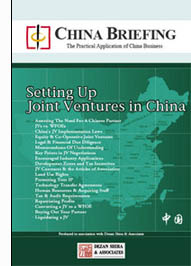 This brand new guide book is a comprehensive overview of establishing joint ventures in China. It details all applicable decision making processes, assessing your potential partner, choosing the relevant JV structure, conducting legal and financial due diligence. The guide contains complete JV contract and articles of association as well as an overview of JV law, details negotiation issues, land use rights, IP Protection and technology transfer, in addition to tips of staff hiring and HR. It also describes the tax and audit responsibilities in addition to buying out a JV partner and liquidations. It is a concise, detailed yet pragmatic guide of use to anyone considering or owning a JV in China.
- Previous Article Hong Kong ’08 budget proposes HK$75 billion in relief measures
- Next Article NPC: Official – China labor law criticism unfounded