<?xml version="1.0" encoding="UTF-8"?><!-- generator="wordpress/2.3.2" -->
<rss version="2.0"
	xmlns:content="http://purl.org/rss/1.0/modules/content/"
	xmlns:dc="http://purl.org/dc/elements/1.1/"
	>
<channel>
	<title>Comments on: China joint ventures offer easier access to China markets</title>
	<link>http://www.china-briefing.com/news/2008/03/10/china-joint-ventures-offer-easier-access-to-china-markets.html</link>
	<description></description>
	<pubDate>Mon, 13 Oct 2008 20:07:52 +0000</pubDate>
	<generator>http://wordpress.org/?v=2.3.2</generator>
		<item>
		<title>By: Tom</title>
		<link>http://www.china-briefing.com/news/2008/03/10/china-joint-ventures-offer-easier-access-to-china-markets.html#comment-8473</link>
		<dc:creator>Tom</dc:creator>
		<pubDate>Wed, 12 Mar 2008 01:48:42 +0000</pubDate>
		<guid>http://www.china-briefing.com/news/2008/03/10/china-joint-ventures-offer-easier-access-to-china-markets.html#comment-8473</guid>
		<description>Chris I found this piece telling, and agree with much of what you have to say. JVs are the way to break into the national level of manufacturing sales. To proceed with JV's is largely a strategic choice and I have had too much experience elsewhere with legal advice telling me all the reasons why not to have a JV with a Chinese partner. I have set up 5 in China, all bar one now is a WFOE. Yet without the original Chinese partners in hand at the beginning I would not have been able to build a national distribution network. I am convinced of that. I appreciate someone out there at least understands the longer term implications instead of concentrating on the negative aspect of China business. It is, as you indicate, largely in the destiny of the foreigner investor to get it right and most certainly his responsibility.</description>
		<content:encoded><![CDATA[<p>Chris I found this piece telling, and agree with much of what you have to say. JVs are the way to break into the national level of manufacturing sales. To proceed with JV&#8217;s is largely a strategic choice and I have had too much experience elsewhere with legal advice telling me all the reasons why not to have a JV with a Chinese partner. I have set up 5 in China, all bar one now is a WFOE. Yet without the original Chinese partners in hand at the beginning I would not have been able to build a national distribution network. I am convinced of that. I appreciate someone out there at least understands the longer term implications instead of concentrating on the negative aspect of China business. It is, as you indicate, largely in the destiny of the foreigner investor to get it right and most certainly his responsibility.</p>
]]></content:encoded>
	</item>
	<item>
		<title>By: Chris Devonshire-Ellis</title>
		<link>http://www.china-briefing.com/news/2008/03/10/china-joint-ventures-offer-easier-access-to-china-markets.html#comment-8427</link>
		<dc:creator>Chris Devonshire-Ellis</dc:creator>
		<pubDate>Tue, 11 Mar 2008 09:54:29 +0000</pubDate>
		<guid>http://www.china-briefing.com/news/2008/03/10/china-joint-ventures-offer-easier-access-to-china-markets.html#comment-8427</guid>
		<description>Hi Noel. JV's failing are usually a result of under-investment by the Foreign partner, and a misunderstanding of the actual motivating factor for the Chinese partner. Actual out and out cases of fraud and deception are rare and are anyway resolvable through the courts, although this may be painful. Attempts at pre-incorporation stages to deceive over business values &#38; assets should be picked up via the due diligence process beforehand. Under investment can manifest itself in a variety of ways:

1) Lack of Management Interest - essentially leaving the whole operation in the hands of the Chinese partner is usually, at least until they have proven themselves capable, not a good idea; 

2) Undercutting Financial Obligations - many foreign investors simply do not provide sufficient funding to the JV in terms of financing or equipment, and seek to dump previously written off assets onto a partner. That may work short term, but long term the repercussions are not going to bear fruit and the businesses infrastructure and financial modelling cannot compete with properly financed domestic / international competitors;   

3) Misunderstanding the China Partners Motivation - the 'Same bed, different dreams" scenario. It is important from the outset both parties fully understand the motivations of both to go through with the JV and exactly how each wants to benefit from it's existence. This may take time, but its time well spent rather than ending up with a hastily arranged JV with a partner whose ideals differ from the foreign investors about what the business is expected to accomplish; 

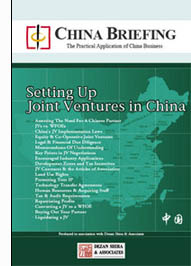
4) Due Diligence - an a lack of it. We all understand it is an upfront expense, but investors who seek to set up in China 'on the cheap' and forgo this are likely to get burnt. The intellect is out there and available - a good start is our book on JV's which costs just USD25 and deals with these issues ! Hardly expensive. 

That includes straightforward concerns over technology transfer and IP. Its hardly unknown news that IP can get ripped off in China. There are procedures to go through to mitigate against this. So spend time and money on them! 

5) Examples: It's not usually a good idea to have a JV partner if the foreign investor feels "It is cheaper than a WFOE" or if the manufacturing process is to be 100% export driven. While there are of course exceptions to these guidelines, they can often betray a lack of investment commitment to the China operation by the Foreign investor - which is a built in road to failure.  

To summarize, 99% of the problems I have seen with JV's could have been avoided with better thought processes and financial commitment to the project being available at the decision making process end. Once you've committed to an ill-thought out JV it is hard to put it right, and it's the responsibility of any foreign investor in China to do his or her homework thoroughly. If due diligence and a long term strategy are actioned, and the right circumstances chosen, most JV's will succeed. They may later evolve into a WFOE when a Chinese partner is no longer required, but thats hardly a sign of failure.  

WFOE's incidentally are easier to incorporate from the legal and due diligence perspective, JV's require more expertise and experience which many law firms simply do not possess, so they are anti-JV due their their own lack of knowledge, and may advise clients poorly. JV's can and do represent an excellent investment vehicle to sell into China or to develop a national business, and are often more rewarding in these aspects than a WFOE may be and going it all alone. You need to discuss these matters with lawyers who are familar and comfortable with both WFOE and JV structures and can advise properly without taking sides of one over the other. That is a strategic and regulatory decision alone, not a political risk based one. Both are legitimate investment vehicles, which is why they have existed for the past 20 years and have specific regulatory guidelines governing them in Chinese Foreign Direct Investment law. Consideration to both should be given at the appropriate time.</description>
		<content:encoded><![CDATA[<p>Hi Noel. JV&#8217;s failing are usually a result of under-investment by the Foreign partner, and a misunderstanding of the actual motivating factor for the Chinese partner. Actual out and out cases of fraud and deception are rare and are anyway resolvable through the courts, although this may be painful. Attempts at pre-incorporation stages to deceive over business values &amp; assets should be picked up via the due diligence process beforehand. Under investment can manifest itself in a variety of ways:</p>
<p>1) Lack of Management Interest - essentially leaving the whole operation in the hands of the Chinese partner is usually, at least until they have proven themselves capable, not a good idea; </p>
<p>2) Undercutting Financial Obligations - many foreign investors simply do not provide sufficient funding to the JV in terms of financing or equipment, and seek to dump previously written off assets onto a partner. That may work short term, but long term the repercussions are not going to bear fruit and the businesses infrastructure and financial modelling cannot compete with properly financed domestic / international competitors;   </p>
<p>3) Misunderstanding the China Partners Motivation - the &#8216;Same bed, different dreams&#8221; scenario. It is important from the outset both parties fully understand the motivations of both to go through with the JV and exactly how each wants to benefit from it&#8217;s existence. This may take time, but its time well spent rather than ending up with a hastily arranged JV with a partner whose ideals differ from the foreign investors about what the business is expected to accomplish; </p>
<p>4) Due Diligence - an a lack of it. We all understand it is an upfront expense, but investors who seek to set up in China &#8216;on the cheap&#8217; and forgo this are likely to get burnt. The intellect is out there and available - a good start is our book on JV&#8217;s which costs just USD25 and deals with these issues ! Hardly expensive. </p>
<p>That includes straightforward concerns over technology transfer and IP. Its hardly unknown news that IP can get ripped off in China. There are procedures to go through to mitigate against this. So spend time and money on them! </p>
<p>5) Examples: It&#8217;s not usually a good idea to have a JV partner if the foreign investor feels &#8220;It is cheaper than a WFOE&#8221; or if the manufacturing process is to be 100% export driven. While there are of course exceptions to these guidelines, they can often betray a lack of investment commitment to the China operation by the Foreign investor - which is a built in road to failure.  </p>
<p>To summarize, 99% of the problems I have seen with JV&#8217;s could have been avoided with better thought processes and financial commitment to the project being available at the decision making process end. Once you&#8217;ve committed to an ill-thought out JV it is hard to put it right, and it&#8217;s the responsibility of any foreign investor in China to do his or her homework thoroughly. If due diligence and a long term strategy are actioned, and the right circumstances chosen, most JV&#8217;s will succeed. They may later evolve into a WFOE when a Chinese partner is no longer required, but thats hardly a sign of failure.  </p>
<p>WFOE&#8217;s incidentally are easier to incorporate from the legal and due diligence perspective, JV&#8217;s require more expertise and experience which many law firms simply do not possess, so they are anti-JV due their their own lack of knowledge, and may advise clients poorly. JV&#8217;s can and do represent an excellent investment vehicle to sell into China or to develop a national business, and are often more rewarding in these aspects than a WFOE may be and going it all alone. You need to discuss these matters with lawyers who are familar and comfortable with both WFOE and JV structures and can advise properly without taking sides of one over the other. That is a strategic and regulatory decision alone, not a political risk based one. Both are legitimate investment vehicles, which is why they have existed for the past 20 years and have specific regulatory guidelines governing them in Chinese Foreign Direct Investment law. Consideration to both should be given at the appropriate time.</p>
]]></content:encoded>
	</item>
	<item>
		<title>By: Noel Baker</title>
		<link>http://www.china-briefing.com/news/2008/03/10/china-joint-ventures-offer-easier-access-to-china-markets.html#comment-8422</link>
		<dc:creator>Noel Baker</dc:creator>
		<pubDate>Tue, 11 Mar 2008 07:46:36 +0000</pubDate>
		<guid>http://www.china-briefing.com/news/2008/03/10/china-joint-ventures-offer-easier-access-to-china-markets.html#comment-8422</guid>
		<description>Chris, great article, very thorough. Can you comment more please on the reasons (when it occurs) why JV's fail and the most common reasons for this occuring - from the foreign investors perspective?</description>
		<content:encoded><![CDATA[<p>Chris, great article, very thorough. Can you comment more please on the reasons (when it occurs) why JV&#8217;s fail and the most common reasons for this occuring - from the foreign investors perspective?</p>
]]></content:encoded>
	</item>
	<item>
		<title>By: Ted Mullins</title>
		<link>http://www.china-briefing.com/news/2008/03/10/china-joint-ventures-offer-easier-access-to-china-markets.html#comment-8421</link>
		<dc:creator>Ted Mullins</dc:creator>
		<pubDate>Tue, 11 Mar 2008 07:18:21 +0000</pubDate>
		<guid>http://www.china-briefing.com/news/2008/03/10/china-joint-ventures-offer-easier-access-to-china-markets.html#comment-8421</guid>
		<description>An excellent explanation - thank you very much. Most enlightening.</description>
		<content:encoded><![CDATA[<p>An excellent explanation - thank you very much. Most enlightening.</p>
]]></content:encoded>
	</item>
	<item>
		<title>By: Chris Devonshire-Ellis</title>
		<link>http://www.china-briefing.com/news/2008/03/10/china-joint-ventures-offer-easier-access-to-china-markets.html#comment-8416</link>
		<dc:creator>Chris Devonshire-Ellis</dc:creator>
		<pubDate>Tue, 11 Mar 2008 03:41:01 +0000</pubDate>
		<guid>http://www.china-briefing.com/news/2008/03/10/china-joint-ventures-offer-easier-access-to-china-markets.html#comment-8416</guid>
		<description>Hi Rich, thanks for your questions. They fall into two categories, regulatory and corporate strategy. As we are already well aware, many industry sectors, especially those of national importance or requiring big-ticket financing require a Chinese partner. So for those industries that need this, the foreign partner will assess the risk factors, including political risk, carefully prior to investing as such investments (many of them in mining and infrastructure) will remain as JV's with no ability to buy out the partner. Many of these arrangements however are also quasi government backed on both sides and can sometimes fall into the realm of bilateral government financing as well, with international rates of return agreed upon and contracted between the Chinese and Foreign government, and then filtering down to the actual businesses who execute and manage the project.  

For JV's when a Chinese partner is no longer required by regulatory guidelines, the request to buy out the Chinese partner is quite common. This I believe falls into a cultural issue, Chinese businessmen still tend to be focussed on short term profit taking rather than longer term development of the business. Indeed, as many JV's are evolving to become national businesses - often being the aim of the multinational partner - the original Chinese JV partner when the business has reached a certain standard may not be capable of developing it further into different regions. We are seeing a large increase in multinationals with several JV's nationally now buying out their various Chinese partners in different locations, making them all WFOEs but with a Holding company at the top end in China to manage the various financial and management aspects of a unified group. Seimens, with some 50 JV's in China, are a good example of this, with their strategy being to buy out the local partner, then place the resulting WFOE under a corporate Holding company structure in China.  

The driving factor for this would be to acquire and secure the long term direction of the business, allow it to share in and with financing and reporting at a China Group level with other subsidiary companies, and to develop as a national corporation. The local Chinese partner, who may have been extremely useful on the ground as the original partner, has reached the logical end of his influence and usefulness and can be 'put out to grass' with a healthy compensation package in terms of the equity received for buying him out. 

In my experience the problems with JV's have tended to be smaller investments where the foreign management did not spend sufficient management time with the company and according things went astray. At corporate level, they remain the choice (in many industries the only choice) and when thought through correctly on the China strategic development side can be a healthy platform into national development. In fact I would go so far as to say the ONLY serious financial and operational platform for the development of a national business in China. The creation of a national China business in my mind would be nigh impossible without assistance from locally sourced JV partners at the outset, followed by a gradual buyout to retain the multinationals presence.</description>
		<content:encoded><![CDATA[<p>Hi Rich, thanks for your questions. They fall into two categories, regulatory and corporate strategy. As we are already well aware, many industry sectors, especially those of national importance or requiring big-ticket financing require a Chinese partner. So for those industries that need this, the foreign partner will assess the risk factors, including political risk, carefully prior to investing as such investments (many of them in mining and infrastructure) will remain as JV&#8217;s with no ability to buy out the partner. Many of these arrangements however are also quasi government backed on both sides and can sometimes fall into the realm of bilateral government financing as well, with international rates of return agreed upon and contracted between the Chinese and Foreign government, and then filtering down to the actual businesses who execute and manage the project.  </p>
<p>For JV&#8217;s when a Chinese partner is no longer required by regulatory guidelines, the request to buy out the Chinese partner is quite common. This I believe falls into a cultural issue, Chinese businessmen still tend to be focussed on short term profit taking rather than longer term development of the business. Indeed, as many JV&#8217;s are evolving to become national businesses - often being the aim of the multinational partner - the original Chinese JV partner when the business has reached a certain standard may not be capable of developing it further into different regions. We are seeing a large increase in multinationals with several JV&#8217;s nationally now buying out their various Chinese partners in different locations, making them all WFOEs but with a Holding company at the top end in China to manage the various financial and management aspects of a unified group. Seimens, with some 50 JV&#8217;s in China, are a good example of this, with their strategy being to buy out the local partner, then place the resulting WFOE under a corporate Holding company structure in China.  </p>
<p>The driving factor for this would be to acquire and secure the long term direction of the business, allow it to share in and with financing and reporting at a China Group level with other subsidiary companies, and to develop as a national corporation. The local Chinese partner, who may have been extremely useful on the ground as the original partner, has reached the logical end of his influence and usefulness and can be &#8216;put out to grass&#8217; with a healthy compensation package in terms of the equity received for buying him out. </p>
<p>In my experience the problems with JV&#8217;s have tended to be smaller investments where the foreign management did not spend sufficient management time with the company and according things went astray. At corporate level, they remain the choice (in many industries the only choice) and when thought through correctly on the China strategic development side can be a healthy platform into national development. In fact I would go so far as to say the ONLY serious financial and operational platform for the development of a national business in China. The creation of a national China business in my mind would be nigh impossible without assistance from locally sourced JV partners at the outset, followed by a gradual buyout to retain the multinationals presence.</p>
]]></content:encoded>
	</item>
	<item>
		<title>By: All Roads</title>
		<link>http://www.china-briefing.com/news/2008/03/10/china-joint-ventures-offer-easier-access-to-china-markets.html#comment-8379</link>
		<dc:creator>All Roads</dc:creator>
		<pubDate>Mon, 10 Mar 2008 13:53:41 +0000</pubDate>
		<guid>http://www.china-briefing.com/news/2008/03/10/china-joint-ventures-offer-easier-access-to-china-markets.html#comment-8379</guid>
		<description>Chris,

A quick question for you to address.

I would agree that JVs can be an excellent vehicle to enter China with, however history has shown that many firms look to unwind those once legally able.  It is something that I have seen in logistics, and what I would appreciate your insights on are the following: 
(1) How many of your clients enter into a JV looking that far into the future; 
(2) How many of these "plans" come to fruition? 
(3) Assuming the relationship is a good one, and both parties are happy for the 49 to 100% shift, what have been the biggest problems when a firm moves from 49% to 100%?  

I have seen different things depending on different industries from a strategic side, but interested in your views given the legal/ accounting angle.

Thanks

r
www.allroadsleadtochina.com</description>
		<content:encoded><![CDATA[<p>Chris,</p>
<p>A quick question for you to address.</p>
<p>I would agree that JVs can be an excellent vehicle to enter China with, however history has shown that many firms look to unwind those once legally able.  It is something that I have seen in logistics, and what I would appreciate your insights on are the following:<br />
(1) How many of your clients enter into a JV looking that far into the future;<br />
(2) How many of these &#8220;plans&#8221; come to fruition?<br />
(3) Assuming the relationship is a good one, and both parties are happy for the 49 to 100% shift, what have been the biggest problems when a firm moves from 49% to 100%?  </p>
<p>I have seen different things depending on different industries from a strategic side, but interested in your views given the legal/ accounting angle.</p>
<p>Thanks</p>
<p>r<br />
<a href="http://www.allroadsleadtochina.com" rel="nofollow">http://www.allroadsleadtochina.com</a></p>
]]></content:encoded>
	</item>
</channel>
</rss>