China Briefing - The Practical Application of China Business
Dezshira India Briefing Vietnam briefing www.2point6billion.com
 
Username Password
Remember Me
Forgot Username
or Password?


The Tibet issue

Foreign criticism often misguided

By Chris Devonshire-Ellis

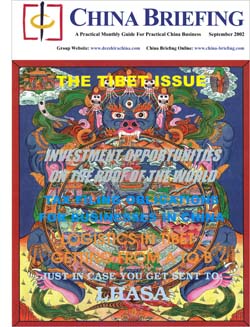
April 9 - With so much talk recently of Tibet for various reasons, and so much Western paranoia about even mentioning the name of the country (blogs running the name as T*bet or T1bet displays rather a lack of confidence, or a somewhat bizarre notion of harboring anti-China naughtiness. It’s almost become a trendy fashion to mistype the capital city that cannot, apparently be actually spelt for great fear of the Chinese police shutting them down) we decided to dig out an old, long deleted back issue of China Briefing about the investment environment there, which we ran in 2002 (click on cover to download the pdf).

Then, China Briefing hadn’t quite reached the glossy professionally produced standards it has today, but it was at the time – pre-blogging of course – pretty much the only source of China investment information available concerning FDI legal and tax issues about China, at least for free. 40,000 print copies were produced for this issue and distributed across China, and online. The issue followed meetings I had with the Tibetan autonomous regional government, at the time headed up by Guo Jinlong, the Party Secretary. Guo, now the mayor of Beijing, spent some time with me explaining the issues China faced with Tibet, and was a generous host, treating us to Tibetan banquets, dancing and singing. He was also obviously a man who enjoyed getting out and about in Tibet’s harsh sunshine; he had become very dark tanned indeed.

Essentially, although the Tibet issue is complicated (see the 2point6billion.com article “Oh Tibet – Who Will Buy Your Spirituality Now?” for the factual status behind Tibetan “independence”, and the evolution of the Dalai Lama) it was apparent that the Chinese were pouring billions of dollars in to assist with the development of the country. Not all of that, I have to say, was culturally sensitive, and much was the standard Chinese white tiled concrete buildings one sees as a depressingly unimaginative architectural site in many other Chinese cities. And here is the rub. Foreign critics, somewhat rampant in their condemnation of China’s role in Tibet, have pressured Western businesses not to invest in Tibet. In doing so, they just place the initiative on the Chinese to do so. It’s an absurd contradiction of intent.

One notorious case is that of the Holiday Inn in Lhasa, also the subject of the best business book written about Tibet, “Running a Hotel On The Roof Of The World: Five Years in Tibet” by Alec Le Sueur – a must read for anyone interested in the region. While the Holiday Inn thrived, (and Alec’s book tells stories of the first Miss Tibet pageant, of defrosting spring time dead rats aroma when the summer air conditioning got turned on, and of traveling around the region) a U.S.-based activist group began putting pressure on the Holiday Inn‘s shareholders to pull the chain out. Ultimately, they succeeded. The Holiday Inn is now the Lhasa Hotel, and purely Han Chinese run. What did the activists accomplish? Actually, several back steps that hurt the indigenous Tibetans. Many lost their jobs as the hotel became increasingly Chinese run; the Holiday Inn, to their credit, had employed a fair amount of locals. Not anymore.

The truth of the matter is, if the Western critics of China in Tibet want to influence matters, instead of just lambasting China, they should engage with it. Pulling foreign investment out of Tibet just hurts the Tibetans. As I wryly noted, some six years ago in China Briefing, “Too much has been written by unqualified people with hidden agendas over investments into Tibet and this is actively working against the preservation of the regions culture. Instead of wanting to blindly condemn any investment into the area, it would be far better to see the potential for development in an organized and sympathetic manner. Tibet needs this if it is not going to end up as a slovenly version of Kathmandu.”

Six years ago, there were no karaoke bars in Lhasa. Now there are. If Western companies do not invest, and if we cannot trust them to provide a culturally sympathetic investment, then the Chinese will. And who can blame them if Lhasa becomes more Han as a result? Sinicization is one by-product of activists creating a foreign investment environment that will not tolerate Western money in the country, and it’s a flawed concept to believe otherwise. The issue also featured a sentence I shall leave you with. “The West has a choice. Keep Tibet full of crap or help upgrade it to a decent standard of service and culture more in line with its proud heritage.” China bashing over Tibet doesn’t help. Engaging China with sensible, pragmatic dialogue and investing in Tibet would.

Related reading
Traveling in Tibet
Lhasa to Everest Base Camp / Tibetan Buddhism, The Kama Sutra, & Tantric Sex / The Road To Shangri-La / Guide To Lhasa
China’s Route to India Via Tibet – The Ancient Tea Horse Route
The Cha Ma Gu Dao route from Yunnan, across Tibet and into India / Pu’er Tea / A visit to Sikkim and Tibet in 1873 / In the footsteps of Genghis Khan
The Mongolian Dalai Lama
History of the Dalai Lama / The Sand Mandala / Mongolian Buddhism / Riddles of the Gobi Desert

Note: Dezan Shira & Associates services clients in Tibet and has done for several years, in both legal incorporation advice and tax filing issues. To contact the firm over Tibet investment issues please email info@dezshira.com.

Share this post > Del.icio.us Digg it Reddit HaoHao

10 Responses to “The Tibet issue”

  1. Francois Says:

    The English language China blogs have been very annoying with T*bet and T1bet - all political correctness and nothing much to say, while at the same time cowering in front of the perceived China firewall. Its nice to see someone has the balls to talk about the subject matter in hand properly. The “Oh Tibet Who Will Buy Your Spirituality Now” piece is particuarly well researched and written. Thanks also for all the other links and magazines on the subject, I don’t think there is any other site with such depth. You guys do an excellent job at China Briefing, it’s very detailed - Merci! (I also subscribe the French issue your magazine)

  2. Cup of Cha Says:

    I guess I’m one of those folks who deeply lacks confidence when I write about Tibet. However, as I’ve documented here ( http://cupofcha.com/2008/03/18/dont-cup-block-me.html ) it has nothing to do with the police specifically targeting my site for content, but rather filtration systems that China instituted during particularly hot moments. As I talked about in the post, I quoted a Chinese article from an official newspaper–and had to access my site via a proxy server to change the text as a result. If you look at the comments section of the post, technology experts have listed links with a clear explanation of how this is done.

    Just because the Man stopped the filter doesn’t mean it doesn’t exist…

  3. Chris Devonshire-Ellis Says:

    You’re an exception to the rule Josh. At least you comment on China (and Tibet) and have the courage to actually live - and as I well know - travel extensively here. Regardless the reason, the current amateur blogging craze of referring to Tibet in English as T*bet is pretty annoying. What next - “Xizhang” ? Message: The Chinese don’t mind you spelling Tibet properly, and you won’t get arrested, imprisoned, or executed for doing so.

  4. Ooyoo Says:

    Toktoy! Ya, viva Tibet! Anyone that hasn’t been should go. Potala, Jokhang, Xigaze, even if Tibetan cheese makes your teeth aching its so hard hah hah. If you didn’t before go to Tibet it is a great land. Dont worry about the Chinese it is still - Tibet. Some things nobodys can be change. And the Potalagong is on the RMB50 note, and Tibetan language is on all China bank notes. So we have some cultural influence on the China.

  5. Alberto Marconi Says:

    Chris,

    I think what Cup of Cha is saying is correct. The bloggers are changing the names not out of fear of China’s police, but so they can be sure their blogging gets through in China. I love your blog, but I urge you to focus on covering China, which you do so brilliantly, and not act so paranoid in going after other bloggers. You only sound petty when you do so and I know you are anything but that as I have always found you to be a man of great warmth and generousity and this blog usually reflects that.

  6. Nigel Harris Says:

    Chris I tend to agree with you on this issue. What activists tend to do (and not just concerning Tibet) is instigate a typically American response to issues they do not feel are correct - and stop people trading with other people they don’t like. It’s an activist form of imposing sanctions aimed at the private sector. Disrupting board meetings, harrassing stockholders etc. It’s not exactly democratic, and much of the rhetoric is shallow. As we have seen already, sanctions just don’t work. North Korea went Nuclear, and Cuba is still Cuba. To help free Tibet from some of it’s inherent problems, the West must engage with China on the issue. The Olympics would be a good place to start, to encourage dialogue - and regional investment. I believe that Western investment into Tibet would be sensitive to the cultural issues (I take your point over white tiled concrete buildings in Lhasa) and that not to do so just leaves the Tibetans them with one option for inbound investment - the RMB.

  7. Chris Devonshire-Ellis Says:

    Hi Alberto; It’s irritating to see Tibet treated in a “politically correct” manner, especially by people who don’t know what they’re talking about, have never been there, and don’t live in China or fully understand the issues. They imply sympathy for the protests but still kowtow to China’s censors. That’s sitting on the fence rather, while maintaining a fashionable position of ‘mild disapproval’ without actually saying anything tangible. It’s a waste of space written by people who feel they have to say ‘something’ but in doing so contribute even less. I’m afraid many of the non-resident “China” blogs and I don’t often see eye to eye. Personally, I view typing as T*bet is just silly. It’s Tibet, and this site and thread is a good reason to demonstrate that you can spell it correctly and not get problems with the firewall. If it was really an issue then you wouldn’t be able to read this. Touché. But thanks otherwise for your comments, they are appreciated.

    Nigel thanks for focusing on the real issue instead of politically sensitive bloggers. Activists can’t have it both ways - persuade foreign investors not to go, and then criticize China for doing so and sinicizing Tibet. Neither do I read any sensible dialogue about an alternative solution than China in Tibet. Criticism for the sake of it isn’t going to do any good. Perhaps we could ask people to think about the issue somewhat and explore it rather than have a constant on-going blog ambience all commenting on riots in Paris and so on. Tibet deserves better than that, and so does the issue. We’re not afraid to discuss it and offer some opinions. We have a position – Tibet needs foreign investment. Anyone care to comment on that?

  8. Andy Scott Says:

    Here is some further reading on investment in Tibet. All are accessible from China.

    The China Tibet Information website.

    Roger Cohen’s remarkable opinion piece A Passage to Tibet.

    Rajinder Puri, of India’s Boloji provides a thought provoking piece Can Tibet Mend China?

    Hong Kong Trade and Development Council data on the impact of the Qinghai-Tibet railway bringing FDI into Tibet.

  9. Andy Scott Says:

    And yet more reading on the issue, a Globe and Mail article from last month, reprinted with permission.

    Canadian bankers and miners help luxury train to Lhasa keep on track amid chaos
    Monday, March 31, 2008
    GEOFFREY YORK

    BEIJING — The timing was awkward, to say the least. On March 13, as Lhasa was about to explode into bloodshed, a tourism company was announcing that China’s first luxury train would soon be carrying “travel connoisseurs” to Tibet - complete with butler service “to cater to the whims of each guest.”

    The next day, Lhasa was in flames and Tibetan monks were battling Chinese police. Hundreds of people would be killed or injured over the following two weeks. But none of the violence has deterred the entrepreneurs - including Canadian financiers and mining companies - who still see Tibet as a happy hunting ground for potential profits.

    China has banned almost all foreigners from entering Tibet since the protests began but foreign investors have managed to keep their projects going.

    “We’re pleased that we’re moving forward,” said Bill Edward, vice-president of marketing at Tangula Group Ltd., which is charging as much as $5,500 (U.S.) per ticket for the luxury train to Tibet, beginning shortly after the Beijing Olympics this summer.

    He admitted that ticket sales have been “a little bit quieter” since the Tibetan protests erupted. “But we’re still getting requests for group bookings,” he said. “Our plans are definitely going ahead. We’re on track to launch on Sept. 1.”

    The company says it is offering “the ultimate in luxury rail travel” - a kind of Orient Express for today’s wealthiest tourists. It promises an experience of “relaxed elegance” that provides “remote exploration in comfort and style.” Passengers will have “privileged access” to “mystical Buddhist monasteries” and can enjoy the opportunity of “sipping tea with grassland nomads.”

    Its train cars will feature flat-screen televisions, wireless Internet service, entertainment systems, en-suite bathrooms and showers, gourmet meals, around-the-clock butler service, and in-room “wellness” treatments. “Every need is anticipated, every whim satisfied,” the company boasts.

    Canadian investors were instrumental in launching the luxury train company, although a majority stake was purchased by a Hong Kong tourism company for $52.9-million last November. Its 49 custom-built train cars were manufactured by a joint venture between a Chinese company and two Canadian firms - Bombardier Inc. and Power Corp.

    Some Tibetan activist groups, calling for a boycott of the luxury trains, have criticized the heavy Canadian business involvement in the region. One group, Students for a Free Tibet, has said it is “appalling” that Canadian companies are profiting from China’s “colonial policy” in Tibet.

    But Canadian entrepreneurs are still gung-ho on Tibet, despite the violent protests and the eviction of foreigners from Tibet.

    Howard Balloch, a former Canadian ambassador to Beijing, is one of the shareholders in the luxury train company and served as an adviser to help it get started. He believes that the Tibet crisis will not have a serious impact on foreign investors in Tibet. “I don’t think this will deter the Chinese government from encouraging foreign businesses to invest in Tibet,” he said in an interview.

    Mr. Balloch, who heads an investment banking firm in Beijing, insists that foreign investment is beneficial for Tibetans. “I continue to believe that development is good and has a positive impact on people’s lives,” he said. “Tourism brings in a substantial amount of activities which local people can benefit from.”

    At the same time, Canadian investors in Tibet should make sure that they are helping local residents, he said. “I hope Canadian companies will make a special effort to maximize their benefits to the local community. If recent events have opened up wounds in Tibet, it’s all the more important to show that their activities have benefits to the local communities.”

    Continental Minerals Corp., a Vancouver-based mining company, is pushing ahead with plans for a $500-million copper and gold mine in central Tibet, even though the Tibetan crisis has disrupted some of its activities in recent weeks.

    “At the moment, it seems to be getting back to normal, and we have no plans to change our business plan,” said Dickson Hall, the company’s vice-president of business development.

    “From day one, we have worked very carefully to establish ourselves as good corporate citizens in the area,” he said. “We’ll monitor and see what happens, but we feel that the project will continue.”

    Continental has finished its feasibility studies and is aiming to apply for a mining licence by the middle of this year for what would become the first foreign-owned mine in Tibet.

    The company’s office in Lhasa was closed for 10 days because of the violent protests and some of its business was interrupted by the temporary shutdown of banks in Lhasa, but these were “nothing but minor headaches,” Mr. Hall said.

    He agreed with Mr. Balloch that community benefits are crucial to business projects in Tibet. His company has cultivated relations with local villagers around the mine site by providing jobs, training, road equipment, electrification and donations to the local school.

    Several other Canadian companies have invested in Tibet and the broader Tibetan regions of China, including other mining companies and a producer of mineral water.

    Bombardier and another Canadian company, Nortel Networks, played key roles in supplying equipment for China’s controversial railway to Tibet in 2006.

  10. Chris Devonshire-Ellis Says:

    I had a good chat with Howard over this issue, and he made a valid point: having spent so much time in the West seperating Church and State, the same needs to occur in Tibet. The Tibetans need to stop putting 4 year old boys into the monasteries as monks, and leave them to decide when they are adults, say 18 years, whether or not they wish to enter the clergy. Taking the first male born child out of the breeding line is really a pretty dumb to be doing. Meanwhile, the Dalai Lama needs to stop pretending the Buddhist monks can run the country, and leave them to organise their religion, and the Chinese to run the country without interfering with Tibetan buddhism. A bit of give and take on both sides. It’s not a problem entirely of China’s making.

Leave a Reply