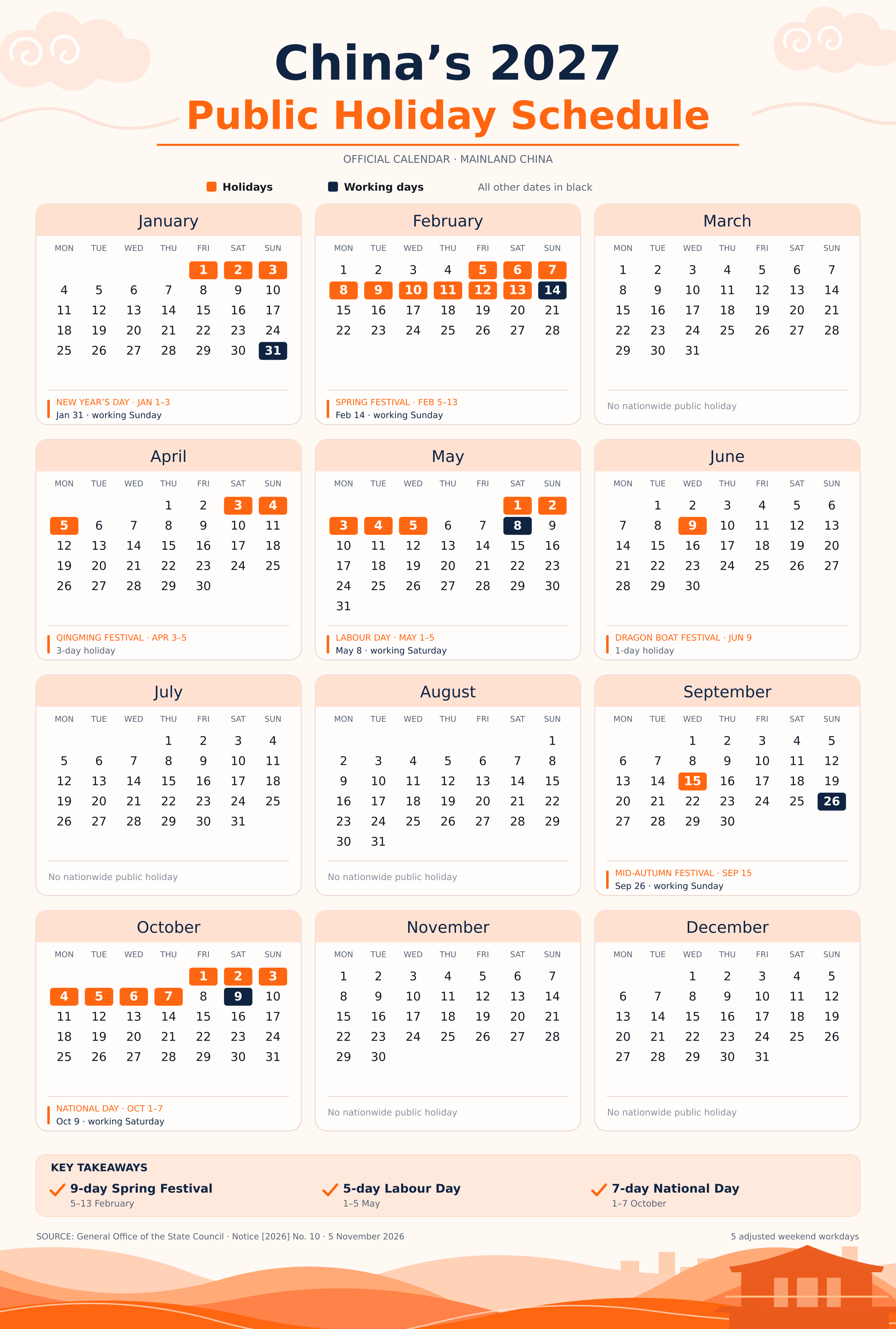
China has released its 2027 public holiday schedule. In 2027, employees in China will have seven holiday periods totalling 29 days off, weekends included, with five weekend days designated as working days. Employees remain entitled to 13 statutory public holidays. The longest breaks are Spring Festival (nine days, February 5 to 13) and National Day (seven days, October 1 to 7).
On November 5, 2026, the General Office of the State Council released the official 2027 holiday arrangements (Guo Ban Fa Ming Dian [2026] No. 10). The notice covers New Year’s Day, Spring Festival, Tomb Sweeping Festival (Qing Ming), Labour Day, Dragon Boat Festival, Mid-Autumn Festival, and National Day.
Two points stand out for foreign human resource managers. First, Dragon Boat Festival (June 9) and Mid-Autumn Festival (September 15) both fall on Wednesdays and are one-day breaks with no adjusted working days. Second, Saturdays and Sundays are again designated as working days to offset the long breaks: January 31, February 14, May 8, September 26, and October 9.
Private companies in China may provide additional days off, provided the official holiday calendar is maintained.
Avoid Holiday Disruptions
Plan for office closures, make-up working days, production schedules, and employee leave requirements in China.China 2027 public holiday schedule: Official calendar
China’s 2027 calendar has seven holiday periods. Each entry below lists the rest days and any weekend days that become working days.
New Year’s Day:
- January 1 to January 3, 2027 (three rest days, in connection with the weekend)
Spring Festival (Chinese New Year)
- February 5 to February 13, 2027 (nine rest days in total)
- Adjusted working days: January 31, 2027 (Sunday) and February 14, 2027 (Sunday)
Tomb Sweeping Festival (Qing Ming Festival)
- April 3 to April 5, 2027 (three rest days in total, in connection with the weekend)
Labour Day
- May 1 to May 5, 2027 (five rest days in total)
- Adjusted working days: May 8, 2027 (Saturday)
Dragon Boat Festival
- June 9, 2027 (one rest day)
Mid-Autumn Festival
- September 15, 2027 (one rest day)
National Day
- October 1 to October 7, 2027 (seven rest days in total)
- Adjusted working days: September 26, 2027 (Sunday) and October 9, 2027 (Saturday)
How does the 2027 holiday schedule compare with 2026?
The 2027 public holiday calendar has 29 days off against 33 in 2026 because Dragon Boat Festival and Mid-Autumn Festival are one-day midweek breaks rather than three-day weekend breaks. The statutory entitlement is unchanged at 13 days, and 2027 has one fewer weekend working day (five, against six).
| Holiday | 2026 | 2027 |
| New Year’s Day | January 1 to 3 (3 days) | January 1 to 3 (3 days) |
| Spring Festival | February 15 to 23 (9 days) | February 5 to 13 (9 days) |
| Tomb Sweeping Festival | April 4 to 6 (3 days) | April 3 to 5 (3 days) |
| Labour Day | May 1 to 5 (5 days) | May 1 to 5 (5 days) |
| Dragon Boat Festival | June 19 to 21 (3 days) | June 9 (1 day) |
| Mid-Autumn Festival | September 25 to 27 (3 days) | September 15 (1 day) |
| National Day | October 1 to 7 (7 days) | October 1 to 7 (7 days) |
| Total days off, weekends included | 33 | 29 |
| Weekend working days | 6 | 5 |
Overtime payment for hours worked on a holiday
Depending on the type of rest days and the working hour system implemented, overtime payment rates differ:
- Under the standard working hour system, for work on an official public holiday, not less than 300 percent of the normal wage shall be paid; for work on an adjusted rest day, and where such rest days cannot be postponed and taken at another time, not less than 200 percent of the normal wage shall be paid.
- Under the comprehensive working hour system, for work performed on public holidays, not less than 300 percent of the normal wage shall be paid. However, no rest day is outlined under this system, so that for work performed on those adjusted working days and weekends, no overtime payments are available.
- Under the non-fixed work hour system, there are differences in overtime regulations across different regions. For instance, in Beijing, employees under the non-fixed work hour system are not entitled to overtime pay for hours worked on public holidays. However, in Shanghai, these hours are considered overtime, and employers are required to pay compensation of up to 300 percent of the normal wage.
- For adjusted working days on weekends, no overtime payment is due.
Also read:
FAQs on China’s 2027 public holidays
How many public holidays does China have in 2027?
China has 13 statutory public holidays in 2027. Including weekends, the official calendar gives 29 days off across seven holiday periods, with five weekend days designated as working days.
When is the Spring Festival holiday in 2027?
The Spring Festival holiday runs from February 5 (Lunar New Year’s Eve, Friday) to February 13, 2027 (Saturday), nine days in total. Employees work on Sunday, January 31 and Sunday, February 14. Chinese New Year’s Day itself falls on February 6.
What is the longest holiday in China in 2027?
Spring Festival is the longest at nine days, followed by National Day at seven days (October 1 to 7) and Labour Day at five days (May 1 to 5).
Which weekend days are working days in 2027?
Five weekend days are working days: January 31 (Sunday), February 14 (Sunday), May 8 (Saturday), September 26 (Sunday), and October 9 (Saturday).
When are Dragon Boat Festival and Mid-Autumn Festival in 2027?
Dragon Boat Festival is on Wednesday, June 9, and Mid-Autumn Festival is on Wednesday, September 15. Each is a one-day holiday with no adjusted working days.
Can employers give more days off than the official schedule?
Yes. Private companies may provide additional days off, provided the official holiday calendar is maintained.
How much is overtime pay for working on a public holiday in China?
Under the standard working hour system, employers must pay at least 300 percent of the normal wage for work on a public holiday. No overtime payment is due for work on adjusted weekend working days.
Need help managing HR and payroll in China?
China’s holiday arrangements can have significant implications for payroll costs, overtime calculations, employee scheduling, and leave administration. Businesses operating across multiple cities must also consider local enforcement practices and special working hour systems.
Dezan Shira & Associates’ HR and payroll specialists help foreign investors manage workforce compliance, payroll operations, employment contracts, and ongoing HR administration throughout the Chinese Mainland.
Our services include:
- Payroll processing and compliance
- HR administration and outsourcing
- Employment contract management
- Social insurance and housing fund compliance
- Special working hour system applications
- Global mobility and expatriate support
Contact our team to discuss your China HR and payroll requirements.