China’s chemical industry in 2026 has an oversupply of commodities and an undersupply at the top. As Beijing phases out ageing plants and a new safety law restricts where hazardous chemicals can be made, opportunities for foreign companies are narrowing to the high end and moving into chemical parks.
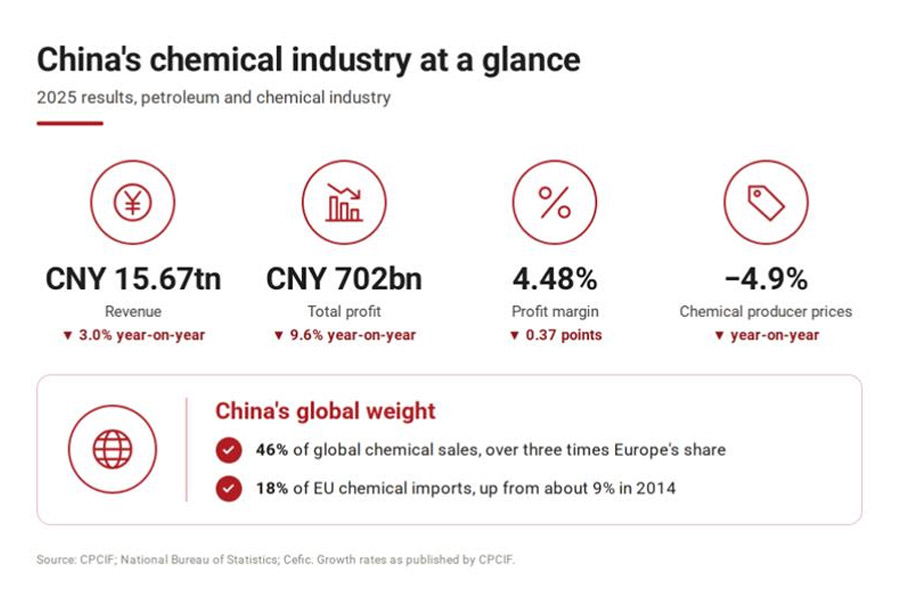
In 2025, China accounted for 46 percent of global chemical sales, according to the European Chemical Industry Council (Cefic), more than three times Europe’s 13 percent. Yet the industry behind that dominance is earning less each year. Profits across China’s petroleum and chemical sector fell 9.6 percent in the same year, after an 8.8 percent drop the year before, as a wave of new capacity met weak domestic demand.
The obvious reading is that China’s chemical market is overbuilt and best avoided. The more useful one is that the surplus is concentrated in commodity products, and the Chinese government is now retiring that end of the industry while steering investment towards the speciality grades it still imports. That is where foreign producers retain an edge, and it explains why BASF and ExxonMobil have brought their largest wholly owned Chinese complexes on stream in the middle of a price war.
Choosing Where to Build in China
How do chemical parks, incentives, and feedstock risks compare across provinces? DSA can assess candidate locations, map your supply chain exposure, and build the business case for your China investment.For foreign investors, the question in 2026 is therefore less whether demand exists than whether they can qualify for it. Since 1 May 2026, China’s first Hazardous Chemicals Safety Law has required new and expanded hazardous chemical production to be located in designated chemical parks, with limited exceptions. Site selection and compliance have become the gating decisions for any new investment.
Why is the industry losing money while it keeps expanding?
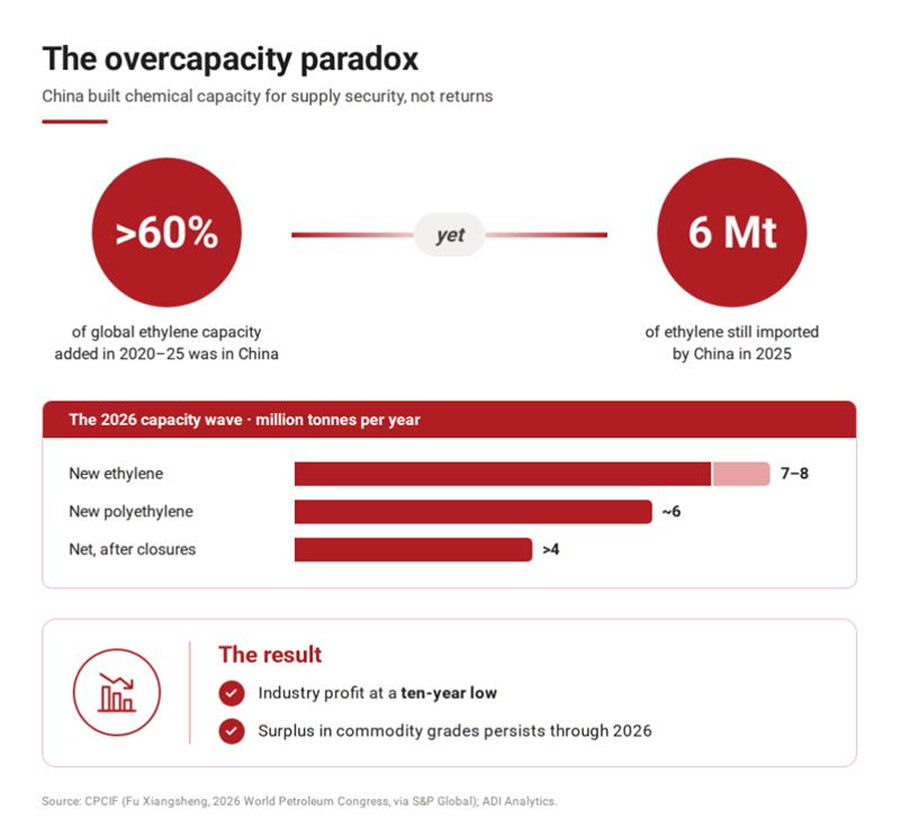
The short answer is that China built its chemical capacity to secure supply, not to maximise returns. The main purpose of increasing capacity is to meet domestic demand: the strategy has worked in volume terms, but it has produced a paradox: despite leading global ethylene additions for five years, China still imported 6 million tonnes of ethylene in 2025.
The build-out is not finished. ADI Analytics estimates that China will add another 7 to 8 million tonnes per annum (Mtpa) of ethylene capacity and around 6 Mtpa of polyethylene in 2026. Even after plant closures, that still leaves more than 4 Mtpa of net new capacity in ethylene and its derivatives, locked in by investment decisions made years ago.
The temporary disruption to shipping through the Strait of Hormuz in early 2026 complicated the picture without changing it. Asian Steam Crackers source more than 60 percent of their naphtha from the Middle East, and the disruption forced run cuts across the region, including at a Shell–CNOOC joint venture in Huizhou that shut an ethylene cracker in March. Higher product prices then lifted first-half results at China’s integrated majors: Sinopec’s attributable profit rose 11.9 percent, and Sinopec Shanghai Petrochemical returned to profit while cutting crude throughput by 10 percent and raising ethylene output by nearly 20 percent.
The rally rewarded feedstock flexibility and integration, not scale, and it has left the structural surplus in commodity grades intact. For the wider supply chain impact, see our analysis of the Hormuz disruption and China’s energy security.
Policy response and industry support
Policy has shifted from building capacity to managing it. Three measures matter most for foreign companies.
A growth plan that prioritises the high end
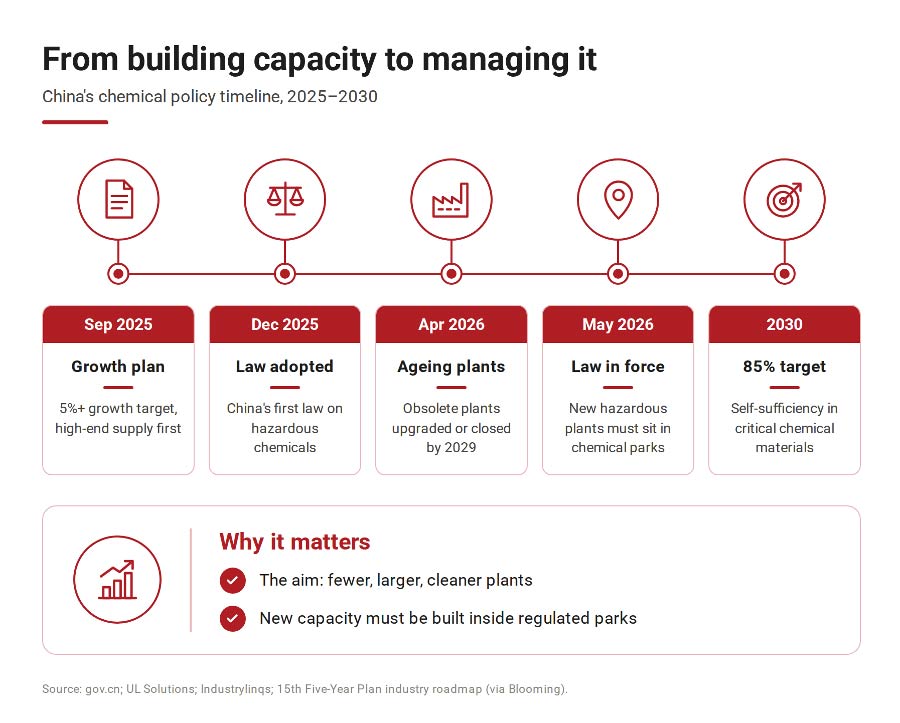
The Work Plan for Stabilising Growth in the Petrochemical and Chemical Industry (2025–2026), issued by the Ministry of Industry and Information Technology (MIIT) and six other departments in September 2025, targets average annual growth in value added of more than 5 percent. It strictly controls new refining capacity through capacity replacement rules and sets the pace of new ethylene and paraxylene additions to prevent overcapacity. Its priority, however, is to expand high-end supply, with breakthroughs sought in electronic chemicals, high-end polyolefins, high-performance fibres, speciality rubbers and high-performance membranes.
A clean-up of ageing plants
In 2025, MIIT asked provincial authorities to report on petrochemical units that had reached their design life or had operated for more than 20 years. In April 2026, MIIT and six other departments followed up with an action plan requiring local governments to decide, plant by plant, whether obsolete facilities should be modernised or closed by 2029, with annual rolling surveys from 2027 to identify further outdated capacity. The plan sets no national capacity figure, so the pace will vary by province.
A long-term shift from fuels to materials
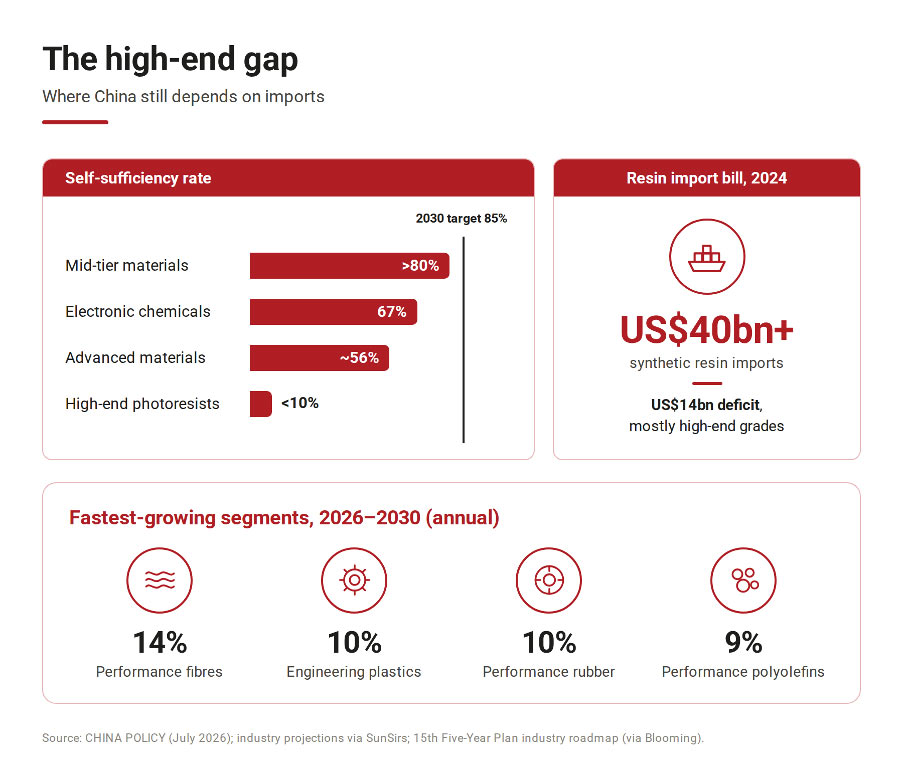
Industry roadmaps for the 15th Five-Year Plan period (2026–2030) call for refiners to move from producing fuels to supplying chemical feedstock and for self-sufficiency in critical chemical materials to reach 85 percent by 2030. Industry projections reported by SunSirs put annual growth over the plan period at 9 percent for high-performance polyolefins, 10 percent for speciality engineering plastics and high-performance rubber, and 14 percent for high-performance fibres, well above the 5 percent annual growth the government has targeted for the industry as a whole in 2025–2026.
Together, these measures describe a clear policy aim: fewer, larger, cleaner plants located inside regulated parks and producing more of what China currently imports.
Where are the opportunities for foreign companies?
The opportunity sits at the top of the value chain, where China’s self-sufficiency is weakest. According to research firm CHINA POLICY, China imported more than US$40 billion of synthetic resins in 2024 and ran a US$14 billion deficit almost entirely in high-end grades, such as metallocene polyethylene, polyolefin elastomers, high-performance polycarbonate, nylon-66 chain, and halogenated butyl rubber. Self-sufficiency already exceeds 80 percent in mid-tier materials such as polyurethanes and thermoplastic elastomers but falls to around 56 percent for advanced materials. In electronic chemicals, a headline self-sufficiency rate of 67 percent masks a deeper gap: locally made high-end photoresists account for less than 10 percent of supply.
Policy supports foreign investment in these segments. The 2025 Catalogue of Encouraged Industries for Foreign Investment, in force since 1 February 2026, contains 1,679 items, including 205 net additions, and lists chemical new materials such as polybutadiene rubber, polyphenylene sulphide and cycloolefin polymers among its core areas. Encouraged projects can qualify for customs duty exemptions on imported equipment, preferential land pricing and, in the western region….
The two largest recent foreign investments show what the winning model looks like:
- BASF, Zhanjiang (Guangdong): BASF inaugurated its €8.7 billion Verbund site on 26 March 2026, the largest single investment wholly owned by a German company in China. It is built around a 1 Mtpa steam cracker that can run on naphtha or butane, with 18 plants serving mainly Chinese customers. BASF estimates that Greater China accounts for about half of the global chemical market but only 14 percent of its sales and will direct 20 percent of its 2026–2029 capital expenditure to Asia Pacific.
- ExxonMobil, Huizhou (Guangdong): ExxonMobil’s complex in the Daya Bay Petrochemical Industrial Park began operating in July 2025 as the first major petrochemical project in China wholly owned by a US company. Its first phase combines a 1.6 Mtpa flexible-feed cracker with high-performance polyethylene and polypropylene units in a Huizhou cluster that also hosts Shell, BASF and Clariant.
What does the Hazardous Chemicals Safety Law change?
Adopted on 27 December 2025 and in force since 1 May 2026, the Hazardous Chemicals Safety Law is China’s first national law dedicated to hazardous chemicals. Its 127 articles replace the State Council’s Regulations on the Safe Management of Hazardous Chemicals (Decree No. 591) with a higher-ranking legal basis. The changes most relevant to foreign companies are:
- A property-based definition: Hazardous chemicals are now defined by their properties, such as toxicity, corrosiveness, flammability or explosiveness. A catalogue will still be published, but a substance whose hazards have not yet been determined may not be produced, stored, used or transported without authorisation.
- Chemical parks enter the law: Parks must be designated and periodically reviewed by provincial governments and must complete a comprehensive safety risk assessment at least every three years. New or expanded hazardous chemical production projects must be located inside them, except for projects linked to other industries or meeting national requirements; non-chemical enterprises, except supporting service providers, may not enter.
- Permits extend to users: Companies that use hazardous chemicals above specified types or quantities now need a safety-use permit, not only producers and traders.
- Public safety assessments: Producers and storage operators must commission a qualified safety assessment every three years and make the report public.
- Personal and criminal liability: Principal managers bear full responsibility for safety. Highly toxic chemicals and explosive precursors cannot be sold to individuals or online, transaction records must be kept for three years instead of one, and high-risk illegal operations can attract criminal liability before any accident occurs.
In practice, the law turns location into a regulatory decision. Expansion projects at sites outside a designated park may fail safety review, and existing facilities could face relocation or closure. Importers and distributors are affected too: a property-based definition means product classifications, safety data sheets, and labels need reviewing, and customers may need their own use permits.
For the site selection and approval steps involved in building a plant, see our guide to setting up a manufacturing WFOE in China.
China Entity Setup for Chemical Manufacturers
Planning a new plant or an expansion under the Hazardous Chemicals Safety Law? DSA can advise on entity structure, business scope drafting, and the registrations needed to operate in a chemical park.What should foreign chemical companies do now?
Companies are advised to:
- Map the portfolio against the import gap: Separate grades China still imports, such as high-end polyolefins, engineering plastics, electronic chemicals and speciality rubbers, from commodity grades where Chinese producers now set prices. Local investment makes the most sense in the first group.
- Check Encouraged Catalogue eligibility early: whether a product or activity is listed affects duties on imported equipment, land costs, and, in some regions, the tax rate.
- Treat park selection as a compliance decision: Confirm the park’s provincial designation and latest safety risk assessment, and weigh feedstock access and port logistics after this year’s Hormuz disruption.
- Reclassify products under the new definition: Review safety data sheets and labels, and check whether customers’ use of your products triggers a safety-use permit.
- Audit existing sites: Record the age of production units and the status of safety assessments, and confirm whether planned expansions would be permitted outside a park.
- Screen acquisition targets carefully: Consolidation will bring assets to market, but facilities flagged in the ageing-plant surveys may face mandatory upgrades or closure by 2029.
- Protect process know-how: The high-end grades still open to foreign firms are where Chinese competitors are investing most heavily, so trade secret protection matters as much as market access.
Key takeaways
China’s chemical industry is two markets. In commodity chemicals, a decade of self-sufficiency-driven investment has produced a surplus that is eroding margins and will persist through at least 2026. At the top of the value chain, China still imports tens of billions of dollars of speciality materials a year, and policy is designed to close that gap. Beijing is pruning the first market and rebuilding the second inside regulated parks under a stricter safety law.
For foreign investors, that narrows the opportunity but sharpens it: the best placed are those with differentiated technology, a clear view of which grades China cannot yet make, and the compliance capability to operate where new capacity must now be built.
How Dezan Shira & Associates can help
Foreign chemical companies assessing China need their investment case tested against their product portfolio, feedstock position and compliance obligations, rather than against headline market data. Dezan Shira & Associates advises multinational companies on market entry, establishment and compliance across China and Asia. Our team can assist with:
- Market research and location analysis;
- Corporate establishment;
- Regulatory compliance reviews and risk assessments under China’s new safety and environmental rules;
- Legal and financial due diligence on acquisition targets and joint venture partners; and
- Tax advisory, including eligibility for incentives under the Encouraged Catalogue.
With offices across China and throughout Asia, Dezan Shira & Associates helps companies align their China operations with their wider regional strategy.
Contact our local advisory team to schedule a consultation.