Foreign investors preparing to enter China in 2026 must decide on their hiring workforce process before (not after) settling on a corporate structure. In this article, we compare the three principal engagement models available under Chinese law, examine how the regulatory developments of 2025 and 2026 have altered the calculus for each, and set out the design decisions companies should take prior to making their first hire.
For companies planning an entry into the Chinese market, workforce structuring has traditionally been treated as an administrative matter to be addressed aftera company has established its presence in China. Recent regulatory developments suggest this sequencing should be reconsidered. Increasingly, however, the way a business engages its workforce is becoming a strategic decision that can significantly affect compliance exposure, operational flexibility, and employment costs.
Under Chinese law, foreign investors have three principal workforce enagement models at their disposal:
- Direct hiring through a locally incorporated entity;
- Labour dispatch; and
- Service outsourcing.
Each allocates managerial control, legal responsibility, and compliance risk differently. Choosing the right model therefore requires more than a simple assessment of staffing needs. It also requires an understanding of the legal boundaries attached to each arrangement.
Recent regulatory developments have made those boundaries more consequential. The Supreme People’s Court’s (SPC) Judicial Interpretation II on the Application of Law in Labor Dispute Cases (Fa Shi [2025] No. 12, hereinafter “Judicial Interpretation II”), which took effect on 1 September 2025, together with the migration of social insurance collection into data-driven tax enforcement and the introduction of China’s first national framework for workers beyond retirement age, has increased the legal and operational implications of workforce structuring decisions.
Against this backdrop, understanding the advantages, limitations, and compliance risks associated with each model is becoming an essential part of market-entry planning
HR and Payroll Compliance
From employment contracts and social insurance to payroll and HR administration, ensure your workforce structure meets China’s evolving labour requirements.Direct hiring: Full exposure, but a record that can be designed
Direct employment through a wholly foreign-owned enterprise (WFOE) or joint venture remains the only route that permits both revenue generation in RMB and the unrestricted engagement of Chinese nationals. It also concentrates the full weight of the Labour Contract Law on the employer, including mandatory written contracts, the open-ended contract trigger following two consecutive fixed terms, a closed statutory list of termination grounds, and statutory severance obligations.
Recent developments
Recent developments have reinforced the importance of strict compliance with China’s employment framework. Rather than introducing fundamentally new obligations, Judicial Interpretation II clarifies how courts should handle a range of common labour disputes, strengthens the protection of employees’ statutory rights, and reduces the scope for employers to rely on informal arrangements that lack a clear legal basis.
This trend is particularly visible in the area of social insurance. The obligation to make statutory social insurance contributions has long been established under Chinese law. Judicial Interpretation II clarifies the consequences of non-compliance, confirming that waiver agreements are invalid and that employees may claim severance if they resign because mandatory contributions were not made.
Enforcement has also become more stringent. The tax administration now leads the collection of social insurance contributions and applies risk-based monitoring to identify potential non-compliance. Penalties include a daily late charge of 0.05 per cent of the outstanding amount and, where contributions remain unpaid, a fine of up to three times the amount owed.
Key considerations for new entrants
For new entrants, the choice of direct hiring should be evaluated in light of both compliance obligations and business objectives. Although statutory labour costs remain an important consideration, direct employment can provide advantages in areas such as workforce stability, employee engagement, management control, and the protection of proprietary know-how. Companies planning a long-term presence in China may therefore view the additional compliance requirements as a trade-off for greater operational certainty and organisational control.
Labour dispatch: A narrow statutory channel with one structural exception
Labour dispatch is a tripartite arrangement in which a licensed agency employs the worker while a host company directs the work.
Some businesses favour this model because it can reduce the administrative burden associated with direct employment, with the dispatch agency assuming responsibility for employment contracts, payroll, social insurance contributions, and other HR administration. For companies entering a new market, managing temporary staffing needs, or maintaining a lean organisational structure, labour dispatch can therefore provide a degree of workforce flexibility.
Its statutory boundaries, however, are strict.
Legal restrictions
Under the Interim Provisions on Labour Dispatch (MHRSS Order No. 22), dispatch may only be used for temporary positions of no more than six months, auxiliary positions providing support to the core b… covering permanent employees who are absent, and the total number of dispatched workers may not exceed 10 per cent of the employer’s overall workforce, a figure that includes the dispatched workers themselves. Auxiliary designations are subject to internal consultation procedures, and the principle of equal pay for equal work applies throughout.
Two features of the regime deserve closer attention than they typically receive in market-entry planning:
- Position-type limits operate independently of the headcount cap: Dispatched employees engaged in positions that are not genuinely temporary, auxiliary, or substitute may bring claims directly against the host company, and labour arbitration commissions and courts retain discretionary power to find a factual employment relationship
- Representative office exception: Because a representative office (RO) does not have a separate legal personality and cannot directly employ Chinese nationals, it is exempted from the restrictions on proportion and position type. For a small, non-revenue-generating exploratory presence, the RO-plus-dispatch structure therefore remains genuinely viable, though its insulation has narrowed.
Key considerations for new entrants
For foreign investors, labour dispatch is best viewed as a supplementary staffing solution rather than a substitute for direct employment. The model may be suitable where workforce needs are temporary, support-oriented, or subject to short-term fluctuations, allowing businesses to access talent without assuming the full administrative responsibilities of employment. It may also serve as a practical option for representative offices, which cannot directly employ Chinese nationals.
However, companies intending to establish a long-term operational presence in China should assess the model carefully. The statutory restrictions on position type and headcount, combined with the risk that an improperly structured arrangement could be re-characterised as a direct employment relationship, limit labour dispatch’s suitability for core business functions. Businesses seeking greater management control, workforce continuity, and long-term talent retention may therefore find direct employment to be the more sustainable option despite the higher compliance burden.
Service outsourcing: The model regulators watch most closely
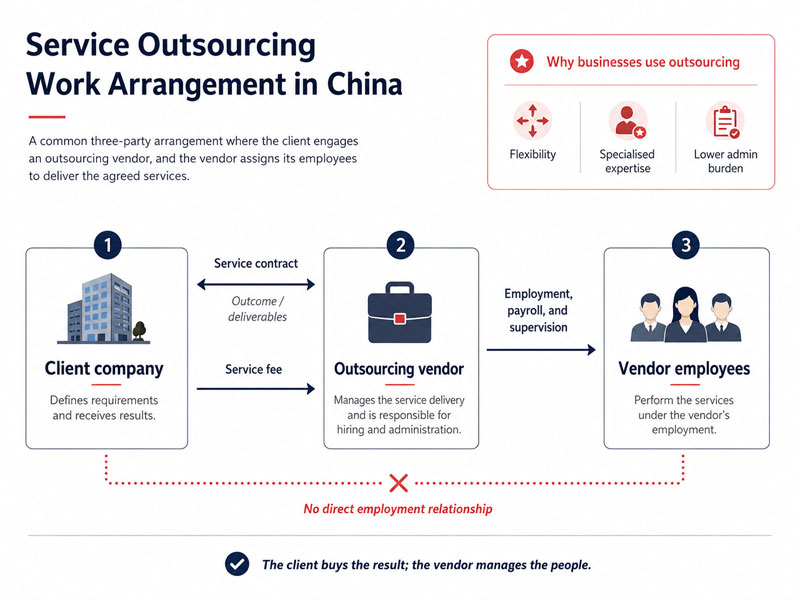
Genuine service outsourcing involves contracting for a defined service or business outcome rather than the provision of personnel. Where properly structured, it falls outside the labour law framework altogether, as no direct employment relationship exists between the client and the contractor’s employees.
Businesses may favour service outsourcing because it enables them to obtain a defined service or business outcome without directly hiring, managing, and administering the personnel involved. This can reduce internal HR and payroll burdens, provide access to specialised expertise, and offer greater flexibility in scaling certain functions as business needs change. For foreign investors, it may therefore be an attractive way to manage non-core activities while keeping internal headcount and administrative complexity relatively lean.
Key condierations for new entrants
Precisely because outsourcing can deliver these advantages, regulators and courts pay close attention to whether an arrangement is genuinely outcome-based or merely labour dispatch in disguise. The distinction is particularly important, as an improperly structured outsourcing arrangement may be re-characterised as an employment or labour dispatch relationship, exposing the parties to additional compliance risks and liabilities.
The design discipline for new entrants is therefore clear:
- Statements of work drafted to deliverables rather than headcount;
- Pricing by outcome rather than person-hours;
- The vendor’s own supervisors managing performance; and
- No client-side appraisal of individual outsourced staff.
Choosing between the three models
The three models are not interchangeable options on a menu. Each is tied to a specific corporate vehicle, a specific category of role, and a specific set of statutory boundaries. The table below sets out how they compare on the questions that matter before entry.
|
|
Direct hire |
Labour dispatch |
Service outsourcing |
| Legal employer | Your WFOE or JV | Licensed dispatch agency | The service provider |
| Who directs the work | You, as employer | You, as host company | The provider, through its own supervisors |
| Entity required | WFOE or JV | WFOE/JV as host, or a representative office | None to contract; an entity is still needed if the function supports RMB revenue |
| Roles it suits | Core, revenue-generating, IP-sensitive, long-term | Temporary (six months or fewer), auxiliary, or replacement positions | Severable functions: Accounting, tax, compliance, IT support, logistics, facilities, parts of customer service |
| Statutory limits | Full Labour Contract Law regime: written contracts, open-ended contract trigger, closed termination grounds, statutory severance | 10 per cent headcount cap and three permitted position types; equal pay for equal work; ROs exempt from the cap and position limits | None, provided the outsourcing is genuine; dispatch rules apply in full if recharacterised |
| Principal risk | Cost and exit rigidity, with no remaining arbitrage on social insurance | Joint and several liability with the agency; deemed direct employment where position limits are breached | Recharacterisation as disguised dispatch, with fines, abatement orders, or licence revocation |
| Flexibility at exit | Low | Moderate, with limited grounds for returning workers to the agency | High, through the commercial contract |
Which model for which entrant
Three entrant profiles cover most cases.
- Exploratory presence, no revenue: For market research, liaison, and supplier oversight with no intention to invoice in RMB, a representative office staffed through a licensed dispatch agency is the lowest-commitment compliant structure, and the RO exemption from dispatch caps and position limits also makes it workable for small teams. Its ceiling is clear, nevertheless. Once business activities expand into revenue-generating operations, a more substantive structure will generally be required.
- Commercial entry with a committed team: Where the business plans to conduct sales, service delivery, manufacturing, or or other revenue-generating activities in China, a WFOE or JV supported by direct employment is generally the most suitable foundation. The relevant question is not whether to hire directly, but which positions are sufficiently temporary, auxiliary, or specialised to justify an alternative arrangement.
- Phased market entry: Companies that wish to maintain operational flexibility during the early stages of market entry may adopt a hybrid approach. Core personnel and strategically important functions can be hired directly, while genuinely temporary roles may be filled through labour dispatch and non-core, outcome-based activities may be outsourced to specialised service providers. This approach allows businesses to balance compliance, operational control, and scalability while retaining the flexibility to adjust their workforce structure as their China operations mature.
How Dezan Shira & Associates can help
Dezan Shira & Associates assists foreign investors with workforce structuring, employment and HR compliance, payroll and social insurance, and ongoing labour risk management. Our teams across China can help businesses assess the most appropriate employment model and maintain compliance as their workforce grows. For support with employment and HR matters in China, contact us to speak with our advisors.