Incorporation gives a company legal status in China, but it does not by itself make the business operational. During the first 90 days, foreign investors must turn that legal status into a functioning business by securing control over the entity, activating banking and tax functions, funding operations, and preparing to hire employees and issue invoices.
Once the business license has been issued, the company begins the practical work of becoming operational, but the legal, financial, and administrative tasks that follow do not share a single deadline. Some timelines run from establishment, while others are triggered by opening an account, hiring staff, or carrying out a transaction; requirements and processing times may also vary by locality, bank, sector, and company profile. This article outlines the principal tasks foreign investors should address during the first 90 days and explains why their sequence matters.
Post-Incorporation Compliance
Dezan Shira & Associates provides one-stop post-incorporation compliance, accounting, tax, and other services.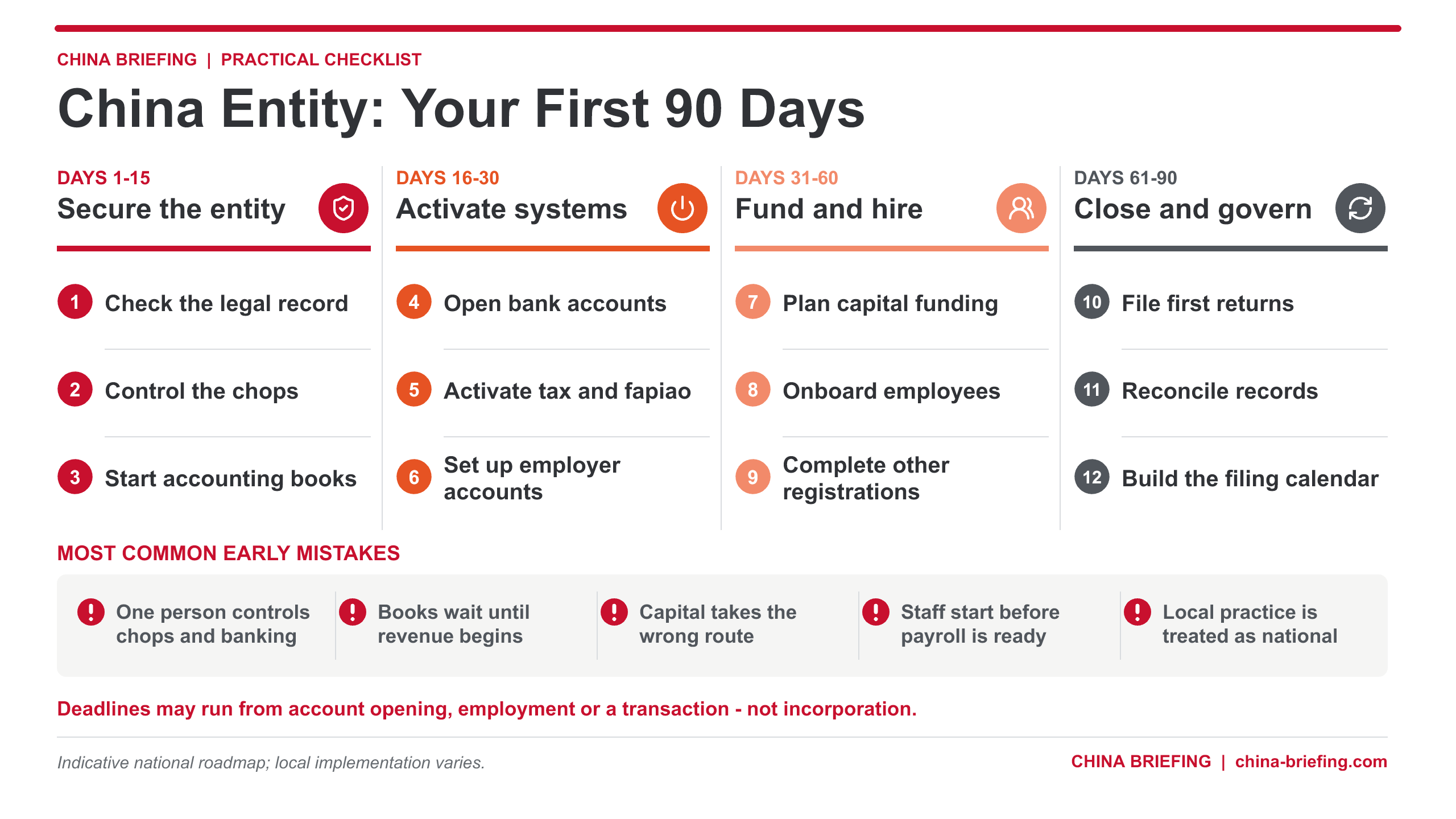
Secure the company’s legal identity and authority
Management should begin by reviewing the incorporation documents, including the business license, articles of association, shareholder and appointment documents, registered address and business scope, and the recorded details of the legal representative, directors, supervisors or audit committee, and senior management.
These records should accurately reflect the company’s intended activities, as errors in the registered address, business scope, or officer details may resurface during bank due diligence, tax setup, or license applications and cause avoidable delays.
The review should extend beyond factual accuracy because the business license, including an electronic license, must also be displayed prominently at the registered business premises under the market entity registration implementation rules. This requirement illustrates a broader point: incorporation produces the company’s legal documents, but management must still complete the practical steps that make the business operational and compliant.
Companies should also confirm that beneficial owner information has been properly filed at establishment. Under the Beneficial Owner Information Management Measures, ultimate beneficial owner (UBO) information is normally submitted through the relevant registration system as part of the company establishment registration process. Any subsequent changes to the beneficial owner information should also generally be reported within 30 days.
Management should appoint a named person to monitor government notices and maintain the registered contact details for the legal representative, registration liaison, finance lead, and tax personnel, as outdated or unattended contact information can cause the company to miss notices or filing deadlines.
Obtain the right chops and control their use
In China, company chops generally perform the function that signatures serve in Western jurisdictions and are used to execute documents and access corporate services. Depending on the business, the set may include the official chop, legal representative chop, financial chop, invoice chop, and customs chop. Companies should obtain them through an authorized provider and follow the applicable local public security requirements.
Because possession of a chop can carry significant authority, courts consider the authority and conduct of the person acting for a company rather than only the appearance or filing status of a seal. The central question is therefore not only which chops the company holds, but also who may use them. Clear internal controls should cover custody, storage, approval thresholds, usage records, supporting documents, and loss or replacement. The official, financial, and legal representative chops should ordinarily be held by different individuals to reduce the risk of unauthorized commitments, payments, or filings.
Open the bank accounts and build payment controls
After securing its chops, the company should open an RMB basic account, and where applicable, a capital account. Under the People’s Bank of China’s account framework, an enterprise may maintain only one RMB basic account, which is used for routine settlement and cash receipts and payments. The capital account is used to receive capital contributions from overseas investors. Depending on its business needs, the company may also open foreign-currency settlement accounts or any other specialized accounts.
When choosing a bank, foreign investors should look beyond convenience and consider cross-border capabilities, online approval functions, payroll, service language, and group treasury requirements, while recognizing that bank due diligence may cover the parent company, UBO, legal representative, premises, counterparties, and anticipated transactions.
Once the accounts are open, the company should introduce payment controls, including dual approval for significant payments, limits for authorized users, and separation between banking credentials and company chops. In addition, the national implementation rules for the Tax Collection Administration Law require taxpayers to report accounts within 15 days of opening or changing them.
Outsource Finance Operations
Streamline bookkeeping, accounting, financial reporting, and statutory compliance.Turn registered capital into a funding plan
Registered capital requires separate planning because it does not automatically have to be paid in full within the first 90 days. For a newly established limited liability company, the current Company Law generally requires shareholders to pay their subscribed contributions within five years of establishment, subject to the articles of association and any special rules applying to the company or sector.
The five-year period is a statutory deadline, not a cash-flow plan, so shareholders should determine when the business will need funds and ensure that each contribution matches the amount, method, and timing recorded in the articles. Cross-border contributions should be coordinated with the bank so that foreign exchange registration, the capital account, remittance purpose, and supporting documents align. Capital contributions, shareholder loans, and trading receipts are not interchangeable, and using the wrong funding route can create foreign exchange, tax, and accounting complications.
Companies should also ensure that capital information has been properly disclosed. Under the registered capital implementation rules, changes to subscribed or paid-in capital, contribution methods, or contribution periods must generally be publicized through the National Enterprise Credit Information Publicity System within 20 working days.
Activate tax, accounting, and fapiao before revenue begins
Receiving a unified social credit code does not mean that every tax function is ready to use. Although a new company does not generally receive a separate tax registration certificate, it must still confirm its information, activate the electronic tax system, identify its local tax authority, and check its assigned taxes and filing periods rather than assuming that every function was activated automatically.
Accounting should begin immediately because the implementation rules for the Tax Collection Administration Law require a business taxpayer to establish accounting books within 15 days of receiving its business license or incurring a tax obligation. The company should therefore appoint an accountant or qualified provider and establish procedures for monthly closing, expense reimbursement, document retention, and approvals.
Filing obligations depend on the taxpayer’s status and activities and commonly include value-added tax, corporate income tax, surcharges, and individual income tax withholding. A required return must still be filed even when no tax is payable.
Fapiao readiness is equally important because customers may require a valid invoice before making payment. China’s fully digital electronic invoice system has been deployed nationwide since 1 December 2024, allowing eligible new taxpayers to use the electronic platform without dedicated tax-control equipment. The company should nevertheless confirm its invoicing authorization and electronic archiving arrangements with its local tax authority.
Before issuing its first customer invoice, the company should test the process and establish rules for invoice data, corrections, input VAT confirmation, and electronic archiving, bearing in mind that outsourcing accounting or tax work does not remove management’s responsibility for accurate records and timely filings.
Become employer-ready before the first hire
Employer registrations should be addressed before payroll begins because the Social Insurance Law generally requires an employer to complete social insurance registration within 30 days of establishment. Housing provident fund registration should likewise be completed within 30 days of establishment, although contribution rates and administration vary by locality.
Registration alone is not sufficient, so the company should test its employer accounts and payment arrangements and apply the correct local contribution bases and rates. Employees must generally be registered within 30 days of hiring, while payroll must be integrated with individual income tax (IIT)withholding. Probation does not postpone either obligation.
Before the first employee starts work, the company should prepare an employment contract compliant with Chinese law, an employee handbook, payroll procedures, working time and leave rules, confidentiality provisions, and employee privacy notices. As a matter of good practice, the written contract should be signed by the first working day; in any case, the Labor Contract Law generally requires the contract to be concluded within one month after employment begins.
Foreign employees require additional planning because China’s Exit and Entry Administration Law prohibits an employer from hiring a foreign national who lacks the required work permit and work-type residence permit. A business visitor should therefore not begin performing local employment duties while an application is pending.
End-to-End Advisory
From new market entry to complex setups, we tailor accounting services to meet evolving needs.Complete the conditional registrations and Day 90 health check
Some post-incorporation tasks apply only to particular activities: importers and exporters may need customs and China Electronic Port arrangements, while regulated businesses may require sector licenses. The company’s premises or operations may also trigger fire safety, environmental, occupational health, product, data, website, or telecommunications requirements. Management should map these requirements against the business scope, premises, products, data flows, and planned transactions.
Foreign-invested enterprises should separately verify that the initial foreign investment information report was submitted during establishment. According to government guidance on foreign investment information reporting, changes that do not require a company registration amendment may still need to be reported within 20 working days. The annual report for the previous year must be submitted between 1 January and 30 June beginning in the year after establishment. The general enterprise annual report follows the same January-to-June window through the National Enterprise Credit Information Publicity System.
By Day 90, management should reconcile five sets of records: corporate registration; beneficial ownership and foreign investment; banking and capital; tax and invoices; and employment and payroll. Any discrepancy should be assigned to a named person with a correction deadline.
Investor takeaway: Test each system before relying on it
Foreign investors should treat the first 90 days as a practical setup period rather than an administrative afterthought, asking not only whether each registration has been submitted but whether the underlying system works.
A company may be legally incorporated yet still encounter operational bottlenecks if its bank accounts are not fully activated, tax and invoicing functions are not configured, employment registrations are incomplete, or internal controls have not been implemented. Conducting a structured post-incorporation review can help identify gaps before they affect business operations, compliance, or cash flow.
Dezan Shira & Associates assists foreign investors throughout this critical post-incorporation stage, providing support with bank account opening, registered capital planning, tax and accounting setup, payroll and HR administration, compliance reviews, and ongoing corporate governance. By helping companies coordinate regulatory, financial, and operational requirements from the outset, we enable businesses to transition more efficiently from incorporation to full operational readiness in China. Contact us to speak to our local advisors.