

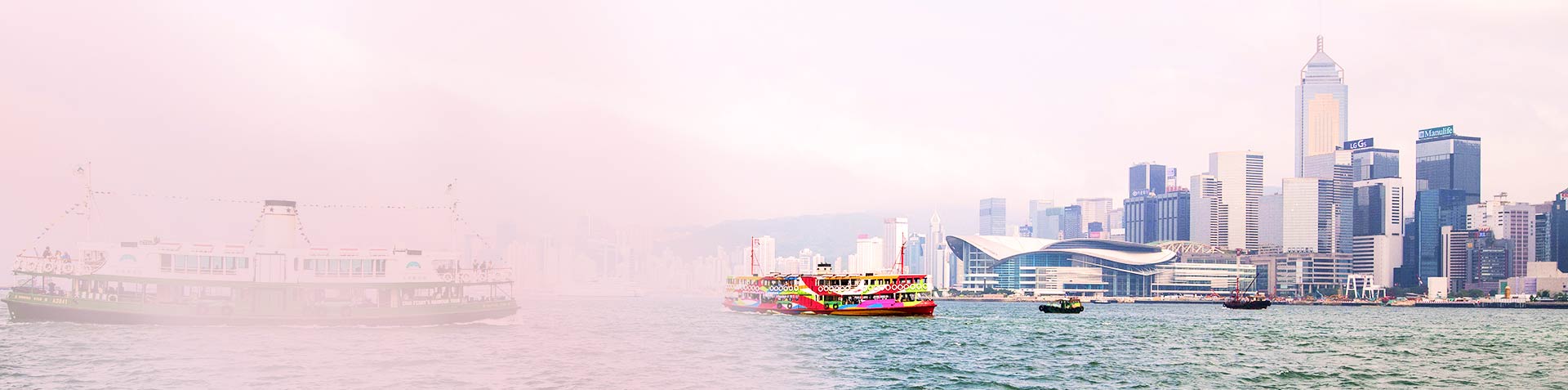
A highly dynamic and globally connected city, Hong Kong is a leading gateway to the Chinese mainland and the broader Asia region. Its strategic location, business-friendly environment, and world-class infrastructure make it one of the most competitive destinations for companies, investors, and professionals worldwide.

In this guide, we explore why Hong Kong continues to attract businesses seeking to capitalize on key market advantages, including:
- An open, fair, and efficient business environment
- Competitive tax regime
- Excellent legal and dispute resolution services under the rule of law
- Closer proximity to markets in Asia, including Chinese mainland
- Leading global financial services center
- Network of international free trade and tax agreements
- World-class infrastructure with sophisticated support services
- Highly skilled and multicultural talent pool and a liberal Immigration policy
Efficient business landscape
Hong Kong’s economic system is defined as a free-market economy characterized by minimum intervention from the government, low taxation, free port trade, and a highly internationalized and modernized financial market.
The city’s service-oriented economy is especially powerful in financial services, international trade, and tourism. Additionally, it has strong economic links to the China's Mainland and other major economies in the Asia Pacific region.
As one of the most Laissez-faire economies in the world, the government’s policy is strictly non-interventionist.
However, recognizing the importance of innovation and technology in driving future growth, the Hong Kong government has launched various support programmes to nurture high-tech startups and encourage business expansion. Notable initiatives include:
- Innovation and Technology Fund (ITF): Provides financial support to projects that promote innovation and technology upgrading in industry.
- Cyberport Incubation Programme: Offers up to HKD 500,000 in financial assistance and business support to digital tech startups.
- Hong Kong Science and Technology Parks (HKSTP) Incubation Programme: Supports early-stage technology companies with funding, lab facilities, mentorship, and market access.
- Enterprise Support Scheme (ESS): A funding scheme under the ITF that provides matching grants of up to HKD 10 million for R&D activities.
- StartupHK: A government-driven initiative that connects startups with investors, industry partners, and global networks.
In addition to government support, several private and institutional funding options are available for businesses aiming to raise capital and scale operations:
- Alibaba Entrepreneurs Fund – Hong Kong: Provides funding and mentorship to young entrepreneurs and high-growth startups.
- AngelHub and WHub: A startup ecosystem and equity crowdfunding platform connecting founders with angel investors and venture capital.
- Gobi Partners: A venture capital firm that actively invests in Hong Kong-based tech startups.
- Chinaccelerator & The Mills Fabrica: Offer funding, accelerator programmes, and investor networks, particularly in fashion, design, and tech industries.
To further enhance its pro-business environment, Hong Kong introduced a new company re-domiciliation regime in 2024, allowing non-Hong Kong-incorporated companies to re-domicile to Hong Kong while retaining their legal identity. This provides an attractive pathway for international and offshore-based businesses to shift their headquarters or operations to Hong Kong, taking advantage of its legal infrastructure, financial ecosystem, and proximity to the Chinese Mainland and the Greater Bay Area. This measure reflects the city's commitment to attracting global business players and reinforces its position as a leading international business hub.
The absence of exchange controls, corruption-free government, and free flow of information, capital, and talent has enabled Hong Kong to maintain a free and efficient business environment for business activities and commerce.
In addition, Hong Kong enjoys a strong reputation as a "free port" with streamlined customs clearance processes. The city imposes no tariffs on imported goods, has no import quotas, and applies excise duties to only four specific commodities: hard alcohol, tobacco, oil, and methyl alcohol.
Competitive tax regime
Businesses and individuals enjoy one of the most tax-friendly systems in the world.
Hong Kong imposes only three kinds of direct taxes – profits tax (for incorporated bodies), salaries tax (for personal income), and property tax (for income sources from Hong Kong property).
There are also generous allowances and deductions, which can reduce the taxable amount.
| Business type | Assessable profits | Tax rate |
|---|---|---|
| Corporations | First HK$2 million | 8.25% |
| Over HK$2 million | 16.5% | |
| Unincorporated Businesses | First HK$2 million | 7.5% |
| Over HK$2 million | 15% | |
|
Standard Rates:
Conditions:
|
||
Legal and dispute resolution services
Hong Kong is home to approximately 850 local solicitor firms and more than 70 global law firms. Benefiting from a sound and independent legal system rooted in English common law under the Basic Law, Hong Kong has long been a regional hub for dispute resolution, with the Hong Kong International Arbitration Centre rated the most preferred seat of arbitration outside Europe.
The independent judiciary under the Basic Law ensures Hong Kong remains within the common law system. The Court of Final Appeal is the highest court in HKSAR, and the HKSAR legal system is separated from the one governing the PRC under the principle of "One Country, Two Systems."
Proximity to the Chinese Mainland, Asian markets
Hong Kong's ideal location in Asia enables businesses to tap into opportunities across the Guangdong-Hong Kong-Macao Greater Bay Area (GBA) and throughout the wider region. The Mainland and Hong Kong Closer Economic Partnership Agreement (CEPA), signed in 2003 and continuously enhanced, facilitates preferential access to the mainland market for Hong Kong products and services. Effective from March 1, 2025, the Second Agreement Concerning Amendment to the CEPA Agreement on Trade in Services introduced new liberalization measures across several service sectors.
The GBA — a mega-city cluster comprising nine Guangdong cities plus Hong Kong and Macao — provides streamlined access for Hong Kong and international investors to the Chinese Mainland. The technology sector, particularly fintech, has emerged as a strategic development focus, with strong support from InvestHK, the Hong Kong Monetary Authority, and the Financial Services and the Treasury Bureau.
Leading financial services center
As one of the world's leading international financial centers, Hong Kong thrives on close financial integration with the Chinese Mainland, extensive global networks, a sound legal system, a low and simple tax regime, free capital flows, and a large pool of financial talent. Key offerings include:
- Unique access channels to and from China: Including Stock Connect, Bond Connect, and the two-way cross-boundary Wealth Management Connect in the GBA.
- Largest offshore RMB center: Offering a wide range of RMB financial services with a robust market infrastructure including the RMB RTGS system.
- Banking hub: Asia's most prominent banking hub for Chinese and international banks.
- Corporate Treasury Centers (CTCs): Tax incentives to encourage more corporations to set up CTCs in Hong Kong.
- Asset management: The largest international asset management hub in Asia, and Asia's largest global private wealth management and hedge fund center.
- Fintech hub: Dedicated to building itself as Asia's leading fintech hub via the HKMA's Smart Banking Initiatives and "Fintech 2025" strategy.
- Green finance: A deep, liquid bond market well-positioned for green and sustainable finance, supported by the Government Green Bond Program and the Green and Sustainable Finance Grant Scheme.
Free trade and tax agreements network
Hong Kong has been actively seeking to expand its Free Trade Agreement (FTA) and Double Taxation Avoidance Agreement Network to secure favorable conditions for businesses operating in the SAR.
Free trade agreements
So far, Hong Kong has signed nine FTAs, respectively with
- The China's Mainland (June 2003);
- New Zealand (March 2010);
- The Member States of the European Free Trade Association (EFTA) (June 2011);
- Chile (September 2012);
- Macao (October 2017);
- The Association of Southeast Asian Nations (ASEAN) (November 2017);
- Georgia (June 2018);
- Australia (March 2019); and
- Peru (November 2024).
In addition to CEPA, Hong Kong has signed FTAs with 13 of the 15 Regional Comprehensive Economic Partnership (RCEP) members, and has submitted a formal accession request to join RCEP — the largest FTA globally.
Separately, FTA negotiations with the Maldives were completed in 2017 though the agreement has not yet been formally signed; this remains an active area of trade diplomacy.
Double Taxation Avoidance Agreements
As of March 2026, Hong Kong has signed comprehensive DTAs (CDTAs) with 57 jurisdictions and has commenced or scheduled negotiations with 18 jurisdictions. Recent milestones include the CDTA with Türkiye entering into force on January 30, 2026, and Hong Kong signing a new CDTA with Norway in December 2025 and with the Kyrgyz Republic in March 2026. The DTA network helps investors assess potential tax liabilities, eliminates double taxation via tax credit methods, and provides an added incentive for cross-border business activity
World-class infrastructure and support services
Hong Kong provides some of the most advanced business infrastructure in the world, with one of the most efficient and affordable public transport systems. Hong Kong International Airport (HKIA) has been named the world's busiest cargo airport for 2025 — the 15th time since 2010 — with cargo throughput reaching 5.07 million tonnes during the year. The Guangzhou-Shenzhen-Hong Kong Express Rail Link connects Hong Kong West Kowloon Station to Shenzhen in 14 minutes, with a journey to Guangzhou taking just 46 minutes. The 55 km Hong Kong-Zhuhai-Macao Bridge — the longest sea-crossing bridge in the world — brings the Western Pearl River Delta within a three-hour drive.
Highly skilled talent and liberal immigration policies
Hong Kong has a diverse talent pool equipped with the skills and knowledge to drive business growth. The city is home to 22 degree-awarding higher education institutions. Five institutions, the University of Hong Kong, Chinese University of Hong Kong, Hong Kong University of Science and Technology, Hong Kong Polytechnic University, and City University of Hong Kong, rank among the top 100 globally in the 2026 QS World University Rankings. Many business professionals are bilingual or trilingual, speaking English, Cantonese, and Mandarin. Hong Kong has also long maintained an open immigration policy, with approximately 170 countries and territories allowed visa-free visits ranging from 7 to 180 days.
Why do foreign companies relocate to Hong Kong?
When considering Hong Kong, or any other destination, as a potential location for relocation, foreign investors must conduct thorough research across various critical factors relevant to their specific needs.
These factors encompass infrastructure, geographical locations, the availability of skilled talent, access to raw materials, incentive programs, logistical capabilities, and several other considerations. A diligent analysis of these factors is essential for making informed decisions regarding relocation.
Here are some top reasons why companies choose to relocate to Hong Kong:
- All of the stated Top Reasons to Invest in Hong Kong
- Government support for businesses
- Structured system for business registration
- Cost-efficient operations due to simple and low taxes
Summary: Top 10 Reasons to Invest in Hong Kong
|
1. |
Proximity to China and Asia markets |
Ideal location in Asia that enables businesses to tap into the various opportunities in the Greater Bay Area and throughout the rest of the region. |
|
2. |
Competitive tax regime |
Offers one of the most tax-friendly systems in the world with low profits tax and not |
|
3. |
Network of DTA's |
Hong Kong's Double Taxation Agreement (DTA) network provides a mechanism to mitigate the challenge of double taxation faced by global investors. |
|
4. |
Leading global financial services center |
Financial markets operate under effective and transparent regulations that align with international standards. |
|
5. |
World-class infrastructure |
Some of the most advanced business infrastructure in the world. The city is easily accessible with one of the world’s most efficient and affordable public transport systems. |
|
6. |
A highly-skilled talent pool |
Hong Kong has a diverse talent pool equipped with the skills and knowledge to drive businesses. |
|
7. |
Improving data privacy protection |
Hong Kong has been ramping up efforts to improve data privacy protection within the jurisdiction. |
|
8. |
Excellent legal and dispute resolution |
Hong Kong is China's only common law jurisdiction and has built well-established commercial case law. |
|
9. |
Thriving services industry |
Hong Kong is one of the most services-oriented economies globally. |