New Interim Provisions resolve the legal ambiguity around hiring over-age workers in China, but compliance demands more than understanding the framework. This guide covers the operational pressure points employers must navigate, from social insurance enrollment and work injury liability to occupational safety obligations and lawful termination.
China’s July 1, 2026 rules on over-age workers establish clear employer obligations, but knowing the law is only half the job.
Part I of our guide set out the structural foundations for hiring over-age workers under China’s July 1, 2026 Interim Provisions, including who the rules apply to, what type of agreement to use, and how to structure terms on pay, hours, and leave.
Part II moves from setup to risk management. It focuses on the operational pressure points where HR teams and in-house counsel are most likely to encounter disputes or regulatory scrutiny: social insurance enrollment choices, work injury exposure, occupational safety obligations, and lawful termination. It is designed to help employers translate the framework into day-to-day compliance decisions that stand up under audit, arbitration, or inspection.
Social insurance and benefits
Q: What social insurance must we enroll the worker in?
Work injury insurance is the one unconditional enrollment obligation: employers must enroll all over-age workers in the work injury insurance scheme and pay the premiums in full (workers do not contribute). This applies from the first day of work, regardless of the worker’s pension or medical insurance status.
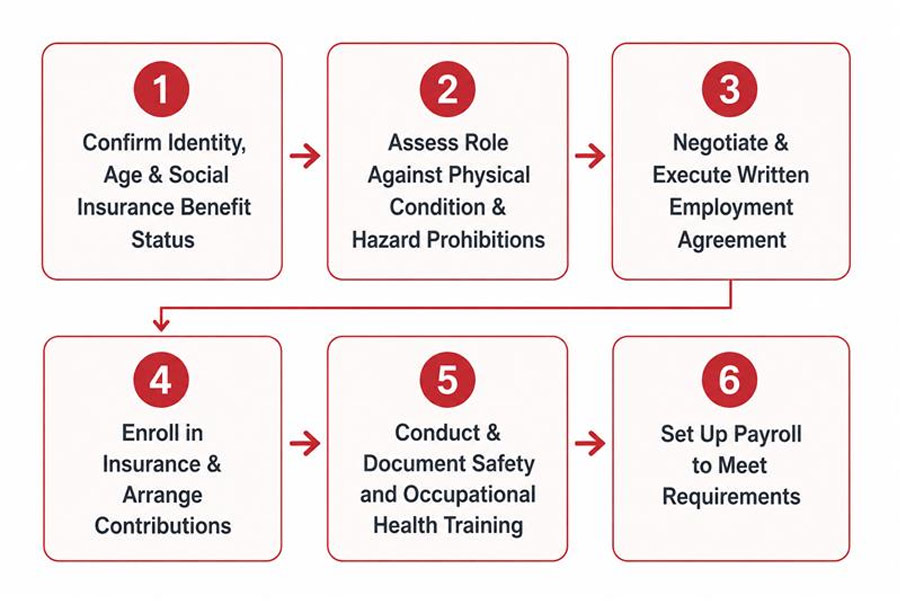
For pension and medical insurance, the rules depend on the worker’s existing benefit status. Workers already receiving basic pension or retiree medical benefits continue those benefits undisturbed, meaning you do not need to enroll them in the contributory scheme. Workers who are not yet receiving pension or retiree medical benefits may choose to continue contributing on an individual basis. If both parties agree, you can arrange employer contributions and handle individual contributions through payroll withholding and remittance.
Also read: China’s Social Security System: An Explainer
Q: What about unemployment insurance and housing fund contributions?
The Interim Provisions are silent on unemployment insurance and housing fund for over-age workers, and there is no general legal obligation to contribute.
Over-age workers are typically ineligible for unemployment benefits in any event. For the housing fund, most local fund management centers do not require or accept contributions for workers past the statutory retirement age. You should verify with your local housing fund center, as practice varies between cities. This is one area where local advisory support pays dividends, particularly for companies operating across multiple cities with different local rules.
Q: If a worker is injured on the job, what is our liability?
Work injury claims for over-age workers follow the standard work injury recognition and compensation process under the Work Injury Insurance Regulations.
The worker (or their dependants) files for work injury recognition with the local HR and social security bureau, the case goes through the prescribed medical assessment and disability rating process if applicable, and compensation is paid from the work injury insurance fund according to the standard schedule.
Because employer premiums fund the scheme, your direct out-of-pocket liability for covered injuries is limited, but failure to enroll the worker in work injury insurance before an injury will expose you to paying all work injury compensation costs personally, plus potential administrative penalties. Enrollment is non-negotiable from day one.
Q: Can the worker still draw their pension while working for us?
Yes. A worker who is already receiving basic pension benefits is entitled to continue receiving them. Your hiring them does not interrupt, reduce, or affect their pension entitlement. This is explicitly confirmed in Article 16 of the Interim Provisions. The practical implication is that you are not substituting for the pension system but supplementing the worker’s income, and the pension authority has no role in approving or limiting the employment.
Occupational safety and health
Q: Are there restrictions on what roles over-age workers can be assigned to?
Yes, and this is one of the more operationally significant obligations.
The Interim Provisions require employers to assess the worker’s physical condition and assign roles with appropriate workloads. You may not assign over-age workers to work that harms their physical or mental health, or to hazardous operations.
In practice, this means roles involving heavy manual labor, exposure to toxic or hazardous substances, extreme temperatures, prolonged physical exertion, or significant psychological stress require careful assessment before assignment.
For sectors like manufacturing, logistics, construction, and hospitality, a documented pre-assignment health review is advisable, both as a compliance measure and as evidence of due diligence in any subsequent dispute. For professional and office-based roles, the restriction is less operationally constraining, but the documentation principle still applies.
Q: What training obligations do we have?
Employers must provide over-age workers with safety and occupational health education and training before they commence work, and must ensure the workplace complies with applicable safety, production, and occupational health standards on an ongoing basis. Training records should be maintained.
This is not a novel obligation. It mirrors what is required for all workers under the Work Safety Law and the Occupational Disease Prevention Law. But it is now explicitly imported into the over-age worker framework, making it enforceable through the over-age worker dispute and enforcement channels, as well as through the safety regulator.
Ending the engagement
Q: How does the engagement end, and is severance required?
The employment agreement terminates automatically when the agreed term expires, when the agreed task is complete, or when any contractually specified termination condition occurs. It can also be dissolved early by mutual written agreement. There is no statutory severance payment required on natural expiry or mutual termination, which is a material difference from standard labor contracts, where employers face economic compensation obligations on non-renewal or certain types of termination.
However, if you unilaterally end the agreement early without a contractual basis, the worker’s remedies under the Interim Provisions include filing a labor arbitration claim for wages and related entitlements. In this case, the agreement should include clear, reasonable termination provisions to avoid ambiguity.
Q: What if the worker’s health deteriorates during the engagement?
The agreement should address this scenario explicitly. Best practice is to include a provision permitting either party to terminate on reasonable notice if the worker’s health condition makes continued performance of the agreed role impossible or unsafe. Document the role assessment process so that any health-related termination decision is demonstrably connected to a legitimate safety concern rather than appearing discriminatory.
If the worker suffers a work-related injury or occupational disease during the engagement, the work injury insurance process takes over. The engagement does not terminate automatically, and the worker retains their work injury benefit entitlements.
Q: Can a dispute about wages or safety be taken to labor arbitration?
Yes. Disputes over the four protected categories (remuneration, rest and leave, occupational safety and health, and work injury) are now explicitly within the jurisdiction of the Labor Dispute Mediation and Arbitration Law.
This means workers can file at the local labor dispute arbitration commission, which is faster and cheaper than civil litigation. Disputes about other matters, such as the terms of the agreement itself, remain subject to civil court jurisdiction.
For HR teams, this means that payroll records, time and attendance records, safety training logs, and evidence of insurance enrollment all need to be maintained to the same standard as for standard labor contract employees.
Building a compliant process
Q: What does a compliant onboarding process look like end-to-end?
A compliant onboarding process for an over-age hire has six practical steps.
Q: How should we update our existing HR templates and policies?
Standard labor contract templates will not serve over-age workers. HR teams should develop a dedicated employment agreement template specifically for this category, drafted to the requirements of the Interim Provisions.
Onboarding checklists, payroll setup procedures, and social insurance enrollment workflows should be updated to include over-age worker-specific steps. Employee handbooks and internal HR policies should clarify how over-age workers fit within the company’s workforce structure, what their entitlements are, and who manages their cases internally.
For FIEs with China HR operations supported by a third-party HR services provider or employer of record, now is the time to confirm that your provider has updated its own templates and processes — the July 1 effective date applies to them as well. Working with an HR partner that has already updated its documentation and bureau relationships for the new framework can significantly reduce the internal workload of standing up a compliant process from scratch.
Q: Are there particular risks for FIEs operating across multiple cities?
Yes. While the Interim Provisions are national in scope, local authorities in different cities and provinces will issue their own implementing guidance, and practice, particularly on work injury insurance premium rates, registration procedures, and local minimum wage.
An over-age worker hired in Shanghai is subject to Shanghai’s local minimum wage, premium rates, and filing requirements; the same worker hired in a Tier 2 city may face a different operational setup.
FIEs with multi-city operations should map their over-age workforce by location and confirm local requirements in each jurisdiction. This is an area where a China-wide HR advisory team or HR services provider with local bureau access adds tangible value.
Key takeaways
The July 1, 2026 Interim Provisions remove the legal ambiguity that made hiring over-age workers in China a calculated risk for employers. They do not, however, reduce the need for careful documentation and process design. FIEs that build compliant onboarding and management workflows now with purpose-built employment agreements, correct insurance enrollment, documented role assessments, and updated HR templates will be well-positioned to draw on China’s experienced older workforce without legal exposure. For companies that prefer not to build these capabilities in-house, Dezan Shira & Associates HR and Payroll professionals can provide tailored support. 1