China just clarified its classification for brain-computer interfaces — and that’s a big deal for anyone eyeing this market. NMPA’s new guideline sorts BCI devices into concrete risk classes and registration pathways, turning what used to be a regulatory guessing game into a roadmap foreign investors can actually plan around. In this article, we lay out what counts as a BCI medical device, how the NMPA sorts BCI devices into risk classes, and what this means to foreign investors.
On June 30, 2026, China’s National Medical Products Administration (NMPA) issued Announcement No. 24, releasing the Guiding Principles for the Classification of Brain-Computer Interface (BCI) Medical Devices alongside a companion naming convention. Together, the two documents give BCI developers their first definitive rulebook for how devices will be classified and named under China’s medical device regime, closing a gap that had sat open since NMPA circulated draft versions for public comment in March 2026.
The timing is not incidental. The guideline arrives 10 months after seven national ministries jointly issued an implementation plan for the BCI industry, targeting key technological breakthroughs by 2027 and two to three globally competitive Chinese BCI enterprises by 2030. Provinces including Sichuan, Hubei, and Zhejiang have already begun setting medical service pricing for BCI treatments, and China’s national medical insurance administration created a dedicated BCI insurance category last year.
Classification is the piece that connects the industrial policy to the reimbursement system: A product cannot be priced, insured, or sold as a treatment until NMPA has decided what it is and how much regulatory scrutiny it requires. Foreign investors mapping out a China entry should treat classification as the starting point of that strategy.
What counts as a BCI medical device
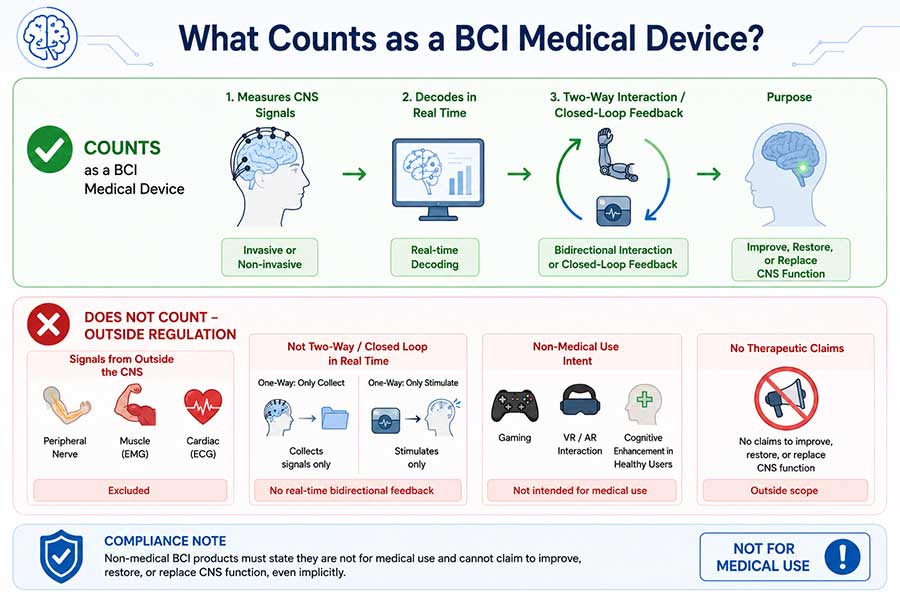
The guideline defines a regulated BCI medical device narrowly: An active device that measures and decodes central nervous system signals in real time, invasively or non-invasively, to enable two-way interaction or closed-loop feedback with an external device, for the purpose of improving, restoring, or replacing central nervous system function.
Several categories fall outside this definition and outside medical device regulation entirely. Devices that only read peripheral nerve, muscle (EMG), or cardiac (ECG) signals are excluded, as are devices that only collect signals or only stimulate in one direction, without real-time bidirectional feedback. Products intended for non-medical use, such as gaming, VR or AR interaction, or general cognitive enhancement in healthy users, also fall outside the scope, provided the manufacturer does not market them with therapeutic claims.
This last point carries real compliance weight for consumer-facing BCI companies: NMPA is explicit that non-medical BCI products must state they are not for medical use and cannot claim to improve, restore, or replace CNS function, even implicitly.
How NMPA sorts BCI devices into risk classes
For products that do meet the medical device definition, the guideline sets classification by invasiveness, clinical purpose, and whether artificial intelligence (AI) is involved:
|
NMPA Classification of BCI Devices |
||||
| Device type | Clinical purpose | AI-enabled | Class | Code |
| Invasive or implantable | Any | — | Class III | 12-00 |
| Non-invasive | Disease treatment | — | Class III | 09-00 |
| Non-invasive | Functional compensation or rehabilitation | — | Class III | 19-00 |
| Non-invasive | Stroke-related motor rehabilitation | No | Class II | 19-00 |
| Non-invasive | Other rehabilitation | — | Class III | 19-00 |
Every implantable device defaults to Class III, NMPA’s highest-risk tier, reflecting the surgical risk and clinical uncertainty inherent to invasive neural interfaces. Non-invasive devices are Class III by default, too, with one narrow exception: non-invasive devices for stroke-related motor rehabilitation that do not use AI-based intent decoding can qualify for the lighter Class II pathway.
NMPA’s rationale is that stroke rehabilitation already has mature clinical protocols and that non-invasive signal collection, absent an AI algorithm’s dynamic uncertainty, carries manageable clinical risk. Introduce AI into that same product, and the classification reverts to Class III, since a misread of patient intent could translate into physical injury.
Why this matters for AI-enabled products
NMPA has also clarified that BCI systems should not be classified under the medical software subdirectory, since safety and efficacy are evaluated at the level of the full system rather than the algorithm alone. Standalone EEG-analysis software that does not perform real-time decoding and feedback falls outside the guideline altogether — a distinction that matters for software and AI companies partnering with hardware makers rather than registering a device independently.
What this means for foreign investors
For companies weighing an entry into China’s BCI market, the guideline converts what was previously a case-by-case regulatory judgment into a predictable framework, and that predictability itself is the headline benefit. Foreign device makers can now map a product concept to a classification, review pathway, and rough timeline before committing capital to China-specific development, rather than risking a late-stage reclassification dispute.
The practical entry points differ sharply by product type. Non-invasive, non-AI stroke rehabilitation devices sit in the only Class II lane in the entire framework, meaning a comparatively faster registration process, and this may be the most accessible on-ramp for foreign medical device companies without the appetite for a full Class III clinical trial program in China. Everything else of real commercial interest, implantable neural interfaces, AI-enabled rehabilitation systems, and non-invasive treatment devices, sits in Class III, which requires more extensive clinical evidence and a longer runway to market. Companies building AI-driven products should factor this classification consequence into their core technology roadmap, not treat it as a late regulatory formality.
The link to insurance coverage raises the stakes further. With provincial pricing already underway for BCI services and national insurance coverage expanding, classification is the prerequisite gate before a device becomes eligible for reimbursement, which is itself the primary driver of patient volume in China’s public hospital system. A foreign-invested device stuck in classification limbo cannot access that pathway at all.
Market access itself remains open. BCI is not currently a restricted sector for foreign investment, but domestic competitors are moving fast with state backing, dedicated industrial parks, and deepening ties to provincial health systems and hospitals running the clinical trials that generate the local data NMPA will expect. Foreign entrants should weigh partnership, joint venture, or licensing structures with Chinese clinical or manufacturing partners as a practical way to generate the local evidence base that a Class III submission requires, rather than attempting a solo path.
Finally, NMPA has acknowledged that this guideline reflects current technology and understanding, and that it will keep adjusting as the field develops. Companies with products that do not map cleanly onto the existing categories can apply through NMPA’s classification determination procedure rather than waiting for the next guideline revision, an option worth building into any China regulatory strategy for genuinely novel BCI technology.
How Dezan Shira & Associates can help
Foreign investors evaluating a China BCI market entry, whether through direct registration, joint venture, or partnership with a domestic developer, should assess classification exposure early, before core technology decisions lock in a Class III pathway that might have been avoidable. Dezan Shira & Associates advises foreign-invested enterprises on market entry, regulatory strategy, and structuring across China’s healthcare and life sciences sectors, and can help evaluate how this guideline applies to a specific product roadmap. To arrange a consultation, please contact our local team.
Also read: