China remains one of the world’s most consequential investment destinations. For foreign companies in 2026 and beyond, however, the key question of where to invest in China is becoming more strategic than ever: not whether to invest in China, but where, and in which sectors, investment will deliver the best results.
After several years of supply chain diversification and reshoring efforts, many global investors have come to recognize that China remains deeply embedded in global production networks, innovation ecosystems, and consumer markets. While challenges persist, the country’s scale, infrastructure, industrial depth, and policy support continue to make it indispensable for a wide range of industries. In this context, making informed, location-specific investment decisions is increasingly critical.
China’s economic landscape is also evolving. Growth is becoming more differentiated across sectors, with advanced manufacturing, green industries, and technology-driven segments showing strong momentum, while other areas adjust to structural shifts. At the same time, policymakers at both the central and local levels are rolling out targeted incentives, further opening selected sectors, and strengthening regional development strategies to attract higher-quality foreign investment.
For foreign investors, this creates a more nuanced and opportunity-rich environment. National market size remains important, but the success of an investment increasingly depends on choosing the right location. Differences across cities, regions, free trade zones, and development zones can be significant, shaping everything from supply chain efficiency and talent access to regulatory conditions and incentive availability.
This article provides a practical, decision-oriented framework for navigating these choices. It examines China’s key investment regions, links locations to specific industries and business objectives, and outlines how investors can evaluate coastal versus inland opportunities, as well as the role of free trade zones, development zones, and local policy incentives when shortlisting investment destinations.
How to select the most suitable investment location in China
China’s current macro environment is best understood as differentiated rather than polarized. Growth and demand conditions vary across sectors, regions, and business models, and this variation, instead of a simple “strong versus weak” narrative, should guide investment location decisions.
For foreign investors, this means that site selection should start with the specific requirements of the project itself. China’s economic structure continues to support a wide range of activities: advanced manufacturing and technology-driven sectors are expanding rapidly, supply chain ecosystems remain highly competitive, and selected areas of consumer demand (particularly in services, premium products, and urban markets) continue to offer meaningful opportunities. At the same time, adjustment pressures in areas such as real estate and parts of mass consumption mean that not all locations or market segments will perform equally.
The practical takeaway is not to deprioritize any single demand driver outright, but to align location choice with the underlying logic of the investment. Projects that rely on manufacturing scale, supplier integration, or export capacity will benefit from locations with mature industrial clusters, efficient logistics infrastructure, and strong trade connectivity. Meanwhile, projects targeting China’s domestic market, whether in consumption, services, or localized production, should prioritize access to relevant customer bases, income levels, urbanization trends, and distribution networks.
This shifts the focus of location selection away from broad indicators such as population size or aggregate GDP, toward more targeted criteria. These include the presence of industry-specific ecosystems, talent availability, infrastructure quality, policy support, and the degree of alignment between local strengths and the investor’s value chain. In practice, two cities with similar economic size can offer very different outcomes depending on how well they match the needs of a given project.
To apply this approach systematically, location selection can be structured across three nested levels: region, city, and zone:
- At the regional level, investors assess overall economic orientation and connectivity;
- At the city level, they evaluate industrial specialization and market characteristics; and
- At the zone level, they compare specific development zones, free trade zones, or industrial parks in terms of incentives, services, and operational conditions.
The sections below walk through each level in turn.
Region lens: Choose the right super city cluster
Before comparing individual cities, it pays to choose a region. China’s economy is organized into a handful of integrated super city clusters, such as the Yangtze River Delta, the Greater Bay Area, the Beijing-Tianjin-Hebei corridor, and the Chengdu-Chongqing Economic Circle, and it is at this level that the things investors care about most take shape: supplier networks, talent pools, logistics corridors, and coordinated regional policy. Narrowing to the right cluster first turns dozens of candidate cities into a manageable shortlist, and it mirrors the order site selection naturally follows: region, then city, then the specific zone or park.
China’s three dominant coastal clusters, the Yangtze River Delta (approximately 25 percent of national GDP), the Greater Bay Area (approximately 9 percent of national GDP), and the Beijing-Tianjin-Hebei region (approximately 9 percent of national GDP), account for the largest share of inbound FDI and offer the greatest depth of industrial ecosystems, international connectivity, and specialist talent. Inland clusters compete on different terms – lower operating costs, access to large western and central domestic markets, and increasingly capable rail and river logistics. For most investors, the deciding question is not coastal versus inland as a general preference, but which trade-off fits the specific project.
The four major super city clusters, and what each does best, are:
The Yangtze River Delta is China’s most economically integrated region and its strongest all-round investment base. Anchored by Shanghai and extending across Jiangsu and Zhejiang, it combines world-class financial and professional services infrastructure, a dense and mature advanced-manufacturing ecosystem, and well-developed international logistics networks. Its internal diversity means investors can locate different functions of the same value chain across the region without leaving the cluster.
The Greater Bay Area is China’s most internationally connected economic cluster and its leading hub for hardware, electronics, and cross-border manufacturing. It combines Guangdong’s vast and highly competitive industrial base with Hong Kong’s role as an international financial and legal center, a combination that is particularly relevant for companies that need to operate on both sides of the border.
The Beijing-Tianjin-Hebei corridor functions differently from the two coastal manufacturing clusters. Its relevance is greatest where market access or competitive position depends on proximity to policy processes, national R&D programs, research institutions, or central-government procurement rather than manufacturing scale or logistics efficiency.
The Chengdu-Chongqing economic circle is China’s most developed inland cluster and the natural gateway to the country’s western domestic market. It offers a lower-cost operating environment than the coastal clusters, with river and rail infrastructure connecting western China to Southeast Asia and to Europe via the China-Europe Railway Express.
City Lens: Which one suits your investment objective
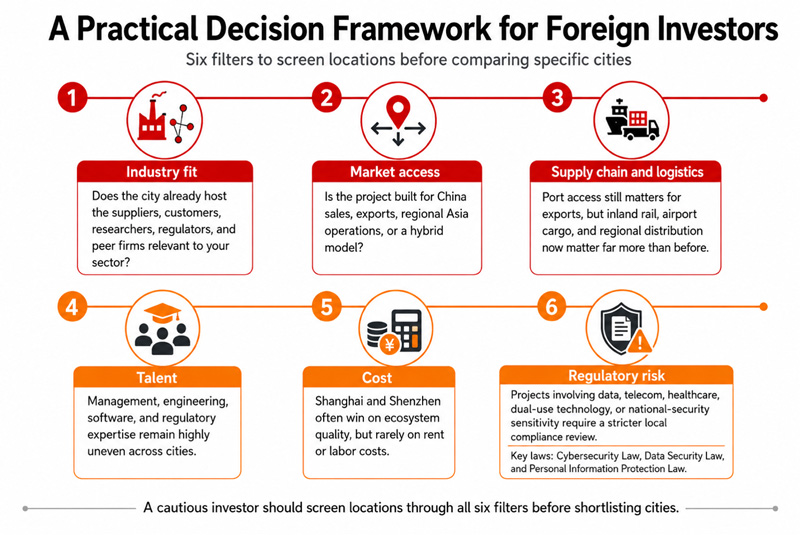
Within a chosen region, city selection turns on a small number of criteria that vary significantly across China’s major urban economies: the maturity and density of industry-specific supply chains and ecosystems; the type and volume of available talent (engineering and technical graduates, bilingual professionals, specialized R&D researchers); policy environment and the presence of sector-specific incentive programs; infrastructure and logistics connectivity; and operating costs, including labor, land, and office space.
These factors do not rank equally for every project. A manufacturing operation dependent on component suppliers weighs ecosystem density and logistics above almost everything else. A services or software business weighs talent quality and cost of living, which affect recruitment and retention, more heavily than supply chain proximity. An R&D center or regional headquarters may prioritize proximity to universities, standards bodies, or government counterparts. Identifying which two or three criteria are genuinely decisive for the specific project, and then mapping cities against those criteria, produces a more reliable shortlist than comparing cities on aggregate indicators such as GDP or population.
The table below maps primary investment objectives to the strongest city options as a starting point. The industry notes that follow illustrate how this logic applies in a selection of sectors, but the same framework applies to sectors not listed.
| Decision Tree: What Does Your Company Need Most? | |
| Primary objective | Strongest locations (examples) |
| HQ, finance, or premium services | Shanghai, Beijing |
| Electronics, hardware, export manufacturing | Shenzhen, Guangzhou, Suzhou, Ningbo |
| R&D, software, platform, and AI-adjacent ecosystems | Beijing, Shanghai, Shenzhen, Hangzhou |
| Lower-cost scale with large domestic reach | Chengdu, Chongqing, Wuhan |
| Policy-led healthcare or life sciences opening | Shanghai, Suzhou, Beijing, Guangzhou, Shenzhen |
| Incentive-led manufacturing or inland expansion | Chongqing, Chengdu, Wuhan, central/western zones |
| Trade, processing, and “offshore” market access | Hainan Free Trade Port; comprehensive bonded zones |
A few examples of how city-sector fit works in practice:
Advanced manufacturing and industrial supply chains, whether in automotive components, machinery, precision engineering, or specialty chemicals, consistently favor cities with mature supplier ecosystems and strong logistics connectivity. Suzhou, Guangzhou, Chongqing, and Wuhan each anchor significant manufacturing clusters, but differ in sector specialization, cost profile, and domestic versus export orientation. The right choice depends on where the supply chain sits, not just where production costs are lowest.
Technology-intensive sectors, including semiconductors, hardware, NEVs and battery technology, and medical devices, require access to both deep supplier networks and specialized engineering talent. The Yangtze River Delta and Greater Bay Area dominate here, but within each cluster, the right city depends on the specific technology segment: fabrication and components concentrate differently from assembly, and EV supply chains cluster differently from telecom hardware.
Life sciences and biopharma follow a pattern shaped heavily by regulatory proximity and research institution density. Shanghai and Suzhou form the commercial and manufacturing core, with the Beijing cluster strongest for companies whose competitive position depends on clinical research partnerships or engagement with national drug approval bodies. Guangzhou and Shenzhen are growing rapidly, with particular strength in genomics and diagnostics.
Software, AI, and platform-driven services weigh talent and business environment more heavily than physical supply chains. Beijing, Shanghai, Shenzhen, and Hangzhou are the four core cities, but they serve different profiles: Beijing for enterprise software, government-adjacent AI applications, and research-intensive development; Hangzhou for consumer platform and e-commerce-adjacent models; Shenzhen for hardware-software integrated products; Shanghai as the broadest base for international-facing technology businesses.
Consumer goods, retail, and services targeting China’s domestic market should be weighted primarily by customer access, such as income levels, urbanization, and distribution network reach, rather than manufacturing logic. First-tier cities offer premium market access and brand positioning; Chengdu, Wuhan, and Xi’an increasingly matter as the anchor cities of large regional consumer markets that are structurally underpenetrated relative to the coast.
Incentive-led or policy-driven investments, including encouraged manufacturing categories, green energy, and sectors on the central or local government priority list, often justify shortlisting cities in central and western China where local governments compete actively on land cost, tax incentives, and infrastructure support, even where ecosystem depth is lower than in coastal clusters.
Zones and parks: A layer that can change the terms of investment
For most foreign investors, the city and region decision comes first, but the specific zone or park within that location can be equally consequential. China operates a wide range of designated investment zones alongside its 23 pilot free trade zones (FTZ): national economic and technological development zones, high-tech industry development zones, cross-border e-commerce zones, bonded logistics centers, bilateral cooperation parks, and sector-specific industry clusters, among others.
Each type offers a distinct combination of regulatory conditions, fiscal incentives, customs treatment, and operational services that can differ materially from the surrounding city.
This means that shortlisting a zone is a substantive part of the investment decision. Two companies in the same city, one inside a relevant zone and one outside it, may face different tax rates, different negative lists, different customs procedures, and different data transfer requirements. In some cases, the zone itself is the reason to choose a particular city at all.
Here we take FTZ as an example. Three features of the zone landscape are especially relevant to foreign investors at present. First, pilot FTZs operate a dedicated, shorter negative list for foreign investment, meaning more sectors are open to FDI within zone boundaries than outside them. Second, since April 2024, a nationwide negative list for cross-border trade in services, alongside a separate FTZ-specific list, presumes that unlisted activities are open, a significant change for services businesses. Third, several FTZs now offer simplified cross-border data transfer rules, a meaningful operational advantage for data-intensive businesses that would otherwise face full security assessment procedures.
Another example is the bilateral and industry parks/zones. In China, many industrial parks have a clear, concentrated industry ecosystem and investor profile. The clearest case is the China-Germany (Taicang) SME Cooperation Demonstration Zone in Taicang, Jiangsu Province, half an hour from Shanghai. The zone now hosts more than 560 German companies with over US$6 billion in cumulative investment, including six of Germany’s 10 largest family-owned machine-tool makers, supported by dense local supplier networks and a German-style dual vocational-training system. For a German precision-engineering firm, “Taicang” is a far sharper starting point than any other city.
The practical implication is that once a region and city have been identified, a structured review of the available zones within that location, covering eligibility, incentive terms, customs treatment, and sector fit, should be a standard part of the investment preparation process.
Conclusion
The best place to invest in China in 2026 and beyond is not a single city. For most foreign investors, it is the city-region or zone combination that most closely aligns industry ecosystem, customer access, logistics, talent, cost, and policy fit.
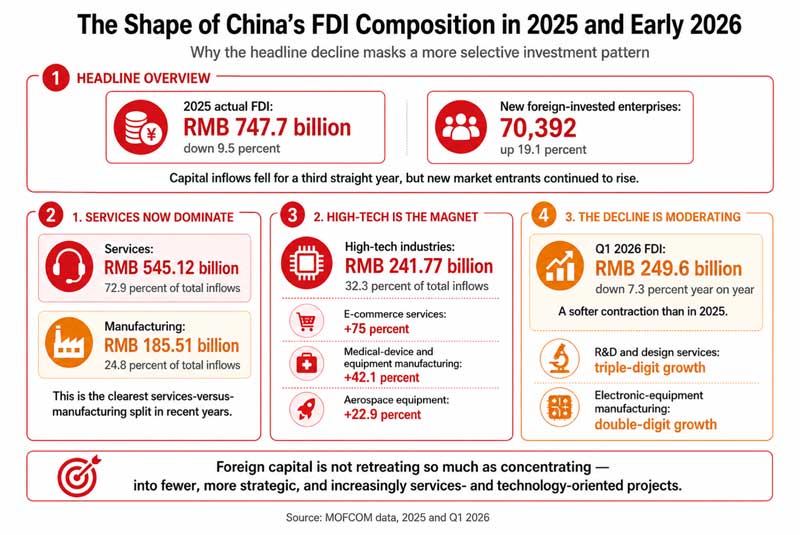
A more selective FDI environment has raised the cost of choosing the wrong location, but they have not closed the opportunity, they have simply concentrated it in the technology-linked, supply-chain-embedded, and services-oriented projects that China is now most actively courting. The task for investors is to define the commercial objective first, then choose the decision path that delivers it.
How Dezan Shira & Associates can help
Dezan Shira & Associates supports foreign companies across the full investment lifecycle in China, from location benchmarking and market-entry strategy to entity setup, tax structuring, and ongoing compliance. We help investors compare incentives and operating costs across competing cities, zones, and free trade ports, identify the regional ecosystems best matched to a given sector, and navigate the regulatory screens, including data and cybersecurity compliance, that increasingly shape where and how a project can operate.
With offices across China, including in Beijing, Shanghai, Suzhou, Hangzhou, Ningbo, Guangzhou, Shenzhen, Haikou, and beyond, we can help align your location decision with your commercial objectives from day one.