
 Other Briefings
Vietnam's E-commerce Market in 2026: Trends, Platforms, and Business Outlook
Vietnam's e-commerce market continues to rank among Southeast Asia's fastest-growing digital economies, underpinned by rising consumer spending, widespread digital adoption, and a supportive policy environment. As online retail evolves beyond rapid expansion, businesses are competing through operational excellence, trusted brands, and customer experience rather than price alone.
Vietnam's e-commerce sector has entered a new stage of development, characterised by sustained double-digit growth and increasingly sophisticated consumer demand.
In 2025, Vietnam's e-commerce market continued to expand, reaching an estimated value of US$38.5 billion, with an annual growth rate of 21 percent.
Although this marked the sector's slowest growth rate in the past decade, the market has grown tenfold since 2015, from US$4 billion. It is projected to expand even further, reaching approximately 25 times its 2015 size by 2030.

Vietnam's e-commerce market sustains strong momentum
Vietnam's e-commerce sector continues to be one of the fastest-growing in Southeast Asia, supported by rising digital adoption and changing consumer behaviour. Retail e-commerce sales are projected to reach US$31 billion in 2025, growing at an average annual rate of 25 percent.
The sector is expected to account for 11 percent of total retail sales, with around 60 percent of the population shopping online.
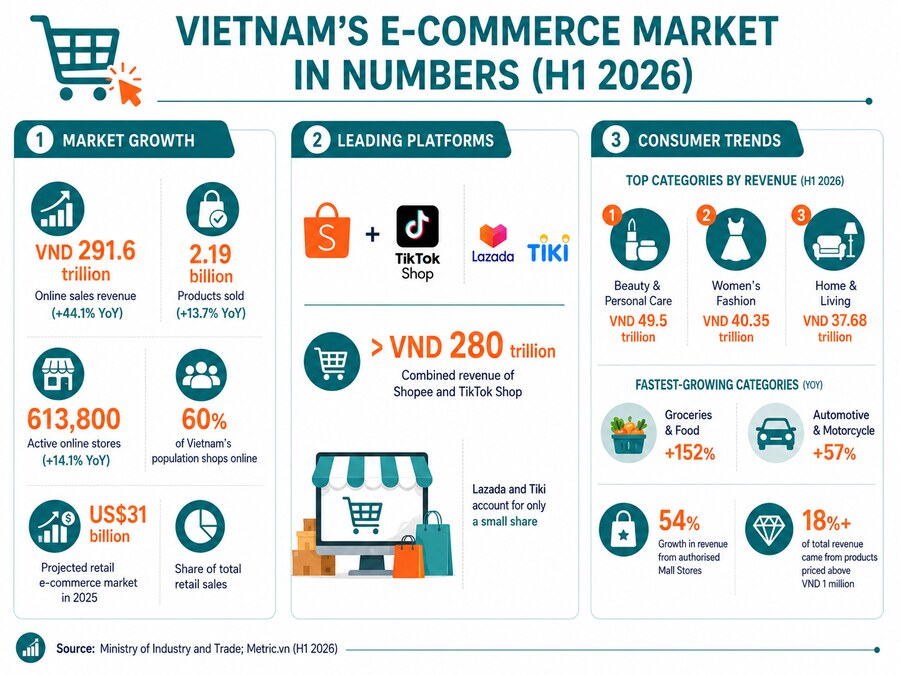
Despite higher platform fees and stricter operating requirements, the market maintained strong growth during the first half of 2026.
- Revenue: VND 291.6 trillion (US$11 billion), up 44.1 percent year-on-year.
- Products sold: 2.19 billion, an increase of 13.7 percent.
- Active online stores: 613,800, up 14.1 percent year-on-year.
The continued growth in both revenue and transaction volume indicates that Vietnam's e-commerce market is entering a more mature phase, with higher consumer participation and increasing spending per transaction.
See also: Vietnam’s E-Commerce Law 2025: Key Provisions and Business Implications
Leading e-commerce platforms
Shopee and TikTok Shop dominate the market
Shopee and TikTok Shop remained Vietnam's two largest e-commerce platforms in H1 2026, generating more than VND 280 trillion (US$10.6 billion) in combined revenue. Meanwhile, Lazada and Tiki accounted for only a small share of the market.
The platforms are also seeing a shift towards higher-value consumption:
- Products priced VND 200,000–350,000 (US$7.60–13.25) gained market share.
- Products priced above VND 1 million (US$38) contributed more than 18 percent of total platform revenue.
- Revenue from authorised Mall stores surged 54 percent, despite a 6 percent decline in the number of sellers, reflecting growing consumer preference for genuine branded products.
Consumer demand shifts towards premium and essential products
Beauty products remained the largest online retail category, while groceries emerged as the fastest-growing segment.
Top categories by sales value:
- Beauty and personal care: VND 49.5 trillion (US$1.87 billion)
- Women's fashion: VND 40.35 trillion (US$1.53 billion)
- Home and living: VND 37.68 trillion (US$1.43 billion)
Fastest-growing categories:
- Groceries and food: +152 percent year-on-year
- Automotive and motorcycle products: +57 percent year-on-year to VND 7.34 trillion (US$278 million)
These trends suggest consumers are purchasing more everyday necessities online while also showing greater willingness to spend on higher-value products.
Vietnam's e-commerce development remains concentrated in major cities
The Vietnam E-Business Index 2026 shows that e-commerce development remains heavily concentrated in the country's largest economic centres, despite continued digitalisation nationwide. The index measures provincial performance across three dimensions: human resources and IT infrastructure, business-to-consumer (B2C) transactions, and business-to-business (B2B) e-commerce.
Key highlights include:
- Ho Chi Minh City ranked first with 91.1 points, maintaining its position as Vietnam's leading e-commerce hub.
- Hanoi followed with 87.5 points, reflecting its strong digital infrastructure and business ecosystem.
- Da Nang placed third with 22.3 points, highlighting a sharp drop from the two leading cities.
The national average score stood at 15.8 points, underscoring the wide disparity in e-commerce readiness across Vietnam. The gap between Ho Chi Minh City and the lowest-ranked province reached 86.9 points, indicating that digital infrastructure, technology adoption, and online business capabilities remain unevenly distributed.
For businesses, the rankings reinforce that while Ho Chi Minh City and Hanoi remain the country's primary digital commerce markets, significant untapped opportunities exist as other provinces continue to strengthen their digital capabilities.
[content_gate]
Latest trends in Vietnam’s e-commerce sector
Competition shifts from price to operational excellence
Vietnam's e-commerce market is entering a more mature stage, with competition increasingly centred on operational capabilities, seller quality, and consumer trust rather than aggressive price promotions.
Leading platforms and sellers are responding by strengthening their operating models:
- Platforms are investing in AI-powered recommendations, integrated advertising tools, and logistics optimisation to improve fulfilment efficiency and customer experience.
- Sellers are increasingly prioritising profitability over sales volume through omnichannel strategies, automation, and data-driven marketing to improve customer retention.
At the same time, the competitive landscape is evolving alongside greater regulatory oversight.
Key developments include:
- Shopee and TikTok Shop increased seller commissions and platform fees during H1 2026, prompting Vietnam's National Competition Commission to assess their impact on merchants, consumers, and market competition. The commission subsequently requested Shopee to review and postpone parts of its revised fee structure.
- Revenue from imported products sold by overseas merchants on Shopee declined 23.4 percent, while sales volume fell 56.9 percent year-on-year, suggesting stronger demand for locally available and officially distributed products.
- Revenue across Vietnam's four largest e-commerce platforms is forecast to reach VND 146.3 trillion (US$5.54 billion) in Q3 2026, supported by seasonal demand from summer travel and the back-to-school shopping season.
This combination of operational investment, regulatory oversight, and evolving consumer preferences indicates that competitive advantage is increasingly determined by execution, product authenticity, and the ability to deliver a seamless end-to-end shopping experience, rather than by price alone.
Social networks remain the leading sales channel
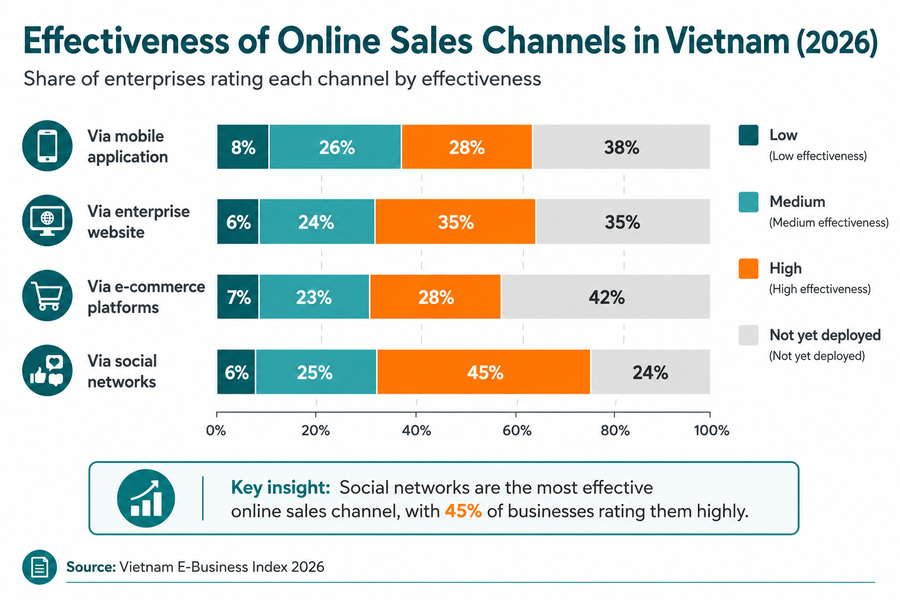
Social media continues to outperform other digital channels in driving online sales. According to the Vietnam E-Business Index 2026, 45 percent of businesses rated social networks as highly effective for selling products online, compared to 35 percent for enterprise websites and 28 percent for both e-commerce marketplaces and mobile applications.
The growing popularity of livestream shopping, influencer marketing, and social engagement has made social platforms a key channel for product discovery and customer acquisition, particularly among younger consumers.
Consumer trust is becoming the key competitive advantage
Vietnamese consumers are placing greater emphasis on authenticity and shopping experience than on discounts alone. Product quality, seller credibility, and product variety remain the top factors influencing purchasing decisions, while the biggest concerns are products not matching their descriptions and personal data privacy.

Vietnam strengthens its position as an e-commerce export hub
Vietnam is also emerging as a regional hub for cross-border e-commerce, supported by its competitive manufacturing base, digital transformation, and export-oriented economy. At the Amazon Global Selling Conference 2025, Amazon identified Vietnam as one of its fastest-growing sourcing markets, citing strong growth in Vietnamese product listings and brand-registered sellers.
As more local businesses adopt digital export channels and global marketplaces expand their presence, Vietnam is expected to play an increasingly important role in regional and global e-commerce supply chains.
What businesses should watch to succeed in Vietnam's e-commerce market
While Vietnam’s e-commerce sector continues its rapid growth, it faces several significant challenges that warrant strategic attention.
Generational consumer gap
Consumer habits present both opportunities and limitations. On one hand, younger, digitally-native consumers fuel growth. On the other hand, middle-aged and elderly segments remain less comfortable with online shopping, limiting the total reachable market for pure-play e-commerce. This generational adoption gap means platforms must still invest heavily in education, localization, trust-building, and UX design to expand beyond the urban-youth core.
Talent shortages
Human resources are a constraint. Vietnam’s e-commerce firms face a shortage of skilled professionals, especially in areas such as data analytics, omnichannel fulfilment, AI-driven personalisation, and global supply-chain management. This talent gap makes it harder to scale globally, adopt best practices from advanced markets, and maintain operational excellence.
Logistics bottlenecks
Logistics and infrastructure remain a structural hurdle and an opportunity at the same time. While Vietnam has made strong strides in delivery networks and fulfilment, the warehousing, last-mile delivery, rural coverage, and cold-chain logistics systems are not yet at the level of more mature e-commerce markets.
Sustainability pressures
Rising awareness of sustainability issues is emerging. A 2025 report by the Vietnam E‑commerce Association (VECOM) points out that the rapid growth of online business and food-delivery services consumed more than 332,000 tons of packaging materials in 2023 alone – 171,000 tons of which were plastic. As consumer and regulatory attention heightens, platforms and sellers will need to integrate greener practices into logistics, packaging, and returns operations.
The future of Vietnam’s e-commerce market
With a young population, rising disposable incomes, and a rapidly expanding middle class, Vietnam continues to stand out as one of Southeast Asia’s most attractive destinations for e-commerce investment. Its growing role as a regional e-commerce export hub further strengthens the country’s long-term outlook, positioning Vietnam as a market to watch in 2026 and beyond.
Yet, realising this potential will require more than simply riding the momentum. While Vietnam’s e-commerce market offers remarkable expansion potential, success will depend on navigating intense competition, staying ahead of regulatory change, broadening consumer adoption beyond younger segments, developing talent and logistics systems, and addressing emerging sustainability expectations.
Those who approach Vietnam with a long-term, well-structured plan and the right local partnerships are poised to benefit from one of the region’s most dynamic digital economies.
See also: Understanding Vietnam’s Tax Withholding Framework for Foreign E-Commerce Platforms
If you're considering expanding into the Vietnamese consumer market, get in touch with our Business Intelligence experts for a tailored market entry strategy for your product or service.
This article was originally published on 20 August 2024. It was last updated on 29 July 2026.
This article first appeared on Vietnam Briefing, our sister platform.

