The AmCham 2026 survey shows how US companies in China are reshaping investment, localisation, and innovation strategies amid improving business sentiment and intensifying domestic competition.
AmCham’s 2026 survey reveals a rebound in confidence among US companies in China, supported by stronger profitability, improving US-China relations, and continued regulatory progress. At the same time, the report points to a shift in business concerns, with domestic competition ranking ahead of US-China tensions as a key challenge for many companies. For businesses operating in or exploring the China market, this development provides additional context for evaluating their China strategies in 2026.
What happened?
The American Chamber of Commerce in Shanghai (AmCham) has published its 2026 China Business Climate Survey, the annual benchmark of how US companies view operating conditions and prospects in China.
For the first time in several years, confidence is rising. Profitability, optimism about China’s five-year outlook, and views on regulatory transparency have all improved, and companies are redirecting fewer planned investments away from China than at any point in recent years. Underpinning the shift is a change in strategic posture: “In China for the world” (29 percent, up 2 percentage points), which means using China-based operations to serve global markets and feed global R&D, has overtaken “in China for China” (24 percent, down five percentage points) as members’ primary business strategy for the first time.
But the survey’s most consequential finding is not the improved sentiment. It is that domestic competition has, for the first time since 2022, overtaken US-China tensions as the top challenge facing member companies.
Confidence is rising and the ground is shifting under it at the same time. That combination, more than any single statistic, is what should shape how foreign businesses plan for China in 2026.
The most striking data from the survey
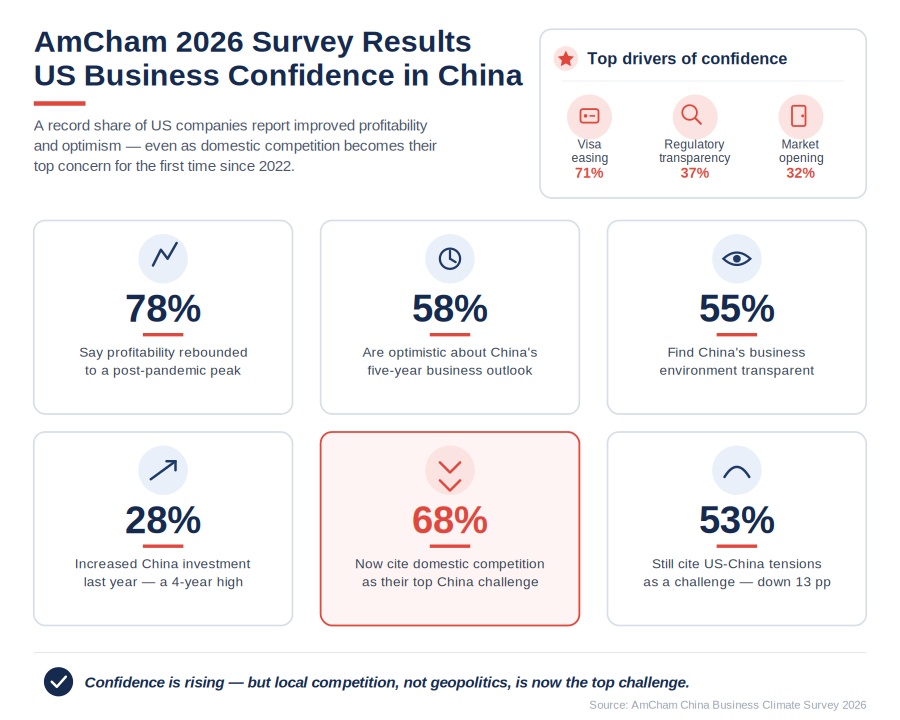
Six figures stand out from this year’s survey:
- 78% of respondents said profitability rebounded to a post-pandemic peak.
- 58% are now optimistic about China’s five-year business outlook.
- 55% said China’s business environment is transparent.
- The share of planned investments redirected away from China fell to 39%, the lowest in several years.
- 28% increased their China investment last year, the highest share in four years.
- 68% named domestic competition their top China challenge, overtaking US-China tensions (53%, down 13 percentage points).
Why is confidence improving?
58 percent of AmCham members surveyed have regained optimism about China’s five-year economic outlook, a shift closely tied to profitability. Roughly four-fifths of respondents now say their China operations are profitable, the strongest reading since the pandemic.
Five government measures explain most of this improvement, in order of impact:
- Visa easing, cited by 71 percent of members – the most impactful measure, reflecting how central international travel is to running a China operation.
- Improved regulatory transparency and predictability, cited by 37% – felt most strongly in healthcare and pharmaceuticals.
- Local government efforts to boost consumption, cited by 32% – most visible in consumer-facing sectors.
- Market-opening measures, also cited by 32%; 39% of members are confident further opening is coming in the near term.
- Promotion of the digital economy, including cross-border data transfer rules, cited by 18%, just ahead of the industrial equipment upgrading action plan (17%).
China Strategy Review
Assess how evolving market conditions and competitive pressures may affect your China operations and investment plans.Why has domestic competition overtaken US-China tensions?
68 percent of respondents now rank domestic competition as their top challenge, ahead of US-China tensions at 53 percent. The pressure is sharpest in retail (85%) and manufacturing (79%), and it is showing up in the numbers that used to define the foreign advantage. The share of members who say they still lead local competitors has fallen to 40 percent (down 4 percentage points) in product development and 67 percent (down 6 percentage points) in quality.
That erosion has an upside. A third of respondents say competing against strong domestic rivals is improving the global competitiveness of their US operations, and three-quarters of applicable members say their China presence benefits their US business in some way, evidence that China has become a proving ground, not just a market, for many multinationals.
The US and China together account for more than half of global R&D investment, and domestic competition is a direct driver of that spending. Companies are investing in R&D not despite the competitive pressure, but because of it.
What does it mean for business?
The numbers in this survey are a starting point, not an answer. What matters for foreign companies is what they imply for decisions already on the table: how much to invest, how much autonomy to give China-based teams, which sectors to prioritize, and how to compete once the traditional foreign advantage in quality and product development is no longer guaranteed.
For companies already operating in China
Rising profitability and confidence should not be read as license to hold course. The erosion in product development and quality leadership, the two areas where foreign firms have traditionally led, shows that whatever competitive edge a company built two or three years ago is depreciating in real time, especially in retail and manufacturing. This year should be treated as a window to reinvest in defensibility, not a signal to relax. In particular, companies are advised to:
- Build a dedicated competitive-intelligence function tracking pricing and technology moves by domestic players, prioritising retail and manufacturing, where the gap is closing fastest.
- Audit where the company’s local advantage is thinnest and direct new investment there first.
- Treat this year’s profitability gains as capital for reinvestment in differentiation, not just distributable returns.
How foreign investors should adjust their China strategy
The rise of “in China for the world” over “in China for China” reflects a shift in what China-based operations are for: not a standalone market unit to be defended, but a node in a company’s global supply chain and innovation network. Making that shift work in practice usually means giving China-based leadership more authority, since much of the reported R&D investment growth is still happening within limits set by US headquarters. Companies are advised to:
- Define delegated decision rights for China leadership rather than routing every decision through headquarters.
- Reframe the mandate of the China entity from “sell into China” to “build for China and export the capability”, and set KPIs that credit teams for capabilities exported globally, not only local revenue.
- Revisit investment approval criteria, so China-based business cases are judged on defensibility and strategic fit with global operations, not local market growth alone.
Expand in China
Speak with our advisors about market entry, localisation, compliance, and growth opportunities in China's evolving business environment.Turning the data into decisions on investment, localisation, innovation, and positioning
The survey’s implications are most useful when translated into the specific calls businesses are already making:
- Investment: With the share of investment redirected away from China at a multi-year low and profitability at a post-pandemic high, boards have a stronger case for approving China investment. That said, approval criteria should weigh defensibility (quality, IP, service) over volume growth in already-contested segments.
- Localisation: Localisation is no longer primarily a supply-chain risk-mitigation tool. Given how fast the foreign product development and quality advantage are narrowing, localisation needs to extend to decision-making authority and R&D budget control, not just the manufacturing footprint.
- Innovation: Rising R&D spend should be positioned internally as a global innovation input feeding worldwide product lines rather than a local cost line that has to be defended each budget cycle.
- Positioning: Companies still competing primarily on price in retail or manufacturing are competing on the terrain where domestic rivals have the clearest structural advantage. The survey’s data on narrowing quality and product-development leads is a strong argument for reallocating investment toward brand, service, and quality-based differentiation instead.
Key takeaways
This year’s survey captures a paradox: confidence is rising at the same time as the ground underneath it is shifting. That isn’t a contradiction but the mechanism. Domestic competition is the reason companies are reinvesting in R&D, decentralizing decisions to China-based teams, and repositioning China operations as part of a global strategy rather than a standalone market bet. Companies that read this year’s improved sentiment as reason to leave their China strategy unchanged are the ones most exposed if next year’s survey looks very different.
How Dezan Shira & Associates can help
For foreign businesses assessing the implications of the latest China business climate 2026 key takeaways, translating survey findings into practical decisions can be challenging.
Dezan Shira & Associates helps multinational companies navigate these shifts through a combination of market intelligence, investment advisory, regulatory compliance, tax planning, and operational support. Whether you are evaluating new China foreign investment opportunities, expanding an existing China presence, or reassessing your competitive position amid intensifying domestic competition in China, our team can assist with:
- China market entry and investment structuring;
- Corporate establishment and regulatory registrations;
- Tax advisory and compliance planning;
- HR, payroll, and employment compliance support;
- Supply chain and manufacturing strategy reviews;
- Localisation and operational restructuring;
- Due diligence and business intelligence services; and
- R&D, technology, and cross-border data compliance advisory.
With offices across China and throughout Asia, Dezan Shira & Associates supports companies in aligning their China operations with broader regional and global business strategies. Contact our local team for customised support.