
 Other Briefings
Import-Export Procedures in India: 2026 Edition
Companies looking to establish trading operations or engage in import-export activities in India need a clear understanding of the end-to-end process, including key stakeholders, compliance checkpoints, and documentation requirements under the evolving regulatory ecosystem.
India’s trade is categorised into:
- Visible trade (merchandise): Physical goods such as textiles, chemicals, machinery, pharmaceuticals
- Invisible trade (services): IT services, consulting, financial services, etc.
In this article, we focus on managing merchandise trade in India, which involves customs procedures, logistics, and regulatory approvals.
Export classification reforms and key developments (2025-2026)

India has implemented targeted reforms to export classification and compliance mechanisms under its Foreign Trade Policy 2023.
In January 2025, the Directorate General of Foreign Trade (DGFT) revised Schedule II (Export Policy) to introduce a more granular, item-level classification system across all ITC (HS) codes. The reform establishes the following:
1. Standardised 8-digit ITC (HS) classification, aligned with global customs practices
2. Item-specific conditions, even for goods previously classified as “free”
3. A clear categorisation framework:
- Free – no export licence required
- Restricted – export subject to authorisation
- Prohibited – export not permitted
- State Trading Enterprises (STEs) – export allowed only through designated entities
Sensitive items, including those under SCOMET regulations, continue to be governed by separate control regimes.
India's ITC (HS) Schedule I and Schedule II, respectively, outline the item-by-item import/export policy. The policy in effect on the date of import or export determines an item's importability and exportability.
|
Modes of Import and Export in India |
|
|
Import activity |
Export activity |
|
|
Policy direction and structural shifts
Building on these classification reforms, India’s trade policy between 2025 and 2026 reflects a broader shift toward a digitised, compliance-driven, and continuously evolving framework.
- Granular compliance architecture: Regulatory requirements are increasingly tied to precise product classification, making accuracy in ITC (HS) mapping essential for determining licensing, duties, and eligibility.
- Dynamic policy environment: FTP 2023 functions as a living policy, with updates introduced through notifications rather than fixed cycles, requiring businesses to actively track regulatory changes.
- End-to-end digitisation: Trade processes—including licensing, customs clearance, and certification—are now largely digital, supported by electronic filing systems and paperless documentation.
- Automated compliance and verification: Reforms such as the digitalisation of Certificates of Origin (CoO) and document standardisation enable system-based cross-verification, reducing errors and improving clearance efficiency.
Types of export and import based on end-use
- Consumer goods: Finished goods ready to be consumed by individuals. For example: Mobile phones, laptops, garments, etc.
- Intermediate goods: Products that will be used for further production. For example: semi-processed leather, chemicals, textile fabrics, etc.
- Capital goods: These are heavy industrial-grade machinery used for the production of other goods. For example: Robotic arms, factory machines, etc.
Who can engage in EXIM trade?
Different business entities can carry out export activities from India. This includes the following:
- Individuals and proprietors: Suitable for small-scale, individual sellers
- Startups and MSMEs
- Limited Liability Partnerships (LLPs)
- Private/public limited companies
Process to start an EXIM business in India
For import or export activities to be carried out, it is pertinent for a trader, manufacturer, or business entity to do due diligence on various aspects.
- Step 1: Market research to choose the right product
- Step 2: Register your business
- Step 3: Apply for Importer-Exporter Code (IEC)
- Step 4: Register with the Export Promotion Council (EPC)
- Step 5: Create operational plan
- Step 6: Refer to import/export data to identify opportunities
- Step 7: Manage logistics
- Step 8: Participate in buyers'/sellers' exhibitions to build a network.
What is the Importer-Exporter Code (IEC)?
An Importer-Exporter Code or IEC is a mandatory business identification number required for undertaking cross-border trade in India. Issued by the DGFT, the IEC is essential for any entity engaged in the import or export of goods. No import or export transaction can be carried out without this registration, unless specifically exempted. However, for service exports, obtaining an IEC is generally not required unless the service provider intends to avail themselves of benefits under the FTP.
Following the implementation of the goods and services tax (GST), the IEC is aligned with the entity’s Permanent Account Number (PAN). While the IEC is effectively the same as the PAN, it is still issued separately by the DGFT upon application.
Basic requirements to obtain an IEC
To apply for an IEC, the applicant entity must meet the following basic requirements:
- A valid PAN in the name of the business
- An active bank account linked to the entity
- A registered business address (subject to DGFT verification)
Applicants are required to ensure that all business and banking details are accurate and readily available at the time of application.
Process to obtain IEC
The IEC registration process is fully digital and streamlined:
- Application submission
An applicant submits an online application through the DGFT portal with required details, including PAN, bank account information, and address proof.
- Verification and issuance
The DGFT processes the application and, upon successful verification, issues the IEC. In some cases, the registered address may be physically verified.
- IEC certificate generation
Once approved, the IEC certificate is generated electronically. It includes key details such as the firm’s name, address, IEC number, and date of issue, along with a QR code for authentication.
Please note that the IEC is a registration identification number for businesses engaged in cross-border trade. It is a one-time process with a validity of a lifetime, or subject to notification from the trade authorities.
Having an IEC can allow a trader to export-import general goods. However, for items that are officially classified as restricted, a registered trader must obtain a separate licence. Such licenses are usually time-bound.
Post-registration compliance and management
After obtaining the IEC, businesses must manage and maintain their registration through the DGFT system. Key functionalities include the following:
- Profile linking and management: IEC must be linked to the user profile on the DGFT portal for access to services and schemes.
- Updating or modifying IEC: Changes in business details can be updated online with minimal approval requirements.
- Monitoring the IEC profile: The profile captures additional information such as export performance, registrations, and scheme benefits.
- Surrender or suspension: IEC can be surrendered voluntarily or may be suspended, with options available for revocation.
- User access control: Multiple users can be authorised under a single IEC with defined roles and permissions.
- Merger/demerger updates: Structural changes in the entity can be recorded and updated in the system.
Digital trade facilitation and procedures in India (2026)
India’s trade ecosystem has undergone major upgradation, with the introduction of SWIFT 2.0 (Single Window Interface for Facilitating Trade) marking a decisive shift toward a fully integrated, single-window clearance system. Led by the Central Board of Indirect Taxes and Customs (CBIC), this framework aims to streamline interactions between customs authorities and Partner Government Agencies (PGAs), reducing procedural complexity for businesses.
SWIFT 2.0: Integrated Single-Window System
SWIFT 2.0 enables importers and exporters to submit all regulatory information through a single electronic interface, primarily via the Bill of Entry (BoE). The system integrates customs with multiple regulatory agencies – covering sectors such as food safety, pharmaceuticals, plant and animal quarantine, and wildlife controls – thereby eliminating the need for separate applications across departments.
A key advancement is the shift to end-to-end digital processing, where applications are automatically routed to relevant authorities and approvals are processed in parallel. Businesses can track application status in real time and receive system-generated alerts, significantly improving transparency and turnaround times.
As of 2026, SWIFT 2.0 covers a substantial share of regulated cargo (estimated at around 70 per cent), enabling a fully digital lifecycle from filing to final approval.
Core digital infrastructure
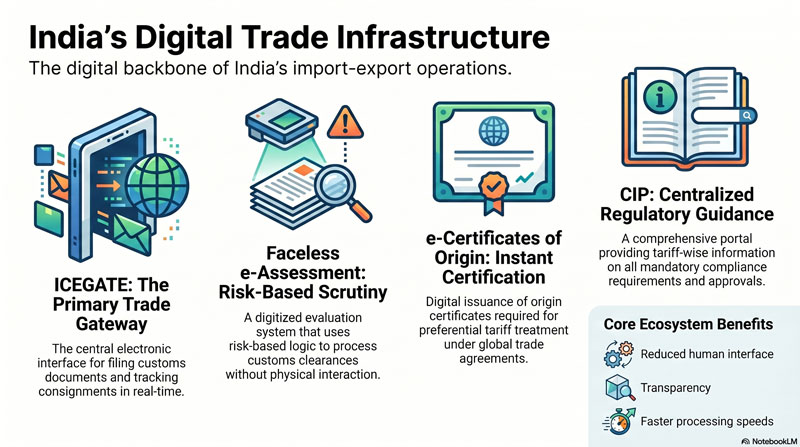
India’s trade facilitation framework is supported by a suite of interconnected digital platforms:
- Indian Customs Electronic Gateway (ICEGATE): The primary interface for filing customs documents, tracking consignments, and managing transactions.
- eSANCHIT: Enables paperless submission and verification of supporting documents.
- Customs e-Payment (CeP 2.0): Facilitates electronic duty payments.
- SCMTR system: Supports advanced cargo information and risk assessment.
- eScrip platform: Manages duty credit and remission schemes such as RoDTEP.
Together, these systems create a digitally integrated compliance environment, reducing manual intervention and improving efficiency.
Import procedures in India (2026)
The import process in India is now largely electronic and streamlined. Businesses begin by classifying goods under the ITC (HS) system and assessing applicable regulatory requirements. Where necessary, import licenses are obtained prior to shipment.
Once goods arrive, importers file the Bill of Entry (BoE) electronically via ICEGATE, supported by document uploads through eSANCHIT. Customs clearance is processed through a faceless assessment system, where risk-based evaluation determines the level of scrutiny. Duties, including basic customs duty, social welfare surcharge, and IGST, are paid electronically, after which clearance is granted digitally.
Export procedures in India (2026)
Export procedures follow a similarly digitised approach. Exporters must obtain an IEC and ensure proper classification of goods. For regulated items, export authorisation must be secured.
Shipments are processed through electronic filing of the shipping bill, followed by customs clearance. A key requirement is the issuance of a digital CoO through the DGFT platform, particularly for exports seeking preferential tariff treatment under trade agreements.
Documentation requirements for import and export
While documentation requirements remain broadly consistent, submission is now almost entirely digital.
For imports, key documents include the BoE, commercial invoice with packing list, and transport documents such as the bill of lading or airway bill.
For exports, the shipping bill, commercial invoice, packing list, and transport documents are required.
Regulatory compliance also involves GST filings (notably GSTR-1 and GSTR-3B), Bank Realisation Certificates (BRC), and Registration-cum-Membership Certificates (RCMC), where applicable.
Of note is that RCMC is mandatory primarily for those seeking benefits under the FTP.
Export promotion schemes in India
India continues to support exporters through schemes, such as the Advance Authorisation Scheme, the Export Promotion Capital Goods (EPCG) Scheme, and the Remission of Duties and Taxes on Exported Products (RoDTEP). These schemes are now integrated into digital platforms, simplifying application, tracking, and utilisation for businesses.
Compliance and information tools
To support regulatory compliance, authorities provide centralised tools such as the Customs Compliance Information Portal (CIP), which offers tariff-wise guidance on applicable regulations and approvals. Combined with ICEGATE and SWIFT dashboards, businesses benefit from greater visibility, predictability, and control over trade processes.
SEZ relief window (2026-2027)
As a temporary facilitation measure, India has introduced a Special Economic Zone (SEZ) relief window applicable from April 2026 to March 2027. This allows eligible manufacturing units within SEZs to sell goods in the domestic tariff area (DTA) at concessional duty rates.
The scheme applies to units operational before 31 March 2025 and is limited to goods manufactured within the SEZ. It imposes a cap of 30 per cent on DTA sales and requires a minimum value-added threshold of 20 per cent, along with certification by the Development Commissioner.
Compliance under this window remains fully digital, including electronic filing of BoE and faceless customs assessment. Notably, such domestic sales are not eligible for export incentives.
Trade credit insurance in India
Trade credit insurance has emerged as a vital risk management tool for businesses engaged in cross-border trade in India in 2026, helping exporters and importers mitigate payment and counterparty risks amid expanding global trade exposure.
For exporters, it protects against buyer insolvency, delayed payments, and geopolitical disruptions, while for importers, it enhances supplier confidence, enables better credit terms, and reduces supply chain risks. Typically covering 80–90 per cent of losses from non-payment, including commercial defaults, protracted delays, and political risks, these policies are cost-effective relative to potential losses.
In India, the Export Credit Guarantee Corporation (ECGC) remains the primary provider, complemented by private insurers offering broader, global coverage. As India advances toward digitised trade systems and higher transaction volumes, trade credit insurance plays a critical role in safeguarding working capital, enabling market expansion, and improving access to trade finance.
For expert guidance on Certificate of Origin compliance, tariff optimisation, trade relief strategies, and digital licensing in India, connect with Dezan Shira & Associates. Reach our advisors at → India@dezshira.com.
This article first appeared on India Briefing, our sister platform.

