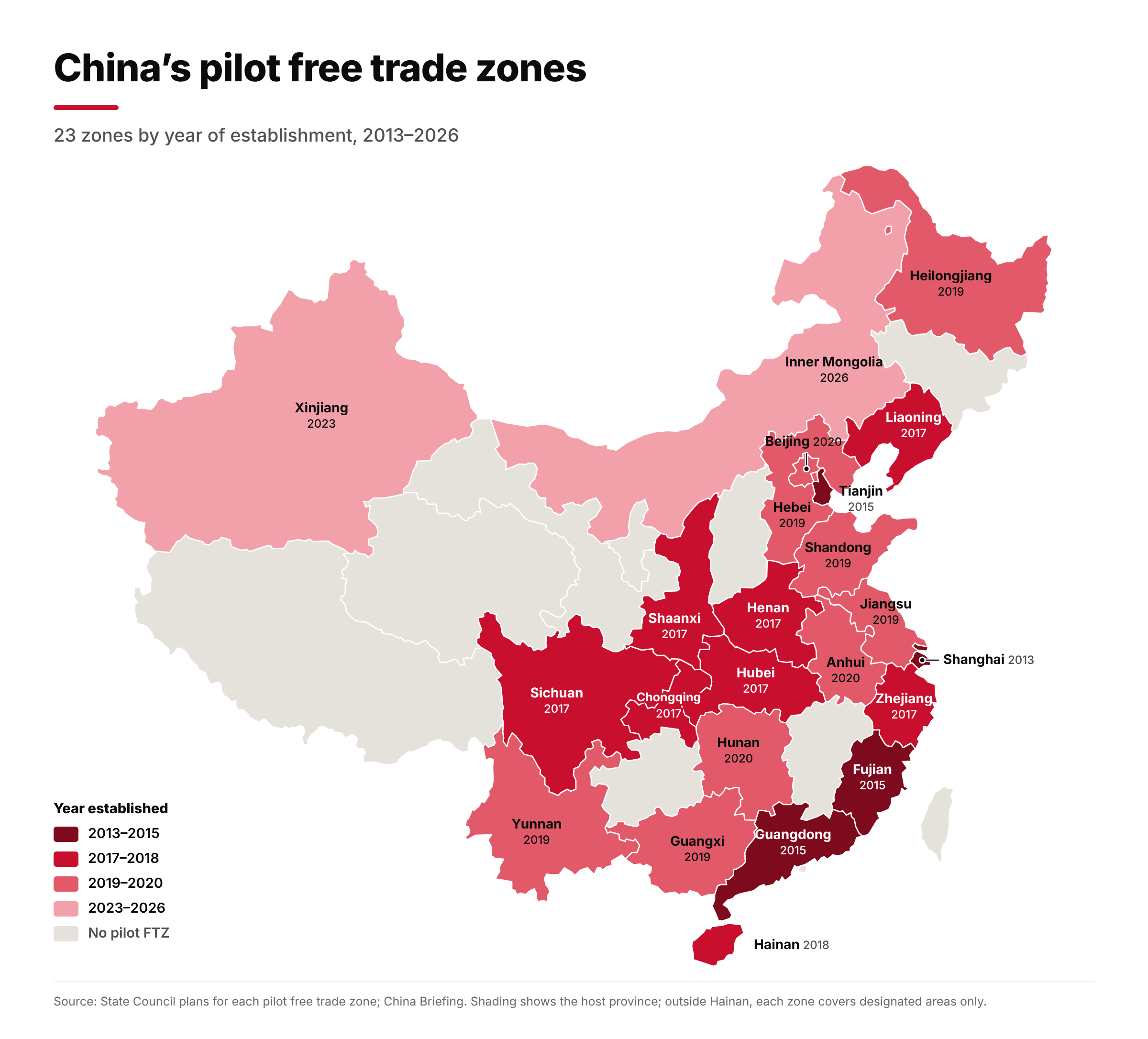
China now operates 23 pilot free trade zones (FTZs) alongside the Hainan Free Trade Port, each offering a different mix of market access openings, customs facilitation, financial pilots, and, in a handful of locations, reduced tax rates. In this article, we explain what these zones offer foreign investors in 2026, which benefits depend on meeting specific eligibility conditions, and how to shortlist the zone that best fits your business model.
Since the China (Shanghai) Pilot Free Trade Zone opened in 2013, China’s network of pilot free trade zones (FTZs) has grown in successive rounds to cover coastal, inland, and border regions. The latest addition came on April 9, 2026, when the State Council approved the China (Inner Mongolia) Pilot Free Trade Zone, bringing the total to 23. Separately, the Hainan Free Trade Port (FTP) launched island-wide special customs operations on December 18, 2025, turning the entire island into China’s most open trade and investment regime.
Location Analysis and Site Selection
Choosing the right free trade zone in China? DSA can compare locations, sector policies, tax incentives, operating costs, and regulatory requirements to identify the zone that best fits your investment and expansion plans.The zones carry economic weight far beyond their size. According to the Ministry of Commerce (MOFCOM), the FTZs attracted US$28.25 billion in foreign direct investment (FDI) in actual use in 2024 (24.3 percent of the national total) and accounted for 19.6 percent of China’s foreign trade, despite occupying less than 0.4 percent of the country’s land area.
Policy momentum remains strong. In April 2025, the Central Committee of the Communist Party of China and the State Council issued the Opinions on Implementing the Strategy of Upgrading Pilot Free Trade Zones (关于实施自由贸易试验区提升战略的意见, the “2025 Opinions”), which set out around five years of deeper reforms covering trade, investment, finance, data flows, and talent mobility. For 2026, the first year of the 15th Five-Year Plan (2026-2030), Commerce Minister Wang Wentao has pledged to expand autonomous opening in services such as value-added telecommunications, biotechnology, and wholly foreign-owned hospitals.
What is a pilot free trade zone in China?
A pilot free trade zone (自由贸易试验区) is a designated area where the central government tests reforms in investment, trade, finance, and public administration before deciding whether to replicate them nationwide. Each FTZ operates under an overall plan approved by the State Council that defines its strategic role and its sub-areas (片区). Most FTZs cover around 120 square kilometres, typically split across three sub-areas in different cities: the new Inner Mongolia FTZ, for example, covers 119.74 square kilometres across Hohhot (76.28 sq km), Manzhouli (25.11 sq km), and Erenhot (18.35 sq km).
Three distinctions matter for investors:
- FTZs are not free trade agreements: China’s pilot FTZs are domestic policy zones and are unrelated to the free trade agreements (FTAs) China signs with its trading partners.
- FTZ boundaries are precise: Benefits apply to entities registered within a sub-area’s boundaries. An address in the same city (or even the same district) is not necessarily inside the FTZ.
- Not all FTZ land is bonded: Bonded treatment applies only within special customs supervision areas, such as comprehensive bonded zones and bonded port areas, many of which sit inside FTZs. Outside these fenced areas, FTZ land is part of China’s ordinary customs territory.
The Hainan FTP is a separate and more far-reaching regime. Built on the Hainan Pilot FTZ established in 2018, it covers the entire island, is governed by its own national law (the Hainan Free Trade Port Law, adopted in 2021), and has operated as a special customs supervision zone since December 2025.
China’s 23 pilot FTZs at a glance
Each FTZ has a distinct mandate tied to its region’s industrial base and geography. Understanding these mandates is the first step in building a shortlist, as zones tend to receive pilot policies that match their strategic role.
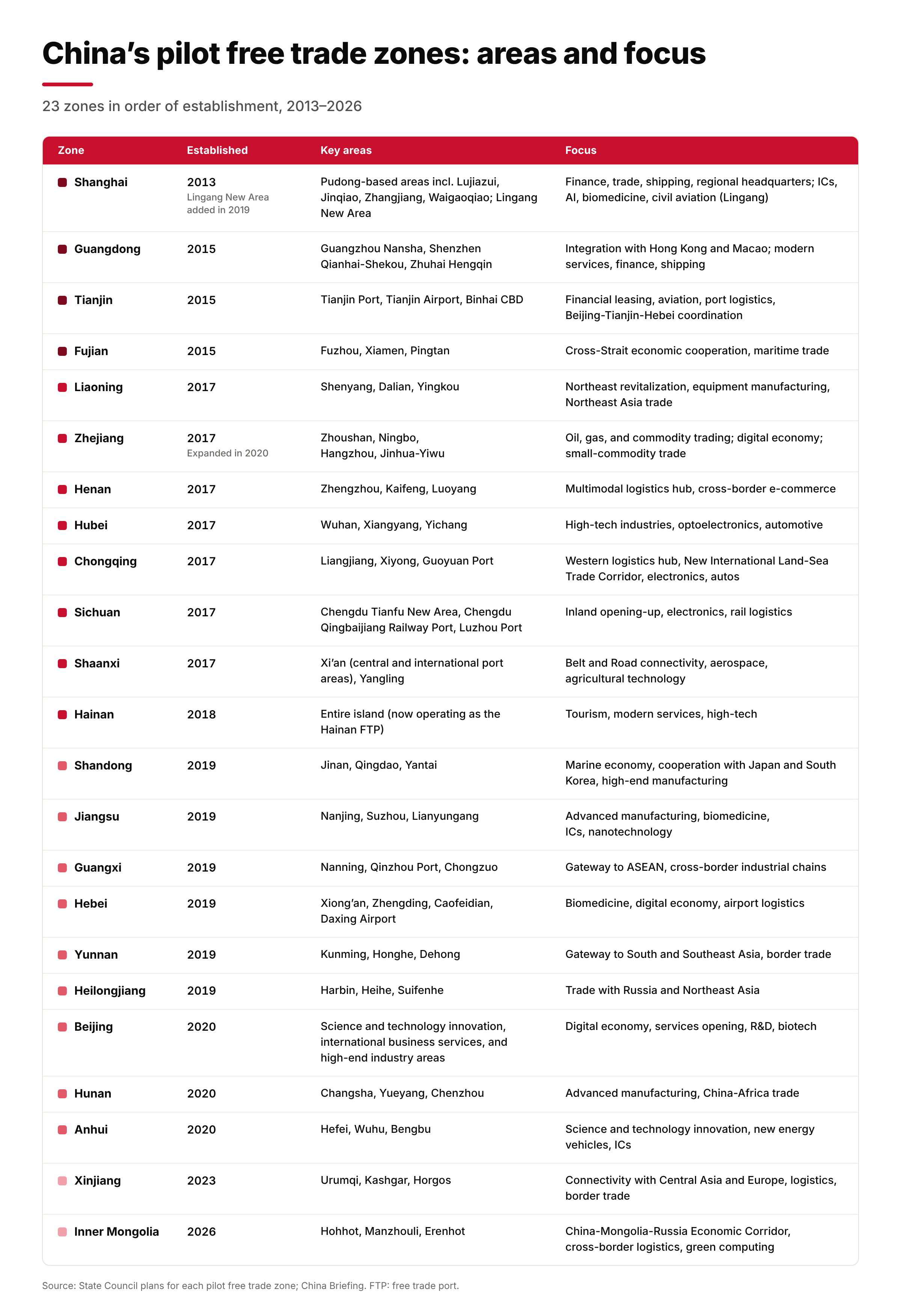
*The Hainan pilot FTZ is counted among the 23 zones; the Hainan FTP regime built on it is discussed separately throughout this article.
What benefits do FTZs offer?
Wider market access
China governs all foreign investment through a negative list. Outside the FTZs, the Special Administrative Measures for Foreign Investment Access (Negative List) (2024 Edition) applies, with 29 restricted or prohibited items. Inside the FTZs, investors can use the separate FTZ negative list, currently the 2021 edition, with 27 items, which goes further in some services.
For example, foreign investors may set up wholly foreign-owned market research firms in FTZs (except for radio and television audience surveys), whereas market research is limited to joint ventures elsewhere. FTZs also allow foreign investment in social surveys, provided the Chinese stake is at least 67 percent, and the legal representative is a Chinese national (an activity that is prohibited outside them).
Related reading: China’s Foreign Investment Negative List – A Guide for Investors
Beyond the negative list, several high-value sector pilots are limited to specific locations:
- Value-added telecommunications services (VATS): Since October 2024, foreign investors can wholly own businesses such as internet data centres, content delivery networks, internet access services, and online data processing and transaction processing in four pilot areas: Beijing’s services sector opening demonstration zone, Shanghai’s Lingang New Area and Pudong, the Hainan FTP, and Shenzhen.
- Biotechnology: Since September 2024, foreign-invested enterprises (FIEs) in the Beijing, Shanghai, and Guangdong FTZs and the Hainan FTP can develop and apply human stem cell and gene diagnosis and therapy technologies for product registration and production, with approved products usable nationwide.
- Wholly foreign-owned hospitals: The same 2024 pilot, which applies at city level rather than only within FTZs, opens the door to wholly foreign-owned hospitals (excluding traditional Chinese medicine hospitals and acquisitions of public hospitals) in Beijing, Tianjin, Shanghai, Nanjing, Suzhou, Fuzhou, Guangzhou, Shenzhen, and across Hainan.
- Other services: The 2025 Opinions allow eligible FIEs in FTZs to provide film post-production services and permit well-known overseas arbitration institutions to set up business offices in qualifying FTZs.
Customs and trade facilitation
The FTZs pioneered many of China’s trade facilitation tools, including the international trade “single window.” Within the special customs supervision areas inside FTZs, goods from abroad enter under bond – with duties and import VAT deferred until the goods enter the domestic market – which supports bonded storage, processing, R&D, repair and maintenance, and entrepot trade. The 2025 Opinions add new measures, such as allowing bonded blending of high- and low-sulfur fuel oils under different tariff codes, granting bonded treatment to liquefied natural gas supplied as fuel to international vessels, and exploring “white lists” that let biopharmaceutical companies import R&D materials without import drug clearance certificates.
The Hainan FTP goes much further. Since December 18, 2025, the number of tariff lines eligible for zero tariffs on goods entering Hainan from abroad has risen from about 1,900 to around 6,600 – roughly 74 percent of all tariff lines, up from 21 percent – covering nearly all production equipment and raw materials. Goods processed in Hainan with at least 30 percent local value added can be sold into the Chinese mainland free of import duties, while other goods moving to the mainland pass through standard customs controls at the “second line.”
Related reading: Hainan to Launch Independent Customs Operations Dec 18: Why It Matters
More open cross-border services trade
Since April 21, 2024, services supplied to China on a cross-border basis – from abroad, through consumption abroad, or through the movement of natural persons- have been managed under negative lists. The FTZ version contains 68 items, compared with 71 in the national version. Among the differences, the FTZ list removes restrictions on foreign individuals providing securities and futures investment consulting, allows foreign individuals employed in FTZs to open securities and futures accounts, and opens several professional qualification exams, such as those for real estate appraisers and registered urban planners – to foreign nationals. The Hainan FTP has its own cross-border services negative list, first introduced in 2021.
Easier cross-border data transfers
For data-intensive businesses, data rules can matter more than tax. Under China’s 2024 Provisions on Promoting and Regulating Cross-Border Data Flows, FTZs may draw up negative lists of data that remain subject to a security assessment, a standard contract, or certification before export. Data processors in the zone can transfer data that is not on the list abroad without going through these procedures, although other data protection obligations still apply.
As of June 2026, nine FTZs and the Hainan FTP had implemented such lists, covering 28 sectors including automotive, pharmaceuticals, retail, and reinsurance. Shanghai and Beijing extended their lists citywide in April and May 2026, respectively, and Guangdong released its FTZ list in May 2026.
Financial and foreign exchange facilitation
FTZs host many of China’s capital account pilots, from the free trade (FT) accounts pioneered in Shanghai to simplified cross-border receipts and payments for qualifying companies. The 2025 Opinions call for expanding pilots of integrated domestic and foreign currency cash pools for multinationals, supporting qualified foreign limited partner (QFLP) programmes in eligible FTZs, and further opening specific domestic futures products to foreign participants. For investors, this can mean faster settlement, more flexible treasury management, and easier access to financing.
Streamlined administration
Provincial governments often delegate approval powers directly to FTZ administrations, and many zones offer one-stop services for company registration, permits, and project approvals. Reforms first tested in FTZs are frequently rolled out across the country: nearly 200 FTZ institutional innovations developed during the 14th Five-Year Plan period (2021-2025) were replicated nationwide. Since 2023, selected FTZs and the Hainan FTP have also piloted more than 110 measures aligned with high-standard trade agreements such as the Comprehensive and Progressive Agreement for Trans-Pacific Partnership (CPTPP) and the Digital Economy Partnership Agreement (DEPA), and in July 2025, the State Council ordered many of them to be replicated across other FTZs.
Tax incentives – but only in specific zones
This is the most common misconception about FTZs: registering in an FTZ does not by itself reduce your tax rate. Most companies in FTZs pay the standard 25 percent CIT. Reduced rates are available only in a handful of locations, each with its own industry catalogue and conditions.
| Main reduced-rate income tax regimes in FTZ areas (as of October 2026) | |||
| Location | Incentive | Key conditions | Current validity |
|---|---|---|---|
| Hainan FTP (entire island) | 15% CIT; CIT exemption on income from new outbound direct investment for tourism, modern services, and high-tech firms; IIT capped at 15% for eligible high-end and in-demand talent | Main business in the Hainan FTP encouraged industries catalogue, accounting for at least 60% of total revenue; substantive operations in Hainan | Through December 31, 2027 |
| Shanghai Lingang New Area | 15% CIT for five years from establishment | Registered in Lingang on or after January 1, 2020 (relocations excluded); substantive production or R&D in core segments of ICs, AI, biomedicine, or civil aviation; at least one key product or technology | Ongoing; five years from each company’s establishment |
| Shenzhen Qianhai (Guangdong FTZ) | 15% CIT | Main business in the Qianhai preferential catalogue (2021 edition), accounting for at least 60% of revenue; substantive operations in Qianhai | Through December 31, 2027 |
| Zhuhai Hengqin (Guangdong FTZ) | 15% CIT; IIT capped at 15% for eligible high-end and in-demand talent, and at Macao tax levels for Macao residents | Main business in the Hengqin preferential catalogue (2021 edition), accounting for at least 60% of revenue; substantive operations | CIT in force since 2021; IIT cap through December 31, 2027 |
| Guangzhou Nansha pilot start-up area (Guangdong FTZ) | 15% CIT; loss carry-forward of up to 13 years for qualifying high-tech firms | Main business in the Nansha preferential catalogue (2022 edition), accounting for at least 60% of revenue; substantive operations in the start-up area | Through December 31, 2026 |
| FTZs in western provinces (Chongqing, Sichuan, Shaanxi, Guangxi, Yunnan, Xinjiang, Inner Mongolia) | 15% CIT under the Western Development policy | Main business in the catalogue of encouraged industries for the western region, accounting for at least 60% of revenue | Through December 31, 2030 |
Sources: Hainan CIT and Hainan IIT; Lingang; Qianhai; Hengqin CIT and Hengqin IIT; Nansha; Western Development: MOF, STA, and NDRC Announcement [2020] No. 23.
Two further points are worth noting:
- First, overseas high-end and in-demand talent working in the nine mainland Greater Bay Area cities (including the Guangdong FTZ) can receive a subsidy for IIT paid above 15 percent, a policy extended through 2027.
- Second, several valuable incentives apply nationwide regardless of location, including the 15 percent rate for High and New Technology Enterprises (HNTEs) and enhanced deductions for R&D expenses. These should not be the deciding factor between an FTZ and a non-FTZ location.
Related reading: Hainan’s Preferential Tax Policies: A Complete Guide
Market Entry Strategy
Planning to establish or expand in a China free trade zone? DSA can assess market access, sector restrictions, entity options, tax implications, and local operating requirements to build a market entry structure aligned with your business goals.Eligibility: Who can benefit, and on what conditions?
Baseline eligibility
In principle, any foreign investor can establish a company in an FTZ, provided that:
- The business scope is not prohibited (and, if restricted, meets the stated conditions) under the FTZ negative list (or the Hainan FTP’s own list), as well as under the Market Access Negative List (2025 Edition), which applies to domestic and foreign investors alike and contains 106 items;
- The company’s registered address lies within the boundaries of an FTZ sub-area; and
- Any industry-specific licenses are obtained, as they would be elsewhere in China.
Once registered, a company can generally use the zone’s facilitation measures, from simplified approvals to services and data pilots, without a separate application. Other benefits carry additional tests.
Conditions for preferential tax treatment
Most reduced-rate CIT regimes share three tests:
- Industry test: The company’s main business must fall within the zone’s preferential or encouraged industries catalogue.
- Revenue test: Income from that main business must account for at least 60 percent of the company’s total revenue.
- Substance test: The company must carry out substantive operations in the zone. This means its actual management body is located there and exercises comprehensive control over production and operations, personnel, accounts, and assets.
For companies headquartered outside the zone, only the income of qualifying branches located inside the zone can benefit from the reduced rate. Lingang applies its own test, aimed at newly established companies carrying out substantive R&D or production of key products in four strategic industries, and it maintains a list of qualifying companies.
Authorities enforce these conditions actively. Local guidance in zones such as Qianhai indicates that hosted or “cluster” registration addresses can support business registration but not a claim to substantive operations, while Nansha’s tax bureau checks every company newly claiming its incentive and samples existing beneficiaries.
Conditions for individual income tax caps
The 15 percent IIT caps in Hainan and Hengqin are administered through talent lists. In Hainan, individuals generally need to reside in the FTP for at least 183 days in a tax year or meet employment conditions, such as holding a labour contract with a local employer, and must also be recognised as talent by Hainan authorities or earn at least RMB 300,000 (US$336,492) a year in the FTP. Only income sourced from the zone (such as wages, remuneration for services, and business income) qualifies.
Conditions for sector pilots, bonded operations, and data rules
- Sector pilots such as VATS, biotechnology, and hospitals require registration in a designated pilot area, approval from the relevant regulator, and compliance with sector rules (for biotechnology, these include human genetic resources management, clinical trial, and ethics review requirements).
- Bonded treatment requires operating within a special customs supervision area and meeting customs supervision requirements.
- Hainan’s zero-tariff regime applies to companies and institutions registered in Hainan, and processed goods must meet the 30 percent value-added threshold to enter the mainland duty-free.
- Data export negative lists apply to data processors in the relevant zone (or, in Beijing and Shanghai, now citywide) and cover only the sectors and scenarios specified in each list.
Investors should also treat promises of local tax rebates or subsidies with caution. Since August 1, 2024, the Fair Competition Review Regulations have barred local governments from granting tax preferences or selective subsidies to specific businesses without a basis in law, administrative regulations, or State Council approval.
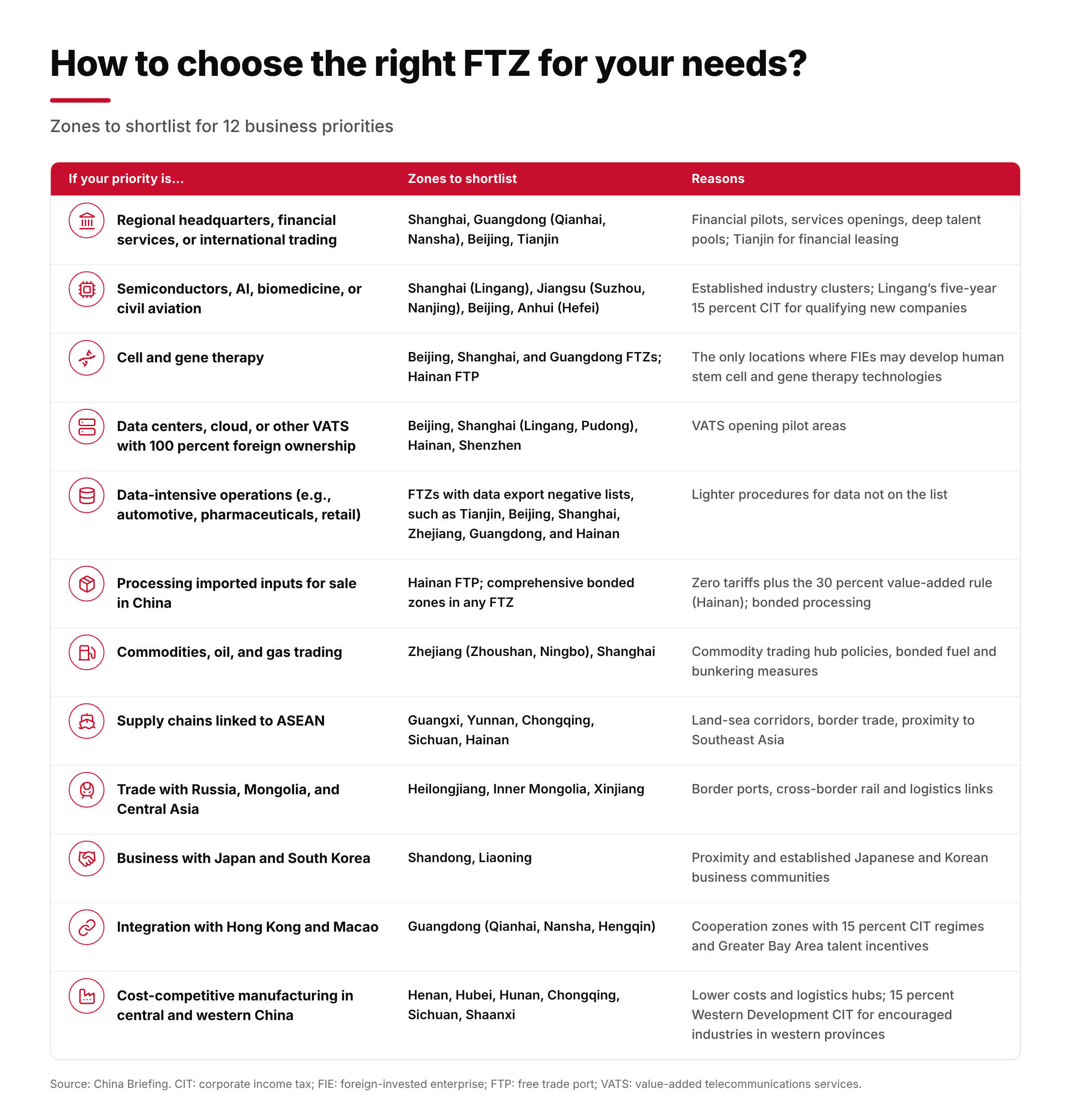
How Dezan Shira & Associates can help
China’s free trade zones can offer foreign investors greater market access, streamlined administrative procedures, and preferential policies, but the advantages vary significantly by location, industry, and investment structure. Dezan Shira & Associates helps foreign companies assess whether an FTZ is the right location for their investment, compare available incentives and sector-specific policies, and structure their market entry around operational, tax, and regulatory requirements.
Contact Dezan Shira & Associates for a tailored consultation.