Transfer pricing rules across Asia and the Middle East saw significant developments in the second quarter of 2026, with tax authorities in Singapore, Vietnam, and the UAE all issuing updated guidance that foreign-invested enterprises (FIEs) should assess against their existing intercompany pricing policies. This brief summarises the key changes below.
Key highlights
- The Inland Revenue Authority of Singapore (IRAS) released the Ninth Edition of its Transfer Pricing Guidelines on 4 June 2026, introducing new guidance on how share-based compensation (SBC) costs should be treated when a Singapore entity applies the Transactional Net Margin Method (TNMM) to price intercompany service transactions. The change takes effect from Year of Assessment (YA) 2026. For multinational groups with Singapore service entities whose employees receive equity-linked remuneration, the update directly affects how intercompany service fees are computed and documented.
- On 30 June 2026, the Vietnam Government issued Decree 255/2026/ND-CP (“Decree 255”) on tax administration for related-party transactions, replacing Decree 132/2020/ND-CP (“Decree 132”) and Decree 20/2025/ND-CP (“Decree 20”). The new Decree retains the core transfer pricing framework while introducing targeted refinements in several areas of administration and compliance, which align with the new Law on Tax Administration No. 108/2025/QH15, effective on 1 July 2026 and the regulations regarding Global Minimum Tax, including Resolution 107/2023/QH15 and Decree 236/2025/ND-CP. Decree 255 took effect on 1 July 2026 and applies from the 2026 corporate income tax (CIT) period onwards. This tax alert summarises the key developments relating to transfer pricing taxation under the above legal instruments, with a primary focus on the new provisions introduced by Decree 255.
- On June 22, 2026, the UAE issued Ministerial Decision No. 96 of 2026. It formally adopts the latest OECD interpretive materials for the UAE’s QDMTT regime, including the 2026 Consolidated Commentary, the 2026 Administrative Guidance/Central Record, and the January 2025 GloBE Information Return. It applies to fiscal years beginning on or after 1 January 2025, repeals Ministerial Decision No. 88 of 2025, and takes effect from its date of issuance.
Singapore clarifies the transfer pricing treatment of share-based compensation
The Inland Revenue Authority of Singapore (IRAS) released the Ninth Edition of its Transfer Pricing Guidelines on 4 June 2026, introducing new guidance on how share-based compensation (SBC) costs should be treated when a Singapore entity applies the Transactional Net Margin Method (TNMM) to price intercompany service transactions. The change takes effect from Year of Assessment (YA) 2026.
For multinational groups with Singapore service entities whose employees receive equity-linked remuneration, the update directly affects how intercompany service fees are computed and documented.
Share-based compensation costs in intercompany services pricing
Where a Singapore company provides services to a related party and uses a full cost mark-up as its profit level indicator under TNMM, the question of which costs belong in the base affects the fee charged and the taxable outcome.
IRAS has clarified its position across three scenarios:
- The SBC cost is incurred and charged by a related party to the Singapore entity;
- The cost should have been charged to the Singapore entity by a related party but was not charged and is not recognised in the Singapore entity’s accounts;
- The cost is not charged by related parties but recognised in the Singapore entity’s financial statements as a notional amount under applicable financial reporting standards;
IRAS confirmed that from a technical transfer pricing perspective, SBC costs should be included in the cost base across all three scenarios.
Transfer Pricing Support
Assess whether recent Singapore, Vietnam, and UAE developments affect your group's transfer pricing policies.Practical relief for uncharged and notional costs
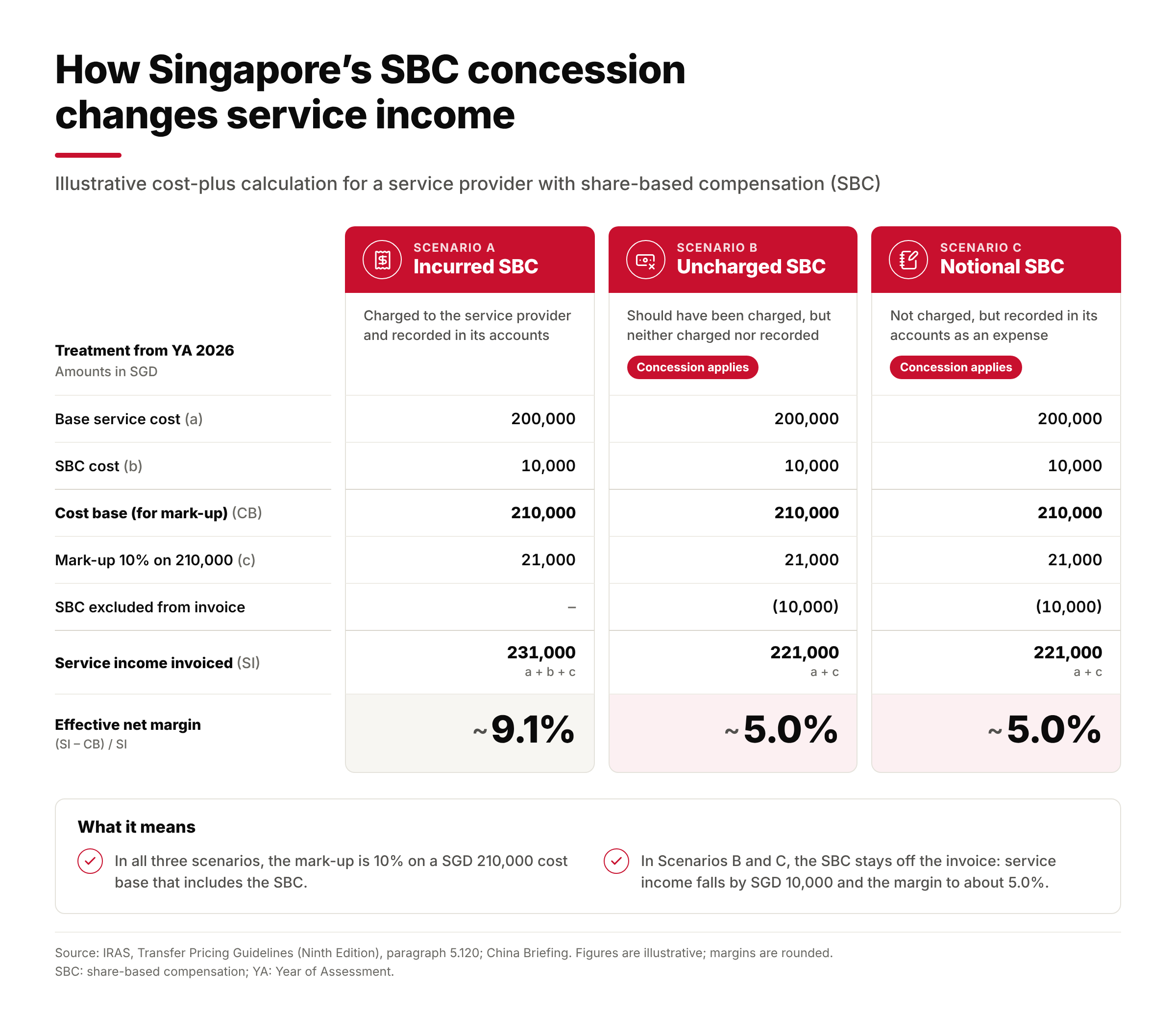
While the technical position treats all three scenarios identically, IRAS has introduced a practical concession. With effect from YA 2026, uncharged share-based compensation costs and notional SBC costs may be excluded from service income. For incurred SBC costs, the treatment remains unchanged.
IRAS has provided a table in the newly added paragraph 5.120 for further explanation.
| SBC cost type and scenarios | In the cost base? (YA 2025 & before) | In service income? (YA 2025 & before) | In the cost base? (From YA 2026) | In service income? (From YA 2026) |
|---|---|---|---|---|
| (A) Incurred SBC | ✓ Yes | ✓ Yes | ✓ Yes | ✓ Yes |
| (B) Uncharged SBC | ✓ Yes | ✓ Yes | ✓ Yes | ✗ No (concession) |
| (C) Notional SBC | ✓ Yes | ✓ Yes | ✓ Yes | ✗ No (concession) |
The example below clarifies it further; the SBC cost should always be included in the cost base to determine the arm’s length mark-up but may be excluded from actual invoicing for uncharged and notional SBC. From a transfer pricing perspective, SBC cost should always be included in the calculation.
Transfer pricing policies to review from YA 2026
Multinational groups where Singapore service entities provide intragroup services and employees participate in group equity schemes should assess whether their current policies and documentation reflect the updated guidance. Groups should confirm how share-based compensation costs are classified in their Singapore entity’s accounts, whether existing intercompany service agreements are consistent with the YA 2026 position and whether transfer pricing documentation requires updating accordingly.
Decree No. 255/2026/ND-CP on tax administration for related-party transactions
Key highlights:
- Refining cases for determining related-party relationships
- A new hierarchy for the application of comparability databases
- Revenue threshold for exemption from preparing Transfer Pricing (TP) Documentation – increased to VND500 billion (approx. US$19 million)
- Revenue threshold for preparing Country-by-Country Profit Reporting (CbCR) adjusted to EUR750 million; and updates on CbCR filing requirement
- Introducing a separate framework for TP tax audits to reflect the tax authority’s enhanced focus on TP administration and enforcement
Updates on types of related-party relationship
The definition of related parties generally follows the provisions under Decree 132 and Decree 20. However, Decree 255 introduces the following notable changes:
- For related-party relationships arising from financial transactions, a creditor or guarantor that is a wholly state-owned enterprise will not be considered as related to the borrower or guaranteed entity, provided that such creditor or guarantor does not directly or indirectly participate in the management, control, capital contribution, or investment in those enterprises.
- The scope of related-party relationships is expanded for lending and borrowing transactions between an enterprise and an individual who directly manages/controls the enterprise; or falls within one of the family relationships specified under the Decree.
These amendments reflect a greater emphasis on the substance-over-form principle, address practical challenges encountered in applying Decree 132 and Decree 20, and further clarify the relationships subject to transfer pricing regulations.
Introduction of a hierarchy for databases used in arm’s length analysis
Decree 255 establishes the following hierarchy for data source utilisation:
- Publicly available information and data (including securities market disclosures, commodity and service exchange data, official government sources, and national databases);
- Commercial databases;
- Tax administration databases.
Notably, Decree 255 also introduces the National database information and information published by government ministries, agencies, or other official sources as new data source used for TP compliance and administration purposes. However, Decree 255 does not clearly define the scope or contents of the national database.
Threshold change in TP documentation exemption regime
Decree 255 refines the framework for TP documentation exemptions, including:
- Increase in revenue threshold for exemption from VND200 billion to below VND500 billion (approx. USD19 million); and
- Removal of the “simple functions” criterion when assessing eligibility under the same regime.
- Beyond the changes above, the provision to maintain a requisite Operating Margin to qualify the threshold (i.e. 5% for distribution, 10% for manufacturing and 15% for toll manufacturing) remains unchanged.
These changes reduce ambiguity and may simplify the application of exemption rules in practice.
Updates to Country-by-Country Reporting (CbCR)
Decree 255 provides further clarification on Vietnam’s CbCR framework.
a) Filing requirement for Multinational Enterprises (MNEs) whose Ultimate Parent Entities (UPEs) in Vietnam:
Threshold change – The consolidated group revenue equivalent to EUR750 million or more is required to prepare and submit a CbCR, replacing the previous VND18,000 billion threshold. This change aligns with the provision in the prescribed regulations regarding Global Minimum Tax, which enhances the consistency between the legal frameworks and brings Vietnam closer to the OECD BEPS Pillar II and international practices.
b) Filing obligations for Vietnamese taxpayers with foreign UPEs:
A Vietnamese taxpayer whose UPE is located overseas is not required to submit a CbCR to the Vietnamese tax authorities if:
- The CbCR has already been filed and exchanged automatically under the Multilateral Competent Authority Agreement (MCAA); or
- The UPE is exempt in its home jurisdiction due to differences in thresholds, currency conversion or revenue calculation rules.
Local filing is still required for Vietnamese taxpayer where:
- There is systemic failure, i.e. the foreign jurisdiction fails to exchange CbCR information with Vietnam despite having an agreement in place; or
- No effective MCAA exists between Vietnam and the jurisdiction of the UPE; or
- The UPE did not prepare and file a CbCR in its jurisdiction of residence.
This provides a clearer framework for assessing local filing obligations, but also increases the need for multinational groups to closely monitor exchange status, overseas filing arrangements and notification obligations.
Updates on TP inspection and TP reassessment circumstances
Law on Tax Administration introduces a separate framework for TP tax audits, A notable change is the introduction of a specific audit timeline for TP inspection:
- TP tax audits may last up to 40 days, compared to 20 days for other tax audits.
- Where necessary, the audit period may be extended by up to an additional 40 days.
- In cases requiring information collection from or exchange with foreign tax authorities, the audit period may be extended to a maximum of two years.
The establishment of a dedicated TP audit framework under new Tax Administration Law reflects the tax authority’s enhanced focus on TP administration and enforcement.
In addition, Decree 255 introduces an additional reassessment circumstance during TP inspection: Incorrect declaration of information in Appendix I – Information on Related-Party Relationships and Related-Party Transactions.
This expansion highlights a stronger focus on the accuracy of disclosures relating to related-party relationships and transactions and reflects the tax authority’s increasing emphasis on compliance monitoring.
Transfer Pricing Support
Need help reviewing intercompany pricing arrangements or updating TP documentation? Our specialists assist with compliance, benchmarking, and audit preparedness across Asia.Impact and recommendation
Decree 255 further strengthens Vietnam’s TP tax administration framework, aligning it with the changes introduced under the new Law on Tax Administration. In addition, Decree 255 has presented the cooperative efforts of the Vietnamese government in participating in the global regulatory regime and tax management, via the recognition of OECD BEPS 13, MCAA, and international practices, particularly in relation to CbCR obligations, data transparency, and information exchange mechanisms.
Taxpayers should therefore closely monitor these disclosures, particularly where they rely on overseas filing and exchange mechanisms, and ensure coordination with group-level tax functions to assess potential fallback filing obligations in Vietnam.
Taxpayers should also carefully review the new regulations and proactively assess their impact on business operations, TP policies, and existing compliance processes. This will help ensure timely implementation of, and necessary adjustments to, current practices so as to achieve compliance with the new requirements.
The UAE adopts the OECD Side-by-Side tax package via Ministerial Decision No. 96 of 2026
On 22 June 2026, the UAE Ministry of Finance issued Ministerial Decision No. 96 of 2026 (“MD 96/2026”), formally adopting the latest OECD interpretive materials for the UAE’s qualified domestic minimum top-up tax (QDMTT) regime, including the 2026 Consolidated Commentary, the 2026 Administrative Guidance/Central Record, and the January 2025 GloBE Information Return. The decision applies to fiscal years beginning on or after 1 January 2025, repeals Ministerial Decision No. 88 of 2025, and takes effect from its date of issuance.
A key consequence of the decision is the incorporation of the OECD’s January 2026 ‘Side-by-Side’ package, in particular the Substance-Based Tax Incentive Safe Harbour and the treatment of Qualified Tax Incentives. This is especially important for the UAE’s new R&D Tax Credit, which applies for tax periods or fiscal years commencing on or after 1 January 2026. The UAE R&D Tax Credit may be capable of fitting within the OECD’s QTI framework in many cases, but the outcome will depend on the statutory conditions, the factual design of the claim, the level of discretion involved, and the Substance Cap.
MD 96/2026 acts as a transposition of the OECD guidance.
Article 1 adopts the Commentary and Agreed Administrative Guidance listed in its annexure “for the purposes” of Cabinet Decision No. 142 of 2024 (which implemented the UAE’s QDMTT).
Article 2 states that the decision applies to fiscal years starting on or after 1 January 2025.
Article 3 repeals MD 88/2025, and Article 4 provides that the decision is published and effective from the date of issuance, 22 June 2026.
The annex to MD 96/2026 identifies three adopted OECD packages: the 2026 Consolidated Commentary to the GloBE Model Rules, the 2026 Administrative Guidance on the GloBE Model Rules/Central Record for the Global Minimum Tax, and the GloBE Information Return, January 2025.
The repeal of MD 88/2025
MD 96/2026 expressly repeals MD 88/2025. This means that positions previously benchmarked against the earlier adopted OECD material should be refreshed. That is particularly relevant for groups that have already prepared 2025 UAE domestic minimum top-up tax models, accounting provisions, safe harbour analyses, or governance papers.
The effect is that MD 96/2026 updates the adopted interpretive materials for applying the existing UAE top-up tax regime to fiscal years beginning on or after 1 January 2025.
The OECD Side-by-Side package
The OECD published the January 2026 Side-by-Side package as part of its Pillar Two implementation materials. This includes the Simplified ETR Safe Harbour, a one-year extension of the Transitional CbCR Safe Harbour, the Substance-Based Tax Incentive Safe Harbour, and a broader Side-by-Side System for MNE Groups headquartered in eligible tax regimes.
The 2026 Consolidated Commentary, published by the OECD in May 2026, incorporates Agreed Administrative Guidance released since March 2022 up to May 2026. Because MD 96/2026 adopts that 2026 Consolidated Commentary and the 2026 Administrative Guidance/Central Record, the UAE has effectively updated its Pillar Two interpretive framework to include the Side-by-Side package.
For most UAE taxpayers, the headline item is likely to be the Substance-Based Tax Incentive Safe Harbour rather than the broader Side-by-Side System. The Side-by-Side System leaves QDMTT’s unaffected, while the SBTI Safe Harbour is directed at the treatment of qualifying substance-based tax incentives in the GloBE ETR and top-up tax computation.
MD 96/2026 should also bring the OECD’s Simplified ETR Safe Harbour and the one-year extension of the Transitional CbCR Safe Harbour into the UAE DMTT framework.
The Simplified ETR Safe Harbour should be available in the UAE from FY2027 and may be relevant from FY2026 where the OECD early-application conditions are satisfied, including where the UAE QDMTT Safe Harbour applies.
What should FIEs do now?
Groups with Singapore, Vietnamese, or UAE operations should review intercompany service pricing policies, transfer pricing documentation thresholds, CbCR filing obligations, and Pillar Two safe harbour positions against these updates ahead of their next filing cycles.
How Dezan Shira & Associates can help
As transfer pricing rules continue to evolve across Asia, multinational enterprises should regularly review their intercompany pricing arrangements, documentation policies, and compliance processes to ensure they remain aligned with local requirements and international standards.
Dezan Shira & Associates assists foreign-invested enterprises throughout the region with practical transfer pricing planning, compliance, and dispute-prevention strategies. Our transfer pricing specialists can help businesses:
- Review and update intercompany pricing policies in light of regulatory changes.
- Assess transfer pricing risks arising from intragroup service arrangements, financing transactions, intellectual property licensing, and business restructuring.
- Prepare and maintain transfer pricing documentation, including Local Files, Master Files, benchmarking studies, and CbCR compliance assessments.
- Evaluate transfer pricing exemption eligibility and documentation thresholds under local regulations.
- Align transfer pricing policies with Global Minimum Tax (Pillar Two) requirements and broader international tax developments.
- Support taxpayers during transfer pricing audits, information requests, and dispute resolution processes with local tax authorities.
- Coordinate regional transfer pricing compliance across multiple jurisdictions through our network of offices throughout Asia and the Middle East.
For companies operating across the region, proactive monitoring of transfer pricing developments has become increasingly important. Dezan Shira & Associates’ tax and transfer pricing professionals provide integrated support to help businesses manage compliance obligations while maintaining efficient and defensible cross-border operating structures. Contact our local professionals to discuss how recent Asia transfer pricing Q2 2026 developments may affect your group’s transfer pricing policies, documentation requirements, and international tax strategy.