
 Other Briefings
Vietnam Reduces CIT Payable by 30% in 2026–2027 for Eligible Enterprises with Revenue of Up to VND 10 Billion
Vietnam's Resolution 43/2026/QH16 cuts corporate income tax payable by 30 percent for the 2026 and 2027 tax years for companies with annual revenue of VND 10 billion or less. Many small foreign-invested enterprises incorporated in Vietnam qualify. We explain who qualifies, how to calculate the reduction, and what to do before the Q3 provisional payment deadline on 2 November 2026.
Key facts at a glance
- What: 30 percent reduction in CIT payable (not the CIT rate)
- Who: Companies established under Vietnamese law, including foreign-owned subsidiaries, with annual revenue of VND 10 billion or less
- When: The 2026 and 2027 tax years, tested year by year
- Legal basis: Resolution 43/2026/QH16, in force since 24 August 2026; Decree No. 398/2026/ND-CP on Personal Income Tax and Corporate Income Tax issued on 29 October 2026
- Incentives: The reduction applies after existing CIT incentives
What does Resolution 43/2026/QH16 provide?
Resolution 43/2026/QH16 is a two-year income tax relief measure for small businesses, adopted by Vietnam's National Assembly on 24 August 2026. It took effect immediately but applies to the full 2026 and 2027 tax periods, so qualifying companies benefit for their whole 2026 tax period, not only from August.
The resolution has two parts:
- Corporate income tax (CIT): A 30 percent reduction in CIT payable for enterprises and organizations established under Vietnamese law whose annual revenue does not exceed VND 10 billion.
- Personal income tax (PIT): A 30 percent reduction in PIT payable on business income for resident individuals and household businesses under the same revenue threshold. This does not cover salaries or wages.
It is important to be precise about what is being cut. The measure does not lower Vietnam's statutory CIT rate (20 percent standard, with 15 percent and 17 percent rates for qualifying smaller businesses under the 2025 CIT framework). It reduces the final tax bill a qualifying company would pay by 30 percent.

Who qualifies for the 30 percent CIT reduction?
The principal eligibility conditions are set out below, subject to the exclusion for certain enterprises formed through division or separation, as detailed later in this article.
- It is established under Vietnamese law: This includes locally incorporated companies, such as foreign-invested limited liability companies and joint stock companies holding an Enterprise Registration Certificate.
- Its annual revenue in the relevant year does not exceed VND 10 billion: Eligibility is tested separately for 2026 and for 2027, based on actual revenue for the full tax year.
What this means for foreign investors
Ownership does not affect eligibility. A 100 percent foreign-owned subsidiary in Vietnam is a Vietnamese legal entity, so a small foreign-invested entity (a newly established trading company, a service company in its early years, or a regional support office set up as a subsidiary) can qualify on the same terms as a domestic SME. Being a subsidiary can, however, affect eligibility for other small-business rules, including the 15 and 17 percent CIT rates and the VND 1 billion exemption described below.
The position is different for structures that are not Vietnamese legal entities. Foreign contractors taxed under the foreign contractor tax regime are outside scope, and representative offices do not pay CIT in the first place. Branches of foreign companies should confirm their position once the implementing decree is issued.
The VND 10 billion cliff edge
The threshold is a hard line. A company with VND 9.9 billion in revenue receives the full reduction, while one with VND 10.1 billion receives none. Businesses close to the threshold should carefully forecast full-year revenue and review the year-end revenue cut-off to ensure compliance with applicable recognition rules. This review should consider actual delivery dates, service completion and acceptance records, and any other relevant recognition criteria.
How is the reduction calculated?
The 30 percent reduction is applied last, to the CIT a company would otherwise pay:
- Calculate taxable income and apply the applicable CIT rate, including any preferential rate the company is entitled to;
- Apply any CIT exemptions or reductions the company already enjoys; and
- Reduce the remaining CIT payable by 30 percent.
Because the reduction stacks on existing incentives rather than replacing them, companies already enjoying incentives can still benefit, provided some CIT remains payable after those incentives. A company in a full CIT exemption period has no remaining liability to reduce.
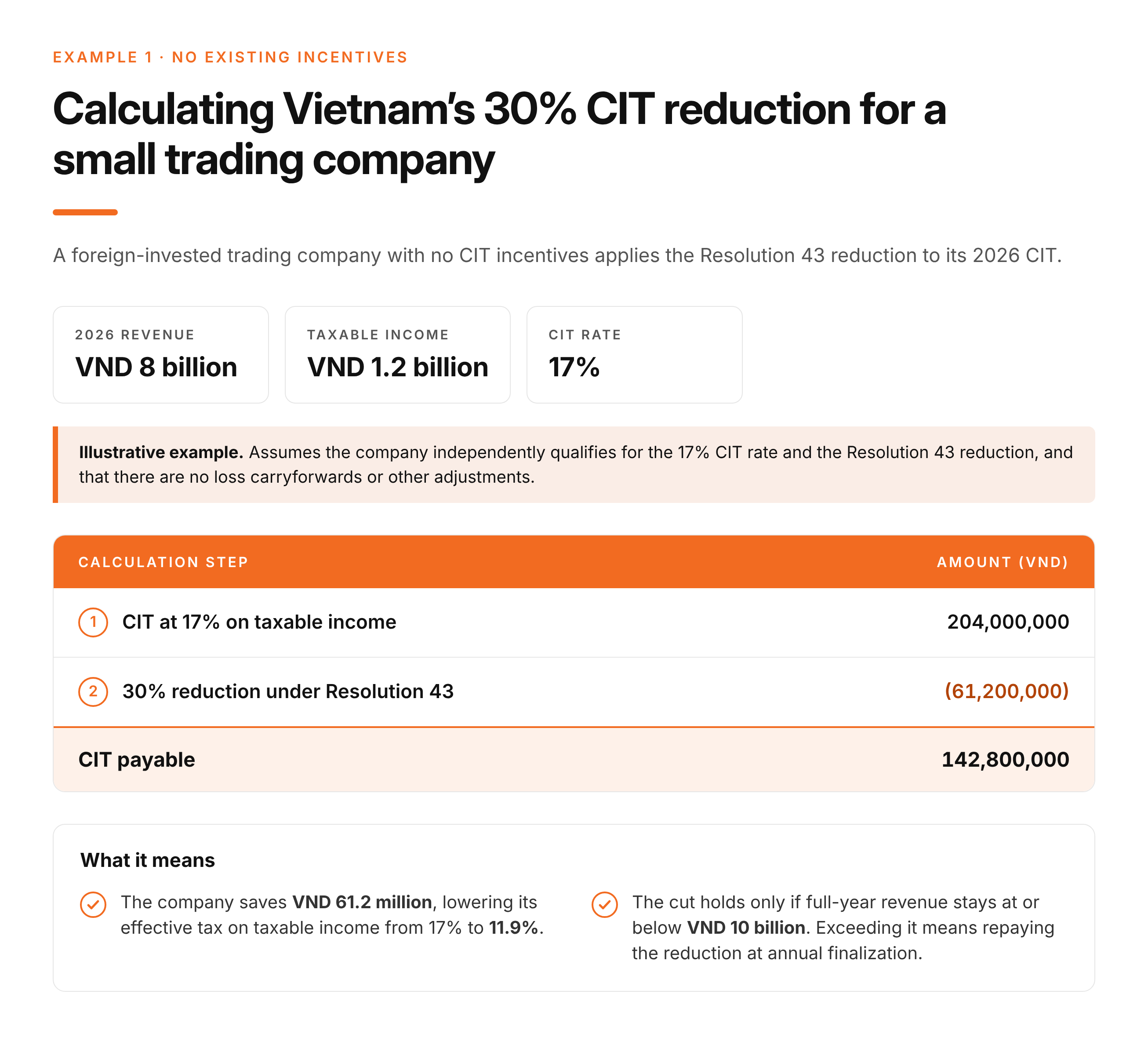
Note: Example 1 assumes the 17 percent rate applies. For an existing company, that rate generally depends on preceding-year revenue, and subsidiaries or related enterprises may not qualify. A subsidiary paying the standard 20 percent rate would have CIT of VND 240 million before relief, a reduction of VND 72 million, and CIT payable of VND 168 million.
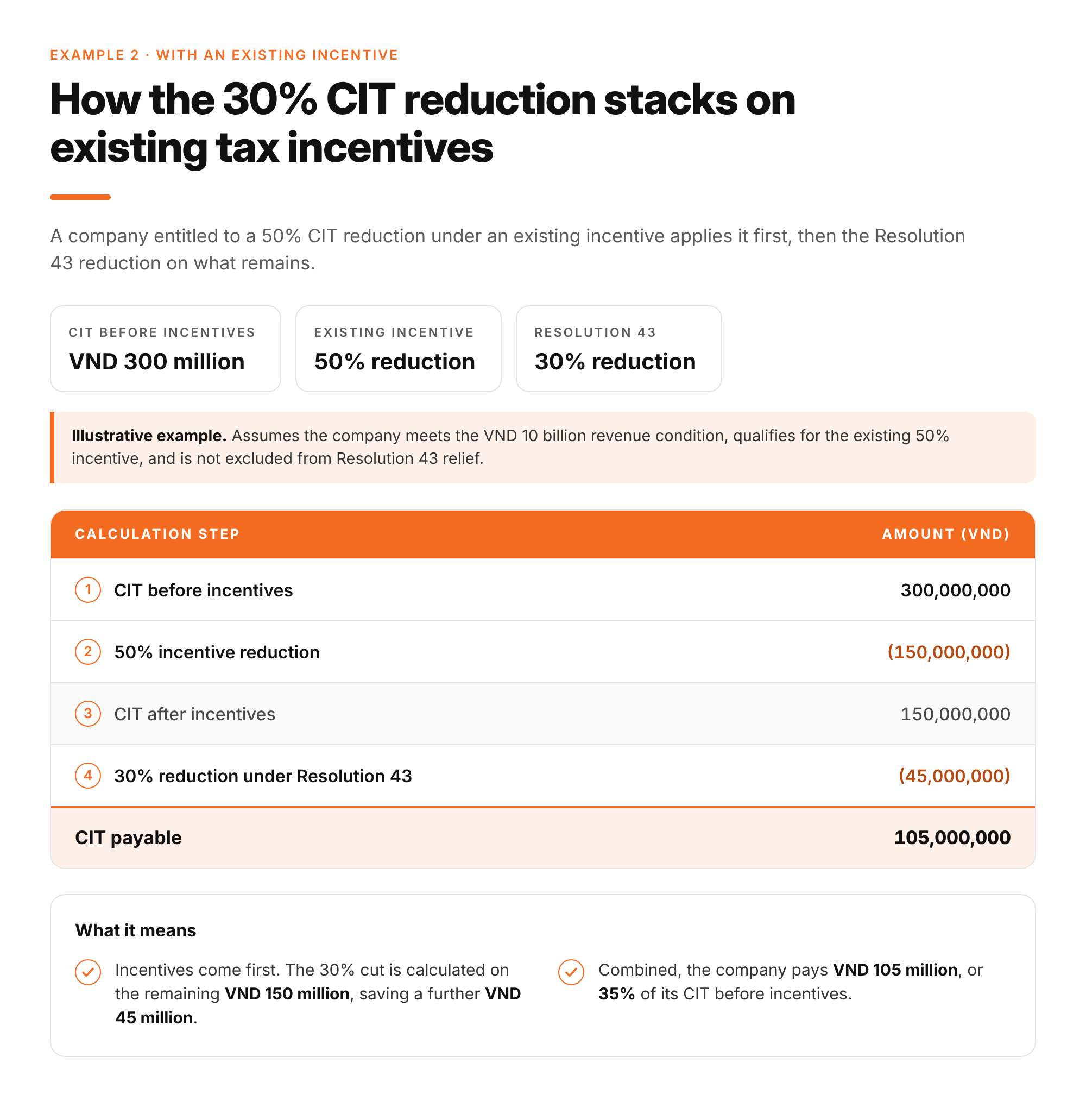
Note: Figures are illustrative. The applicable CIT rate depends on the company's revenue and on the conditions in the CIT Law and Decree 320/2025/ND-CP.
Which companies are excluded from the reduction?
The resolution blocks one obvious way of gaming the threshold. Enterprises formed by dividing or splitting an existing company after 24 August 2026 do not qualify if the combined 2026 or 2027 revenue of the new entities exceeds VND 10 billion.
Foreign groups should keep this in mind when planning restructurings in Vietnam. Splitting one operating company into several smaller ones purely to bring each below the threshold will not secure the reduction. Tax authorities can be expected to look closely at related-party arrangements that shift revenue between group entities.
The relief also sits alongside, not instead of, existing small-business rules. Under Decree 320/2025/ND-CP, as amended by Decree 141/2026/ND-CP, enterprises with annual revenue of VND 1 billion or less are exempt from CIT. Revenue is generally tested on the preceding year, with separate rules for new businesses and short tax periods, and the exemption does not apply to subsidiaries or related enterprises where the associated enterprise does not itself meet the conditions. Foreign-invested companies, many of which are subsidiaries of a foreign parent, should check this carefully. Hence, the 30 percent reduction matters most to businesses between VND 1 billion and VND 10 billion, and to smaller companies that do not qualify for the exemption.
Enterprises should determine their eligibility for the relevant tax incentives and retain supporting documentation in accordance with statutory requirements.
How will companies claim the 30 percent CIT reduction?
Companies will claim the reduction through their own CIT filings under rules set by an implementing decree. The Ministry of Finance circulated a draft for consultation on 5 September 2026 (Official Letter 13905/BTC-CST). The Prime Minister set a 10 October deadline for the ministry to submit the decree and, on 5 October, directed it to submit the decree for immediate issuance. As of 26 October 2026, the final decree had not been published, so the points below reflect the draft and may change.
Under the draft decree:
- Revenue definition. Revenue for the VND 10 billion test includes sales of goods and services (net of revenue deductions), financial income and other income, plus the revenue of branches and other dependent units shown in the company's combined annual financial statements.
- Self-assessment in provisional payments. Companies projecting 2026 or 2027 revenue of VND 10 billion or less can apply the 30 percent reduction themselves when calculating quarterly provisional CIT.
- Year-end test. Eligibility is confirmed on actual full-year revenue at annual CIT finalization. A company that exceeds the threshold must pay back the reduction it applied during the year. Under the draft, late-payment interest would follow the general rule for provisional payments, which charges interest where the four quarterly payments total less than 80 percent of the final CIT liability.
- Amended returns and audits. Where a company files a supplementary return, or the authorities assess additional CIT after an inspection or audit, the additional amount also qualifies for the 30 percent reduction if all conditions are met.
Timeline and filing dates
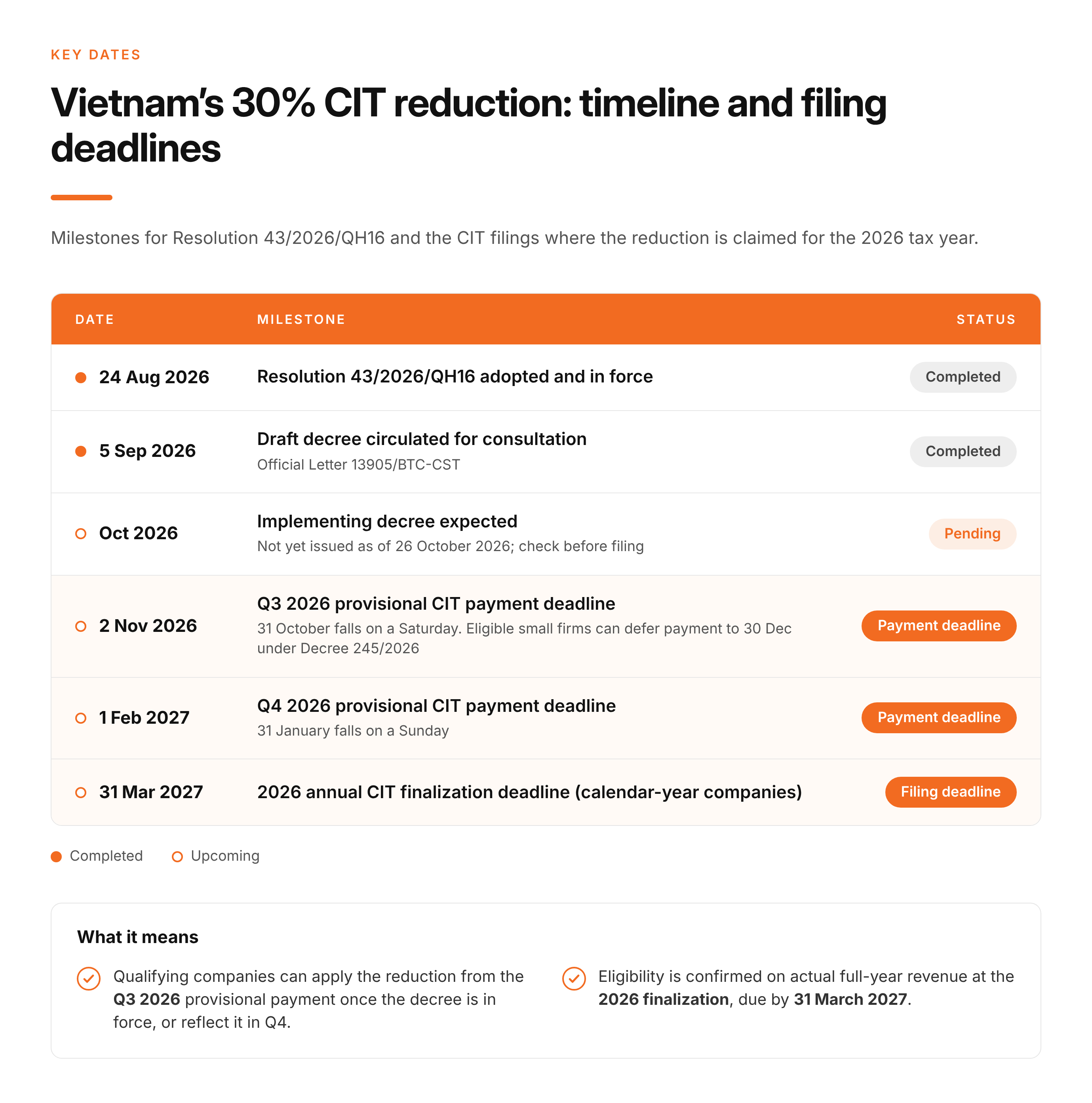
Because the reduction applies to the whole 2026 tax period, companies that already made full provisional payments for Q1 and Q2 are not expected to lose out. The reduction for the full year is reflected when the 2026 finalization return is filed. Any tax overpayment will be handled in accordance with the applicable tax administration rules. For the full list of year-end deadlines, see our Vietnam compliance calendar and our guide to audit and CIT finalization for foreign-owned enterprises. Filings are made electronically under the new tax administration rules in Decree 252/2026.
What should foreign-invested enterprises do now?
- Forecast full-year 2026 revenue: Use management accounts to Q3 and a realistic Q4 estimate. Flag any contracts or year-end invoices that could push revenue over VND 10 billion.
- Confirm your entity type: Check that the Vietnam entity is a company established under Vietnamese law, and review the position of any branches or foreign-contractor arrangements separately.
- Map existing incentives: Confirm which CIT incentives already apply, since the 30 percent reduction is calculated after them.
- Decide on the Q3 provisional payment: Agree with your accountant whether to apply the reduction in the Q3 payment due 2 November 2026 (31 October falls on a Saturday) or wait for the final decree and reflect it in Q4 or at finalization. Small and micro enterprises, and companies in the sectors listed in Decree 245/2026/ND-CP, can also defer the Q3 payment to 30 December 2026 without late-payment interest if they file an extension request by 2 November 2026.
- Review planned restructurings: Check any planned split or division of a Vietnam entity against the anti-avoidance rule.
For small foreign-invested companies in Vietnam, Resolution 43 is a meaningful but conditional benefit. A 30 percent cut in CIT payable for two years frees up cash for reinvestment but only if the company is a Vietnamese legal entity, does not exceed VND 10 billion revenue line for the full yea, and applies the reduction in the right order and filings. Applying it in provisional payments and then failing the year-end test means repaying the reduction, potentially with late-payment interest.
The implementing decree, Decree No. 398/2026/ND-CP on Personal Income Tax and Corporate Income Tax, was issued on 29 October 2026 and applies to the 2026 and 2027 tax years. With the 2026 year-end close approaching, now is the time to forecast revenue, map existing incentives, and agree on an approach with your accountant.
How Ascentium Vietnam can help
Ascentium Vietnam can help businesses assess eligibility for CIT relief, review existing incentives, and prepare tax calculations and filings. Our team can also support revenue forecasting and year-end finalisation, helping you evaluate potential savings and meet applicable compliance requirements as implementing guidance is confirmed.
Editor's Note: This article was last updated 5 November 2026.
Technical inputs were provided by Mia Pham and Pham Thi Hoai Thu.
This article first appeared on Vietnam Briefing, our sister platform.

